Ch. 10 - Sequences and Infinite Series
Briggs - Calculus: Early Transcendentals 3rd Edition
Briggs3rd EditionCalculus: Early TranscendentalsISBN: 9780136847243당신이 사용하는 게 아니라요?교과서 변경
10장, 문제 10.6.5

Explain why the magnitude of the remainder in an alternating series (with terms that are nonincreasing in magnitude) is less than or equal to the magnitude of the first neglected term.

검증된 단계별 안내
1
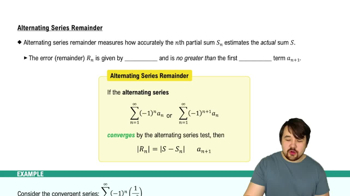
Recall the Alternating Series Remainder Theorem, which states that for an alternating series with terms \( a_n \) that decrease in magnitude and tend to zero, the remainder after \( n \) terms, \( R_n = S - S_n \), satisfies \( |R_n| \leq |a_{n+1}| \).
Understand that the partial sums \( S_n = a_1 - a_2 + a_3 - \cdots + (-1)^{n+1} a_n \) alternate around the actual sum \( S \), meaning each successive partial sum overestimates or underestimates \( S \) by an amount less than the magnitude of the next term.
Since the terms \( |a_n| \) are nonincreasing, the difference between consecutive partial sums \( |S_{n+1} - S_n| = |a_{n+1}| \) provides an upper bound on how much the sum can change, and thus bounds the remainder.
Because the series alternates in sign, the error \( R_n \) does not exceed the size of the next term in magnitude; the partial sums 'zig-zag' closer to the true sum, never overshooting by more than \( |a_{n+1}| \).
Therefore, the magnitude of the remainder after \( n \) terms is at most the magnitude of the first neglected term, which ensures \( |R_n| \leq |a_{n+1}| \).

비슷한 문제에 대한 검증된 영상 답변:

이 영상 해법은 위 문제에 도움이 된다고 튜터들이 추천한 것입니다.
영상 길이:
1m

주요 개념

질문에 올바르게 답하기 위해 반드시 이해해야 하는 핵심 개념들은 다음과 같습니다.

Alternating Series

An alternating series is a series whose terms alternate in sign, typically written as positive, negative, positive, and so on. This pattern affects the convergence behavior and error estimation, making it distinct from series with terms of constant sign.
추천 영상:
가이드 코스
06:00
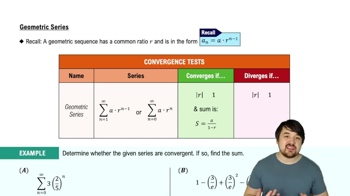
Geometric Series

Nonincreasing Magnitude of Terms

In an alternating series, the terms' absolute values decrease or stay the same as the series progresses. This property ensures that each successive term is smaller in magnitude, which is crucial for bounding the remainder and establishing convergence.
추천 영상:
가이드 코스
05:44
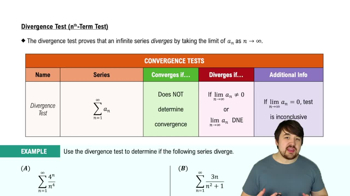
Divergence Test (nth Term Test)

Remainder Estimation in Alternating Series

The remainder after n terms in an alternating series is the difference between the true sum and the partial sum. Its magnitude is always less than or equal to the absolute value of the first omitted term, providing a simple and effective error bound for approximations.
추천 영상:
가이드 코스
06:32
Alternating Series Remainder