Ch. 2 - Limits
Briggs - Calculus: Early Transcendentals 3rd Edition
Briggs3rd EditionCalculus: Early TranscendentalsISBN: 9780136847243당신이 사용하는 게 아니라요?교과서 변경
2장, 문제 2.31a

A projectile is fired vertically upward and has a position given by s(t)=−16t^2+128t+192, for 0≤t≤9.


a. Graph the position function, for 0≤t≤9.

검증된 단계별 안내
1
Step 1: Understand the position function s(t) = -16t^2 + 128t + 192, which represents the height of the projectile at time t. This is a quadratic function, indicating that the graph will be a parabola.
Step 2: Identify the key features of the parabola. The coefficient of t^2 is negative, so the parabola opens downwards. The vertex of the parabola will give the maximum height of the projectile.
Step 3: Find the vertex of the parabola. The vertex form of a quadratic function is given by t = -b/(2a), where a = -16 and b = 128. Substitute these values to find the time at which the maximum height occurs.
Step 4: Calculate the maximum height by substituting the time found in Step 3 back into the position function s(t). This will give the maximum height of the projectile.
Step 5: Plot the graph of the position function s(t) = -16t^2 + 128t + 192 for 0 ≤ t ≤ 9. Mark the vertex and the intercepts on the graph to visualize the trajectory of the projectile.

비슷한 문제에 대한 검증된 영상 답변:

이 영상 해법은 위 문제에 도움이 된다고 튜터들이 추천한 것입니다.
영상 길이:
8m
도움이 되었나요?

주요 개념

질문에 올바르게 답하기 위해 반드시 이해해야 하는 핵심 개념들은 다음과 같습니다.

Quadratic Functions

The position function s(t) = -16t^2 + 128t + 192 is a quadratic function, characterized by its parabolic shape. Quadratic functions can be expressed in the standard form ax^2 + bx + c, where a, b, and c are constants. The coefficient 'a' determines the direction of the parabola (upward or downward), while 'b' and 'c' affect its position and vertex.
추천 영상:
6:04
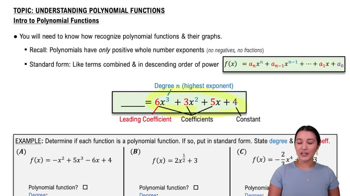
Introduction to Polynomial Functions

Graphing Techniques

Graphing a quadratic function involves identifying key features such as the vertex, axis of symmetry, and intercepts. The vertex can be found using the formula t = -b/(2a), which gives the time at which the projectile reaches its maximum height. The x-intercepts (roots) can be found using the quadratic formula, and the y-intercept is simply the value of s(0).
추천 영상:
06:15
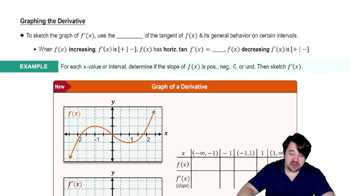
Graphing The Derivative

Projectile Motion

Projectile motion describes the motion of an object under the influence of gravity, typically modeled by a quadratic function. In this case, the function s(t) represents the height of the projectile over time, with the negative coefficient indicating that gravity is acting downward. Understanding the principles of projectile motion helps in analyzing the behavior of the object, including its maximum height and time of flight.
추천 영상:
06:51
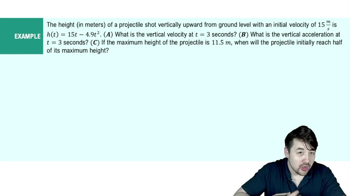
Derivatives Applied To Acceleration Example 2