a. Estimate lim x→π/4 cos 2x / cos x − sin x by making a table of values of cos 2x / cos x − sin x for values of x approaching π/4. Round your estimate to four digits.
Ch. 2 - Limits
2장, 문제 2.5.55a
Complete the following steps for the given functions.
a. Find the slant asymptote of .
검증된 단계별 안내1
Identify that the function \( f(x) = \frac{4x^3 + 4x^2 + 7x + 4}{x^2 + 1} \) is a rational function where the degree of the numerator (3) is one more than the degree of the denominator (2). This indicates the presence of a slant (oblique) asymptote.
To find the slant asymptote, perform polynomial long division of the numerator \( 4x^3 + 4x^2 + 7x + 4 \) by the denominator \( x^2 + 1 \).
Divide the leading term of the numerator \( 4x^3 \) by the leading term of the denominator \( x^2 \) to get the first term of the quotient, which is \( 4x \).
Multiply the entire divisor \( x^2 + 1 \) by \( 4x \) and subtract the result from the original numerator to find the new polynomial.
Repeat the division process with the new polynomial until the degree of the remainder is less than the degree of the divisor. The quotient obtained (ignoring the remainder) represents the equation of the slant asymptote.

비슷한 문제에 대한 검증된 영상 답변:
이 영상 해법은 위 문제에 도움이 된다고 튜터들이 추천한 것입니다.
영상 길이:
4m주요 개념
질문에 올바르게 답하기 위해 반드시 이해해야 하는 핵심 개념들은 다음과 같습니다.
Slant Asymptote
A slant (or oblique) asymptote occurs when the degree of the numerator of a rational function is exactly one higher than the degree of the denominator. To find it, perform polynomial long division on the function. The quotient (ignoring the remainder) gives the equation of the slant asymptote, which describes the behavior of the function as x approaches infinity.
추천 영상:
가이드 코스
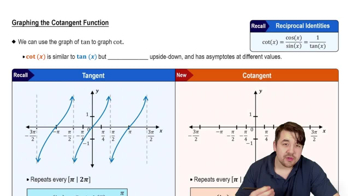
Introduction to Cotangent Graph
Polynomial Long Division
Polynomial long division is a method used to divide a polynomial by another polynomial of lower degree. It involves dividing the leading term of the numerator by the leading term of the denominator, multiplying the entire denominator by this result, and subtracting it from the numerator. This process is repeated until the degree of the remainder is less than that of the divisor.
추천 영상:
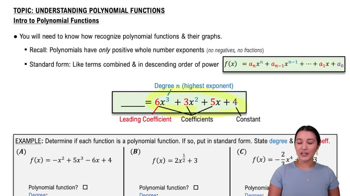
Introduction to Polynomial Functions
Rational Functions
Rational functions are expressions formed by the ratio of two polynomials. They can exhibit various behaviors, including vertical and horizontal asymptotes, depending on the degrees of the numerator and denominator. Understanding the properties of rational functions is crucial for analyzing their limits and asymptotic behavior, particularly as x approaches infinity or specific values.
추천 영상:
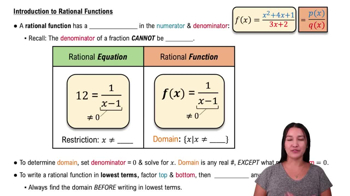
Intro to Rational Functions
관련 실천
교과서 질문
382
views
교과서 질문
Tangent lines with zero slope
a. Graph the function f(x)=x^2−4x+3.
402
views
교과서 질문
A projectile is fired vertically upward and has a position given by s(t)=−16t^2+128t+192, for 0≤t≤9.
a. Graph the position function, for 0≤t≤9.
390
views
교과서 질문
Complete the following sentences in terms of a limit.
b. A function is continuous from the right at a if _____ .
248
views
교과서 질문
A rock is dropped off the edge of a cliff, and its distance s (in feet) from the top of the cliff after t seconds is s(t)=16t^2. Assume the distance from the top of the cliff to the ground is 96 ft.
a. When will the rock strike the ground?
446
views
교과서 질문
Graph the function f(x)=e^−x / x(x+2)^2 using a graphing utility. (Experiment with your choice of a graphing window.) Use your graph to determine the following limits.
a. lim x→−2^+ f(x)
354
views