Ch. 2 - Limits
Briggs - Calculus: Early Transcendentals 3rd Edition
Briggs3rd EditionCalculus: Early TranscendentalsISBN: 9780136847243당신이 사용하는 게 아니라요?교과서 변경
2장, 문제 2.7.43

Suppose limxa f(x)=L{\(\displaystyle\)\(\lim\)_{x\(\to\) a}}\(\text{ }\)f\(\left\)(x\(\right\))=L and limxa g(x)=M{\(\displaystyle\)\(\lim\)_{x\(\to\) a}}\(\text{ }\)g\(\left\)(x\(\right\))=M. Prove that limxa (f(x)g(x))=LM{\(\displaystyle\[\lim\)_{x\(\to\) a}}\(\text{ }\]\left\)(f\(\left\)(x\(\right\))-g\(\left\)(x\(\right\))\(\right\))=L-M.

검증된 단계별 안내
1
Step 1: Start by recalling the limit properties. One important property is that the limit of a difference is the difference of the limits, provided the individual limits exist. This can be expressed as: if \( \lim_{x \to a} f(x) = L \) and \( \lim_{x \to a} g(x) = M \), then \( \lim_{x \to a} (f(x) - g(x)) = \lim_{x \to a} f(x) - \lim_{x \to a} g(x) \).
Step 2: Apply the limit property to the given functions \( f(x) \) and \( g(x) \). According to the problem, \( \lim_{x \to a} f(x) = L \) and \( \lim_{x \to a} g(x) = M \). Therefore, using the property, we have \( \lim_{x \to a} (f(x) - g(x)) = L - M \).
Step 3: Verify the conditions for applying the limit property. Ensure that both \( \lim_{x \to a} f(x) \) and \( \lim_{x \to a} g(x) \) exist and are finite, which is given in the problem statement.
Step 4: Conclude that since the conditions are satisfied and the property is applicable, the limit of the difference \( \lim_{x \to a} (f(x) - g(x)) \) is indeed \( L - M \).
Step 5: Summarize the proof by stating that the limit of the difference of two functions is equal to the difference of their limits, as demonstrated by applying the limit property to the given functions.

비슷한 문제에 대한 검증된 영상 답변:

이 영상 해법은 위 문제에 도움이 된다고 튜터들이 추천한 것입니다.
영상 길이:
6m

주요 개념

질문에 올바르게 답하기 위해 반드시 이해해야 하는 핵심 개념들은 다음과 같습니다.

Limit of a Function

The limit of a function describes the behavior of that function as its input approaches a certain value. Formally, we say that the limit of f(x) as x approaches a is L if, for every small positive number ε, there exists a corresponding small positive number δ such that whenever 0 < |x - a| < δ, it follows that |f(x) - L| < ε. This concept is fundamental in calculus as it lays the groundwork for continuity and differentiability.
추천 영상:
06:11
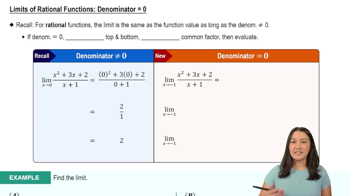
Limits of Rational Functions: Denominator = 0

Limit Properties

Limit properties are rules that allow us to compute limits of functions more easily. One important property is that the limit of the difference of two functions is the difference of their limits, provided both limits exist. This means that if lim(x→a) f(x) = L and lim(x→a) g(x) = M, then lim(x→a) (f(x) - g(x)) = L - M. Understanding these properties is crucial for proving statements about limits.
추천 영상:
가이드 코스
06:21
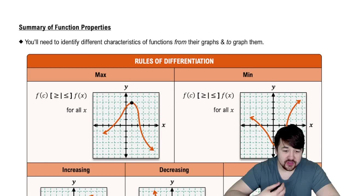
Properties of Functions

Proof Techniques in Calculus

Proof techniques in calculus involve logical reasoning to establish the validity of mathematical statements. Common methods include direct proof, proof by contradiction, and the epsilon-delta definition of limits. In the context of limits, one often uses these techniques to rigorously demonstrate that a limit exists or to derive relationships between limits, such as proving that the limit of a difference equals the difference of the limits.
추천 영상:
가이드 코스
05:03
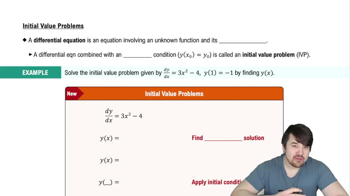
Initial Value Problems
관련 실천
교과서 질문

Use the precise definition of a limit to prove the following limits. Specify a relationship between ε and δ that guarantees the limit exists.

lim x→1 x^4=1

406
views

교과서 질문

b. Estimate a solution to the equation in the given interval using a root finder.


x^5+7x+5=0; (−1,0)

226
views
교과서 질문

Determine the interval(s) on which the following functions are continuous. 

f(x)=1 / x^2−4

320
views
교과서 질문

If a function f represents a system that varies in time, the existence of lim limtf(t){\(\displaystyle\[\lim\)_{t\(\rightarrow\]\infty\)}{f(t)}} means that the system reaches a steady state (or equilibrium). For the following systems, determine whether a steady state exists and give the steady-state value.


The population of a bacteria culture is given by p(t)=2500t+1p\(\left\)(t\(\right\))=\(\frac{2500}{t+1}\).

400
views
교과서 질문

A sequence is an infinite, ordered list of numbers that is often defined by a function. For example, the sequence {2,4,6,8,…} is specified by the function f(n) = 2n, where n=1,2,3,….The limit of such a sequence is lim n→∞ f(n), provided the limit exists. All the limit laws for limits at infinity may be applied to limits of sequences. Find the limit of the following sequences or state that the limit does not exist. 


{2,3/4,4/9,5/16,…}, which is defined by f(n) = (n+1) / n^2, for n=1,2,3,…

308
views
교과서 질문

Determine the points on the interval (0, 5) at which the following functions f have discontinuities. At each point of discontinuity, state the conditions in the continuity checklist that are violated. <IMAGE>

246
views