Ch. 2 - Limits
Briggs - Calculus: Early Transcendentals 3rd Edition
Briggs3rd EditionCalculus: Early TranscendentalsISBN: 9780136847243당신이 사용하는 게 아니라요?교과서 변경
2장, 문제 2.7.41

Use the precise definition of a limit to prove the following limits. Specify a relationship between ε and δ that guarantees the limit exists.
lim x→1 x^4=1

검증된 단계별 안내
1
Step 1: Recall the precise definition of a limit. For the limit \( \lim_{{x \to 1}} x^4 = 1 \) to hold, for every \( \varepsilon > 0 \), there must exist a \( \delta > 0 \) such that whenever \( 0 < |x - 1| < \delta \), it follows that \( |x^4 - 1| < \varepsilon \).
Step 2: Start by expressing \( |x^4 - 1| \) in a form that can be manipulated. Notice that \( x^4 - 1 = (x^2 - 1)(x^2 + 1) = (x - 1)(x + 1)(x^2 + 1) \).
Step 3: To ensure \( |x^4 - 1| < \varepsilon \), we need to bound \( |(x - 1)(x + 1)(x^2 + 1)| \). Assume \( |x - 1| < 1 \), which implies \( 0 < x < 2 \). This gives us bounds for \( |x + 1| \) and \( |x^2 + 1| \).
Step 4: Calculate the bounds: \( |x + 1| < 3 \) and \( |x^2 + 1| < 5 \) when \( 0 < x < 2 \). Therefore, \( |(x - 1)(x + 1)(x^2 + 1)| < |x - 1| \cdot 3 \cdot 5 = 15|x - 1| \).
Step 5: To satisfy \( |x^4 - 1| < \varepsilon \), choose \( \delta = \frac{\varepsilon}{15} \). This ensures that whenever \( 0 < |x - 1| < \delta \), it follows that \( |x^4 - 1| < \varepsilon \), thus proving the limit.

비슷한 문제에 대한 검증된 영상 답변:

이 영상 해법은 위 문제에 도움이 된다고 튜터들이 추천한 것입니다.
영상 길이:
5m

주요 개념

질문에 올바르게 답하기 위해 반드시 이해해야 하는 핵심 개념들은 다음과 같습니다.

Limit Definition

The precise definition of a limit states that for a function f(x) to approach a limit L as x approaches a value c, for every ε > 0, there exists a δ > 0 such that if 0 < |x - c| < δ, then |f(x) - L| < ε. This formalism is crucial for proving limits rigorously.
추천 영상:
05:50
One-Sided Limits

Epsilon-Delta Relationship

In the context of limits, the ε (epsilon) represents how close f(x) must be to the limit L, while δ (delta) represents how close x must be to c. Establishing a relationship between ε and δ is essential to demonstrate that as x gets sufficiently close to c, f(x) will be within ε of L.
추천 영상:
가이드 코스
05:53
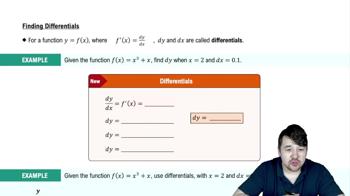
Finding Differentials

Polynomial Functions

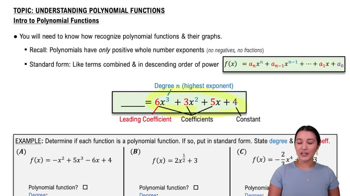
Polynomial functions, such as f(x) = x^4, are continuous everywhere on their domain. This property simplifies limit calculations, as the limit of a polynomial as x approaches a point can be found by direct substitution, making it easier to apply the ε-δ definition.
추천 영상:
6:04
Introduction to Polynomial Functions
관련 실천
교과서 질문

b. Estimate a solution to the equation in the given interval using a root finder.


x^5+7x+5=0; (−1,0)

226
views

교과서 질문

Determine the following limits.

lim θ→π/2 sin^2 θ − 5 sin θ + 4 / sin^2 θ − 1

367
views
교과서 질문

Determine the interval(s) on which the following functions are continuous. 

f(x)=1 / x^2−4

320
views
교과서 질문

If a function f represents a system that varies in time, the existence of lim limtf(t){\(\displaystyle\[\lim\)_{t\(\rightarrow\]\infty\)}{f(t)}} means that the system reaches a steady state (or equilibrium). For the following systems, determine whether a steady state exists and give the steady-state value.


The population of a bacteria culture is given by p(t)=2500t+1p\(\left\)(t\(\right\))=\(\frac{2500}{t+1}\).

400
views
교과서 질문

A sequence is an infinite, ordered list of numbers that is often defined by a function. For example, the sequence {2,4,6,8,…} is specified by the function f(n) = 2n, where n=1,2,3,….The limit of such a sequence is lim n→∞ f(n), provided the limit exists. All the limit laws for limits at infinity may be applied to limits of sequences. Find the limit of the following sequences or state that the limit does not exist. 


{2,3/4,4/9,5/16,…}, which is defined by f(n) = (n+1) / n^2, for n=1,2,3,…

308
views
교과서 질문

Suppose limxa f(x)=L{\(\displaystyle\)\(\lim\)_{x\(\to\) a}}\(\text{ }\)f\(\left\)(x\(\right\))=L and limxa g(x)=M{\(\displaystyle\)\(\lim\)_{x\(\to\) a}}\(\text{ }\)g\(\left\)(x\(\right\))=M. Prove that limxa (f(x)g(x))=LM{\(\displaystyle\[\lim\)_{x\(\to\) a}}\(\text{ }\]\left\)(f\(\left\)(x\(\right\))-g\(\left\)(x\(\right\))\(\right\))=L-M.

345
views