

Matching heights A stone is thrown with an initial velocity of 32 ft/s from the edge of a bridge that is 48 ft above the ground. The height of this stone above the ground t seconds after it is thrown is f(t) = −16t²+32t+48 . If a second stone is thrown from the ground, then its height above the ground after t seconds is given by g(t) = −16t²+v0t, where v0 is the initial velocity of the second stone. Determine the value of v0 such that both stones reach the same high point.
Ch. 3 - Derivatives
3장, 문제 3.8.8
5–8. Calculate dy/dx using implicit differentiation.
e^y-e^x = C, where C is constant
검증된 단계별 안내1
Start by differentiating both sides of the equation with respect to x. The equation is e^y - e^x = C. Since C is a constant, its derivative is 0.
Differentiate e^y with respect to x. Use the chain rule: the derivative of e^y with respect to y is e^y, and then multiply by dy/dx because y is a function of x.
Differentiate e^x with respect to x. The derivative of e^x with respect to x is simply e^x.
Set up the equation from the derivatives: e^y * (dy/dx) - e^x = 0.
Solve for dy/dx by isolating it on one side of the equation: e^y * (dy/dx) = e^x, then divide both sides by e^y to get dy/dx = e^x / e^y.

비슷한 문제에 대한 검증된 영상 답변:
이 영상 해법은 위 문제에 도움이 된다고 튜터들이 추천한 것입니다.
영상 길이:
4m도움이 되었나요?
주요 개념
질문에 올바르게 답하기 위해 반드시 이해해야 하는 핵심 개념들은 다음과 같습니다.
Implicit Differentiation
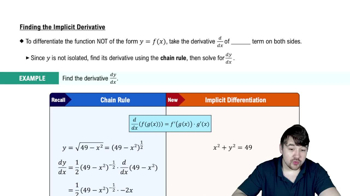
Implicit differentiation is a technique used to find the derivative of a function when it is not explicitly solved for one variable in terms of another. Instead of isolating y, we differentiate both sides of the equation with respect to x, applying the chain rule when differentiating terms involving y. This method is particularly useful for equations where y cannot be easily expressed as a function of x.
추천 영상:
가이드 코스
Finding The Implicit Derivative
Chain Rule
The chain rule is a fundamental principle in calculus that allows us to differentiate composite functions. It states that if a function y is defined as a function of u, which in turn is a function of x, then the derivative of y with respect to x can be found by multiplying the derivative of y with respect to u by the derivative of u with respect to x. This is essential in implicit differentiation when dealing with terms involving y.
추천 영상:
Intro to the Chain Rule
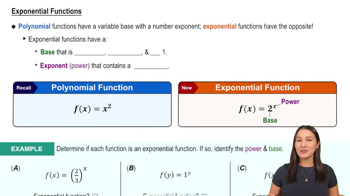
Exponential Functions
Exponential functions are mathematical functions of the form f(x) = e^x, where e is the base of the natural logarithm. These functions have unique properties, such as their derivative being equal to the function itself. In the context of the given equation, understanding how to differentiate e^y and e^x is crucial for applying implicit differentiation correctly and finding dy/dx.
추천 영상:
Exponential Functions
관련 실천
교과서 질문
290
views
교과서 질문
Water is drained out of an inverted cone that has the same dimensions as the cone depicted in Exercise 36. If the water level drops at 1 ft/min, at what rate is water (in ft³/min) draining from the tank when the water depth is 6 ft?
362
views
교과서 질문
Explain why b^x = e^xlnb.
1102
views
교과서 질문
Find the derivative of the following functions.
y = In |sin x|
994
views
교과서 질문
Find and simplify the derivative of the following functions.
f(x) = √(e2x + 8x2ex +16x4) (Hint: Factor the function under the square root first.)
513
views
교과서 질문
Derivatives Find and simplify the derivative of the following functions.
g(t) = t³+3t²+t / t³
473
views
