Ch. 3 - Derivatives
Briggs - Calculus: Early Transcendentals 3rd Edition
Briggs3rd EditionCalculus: Early TranscendentalsISBN: 9780136847243당신이 사용하는 게 아니라요?교과서 변경
3장, 문제 3.9.6

Explain why b^x = e^xlnb.

검증된 단계별 안내
1
Start by understanding the concept of exponential functions. The function \( b^x \) is an exponential function where \( b \) is the base and \( x \) is the exponent.
Recall the natural exponential function \( e^x \), which is a fundamental function in calculus due to its unique properties, such as its derivative being itself.
Use the property of logarithms: \( b^x = e^{x \ln b} \). This transformation is based on the identity \( a^b = e^{b \ln a} \), which allows us to express any exponential function in terms of the natural exponential function.
Understand that \( \ln b \) is the natural logarithm of \( b \). The expression \( x \ln b \) is the exponent in the transformed function \( e^{x \ln b} \). This transformation is useful because it allows us to leverage the properties of \( e^x \) in calculus.
Recognize that this transformation is particularly useful in calculus for differentiation and integration, as the derivative of \( e^x \) is \( e^x \), making calculations more straightforward when dealing with exponential functions.

비슷한 문제에 대한 검증된 영상 답변:

이 영상 해법은 위 문제에 도움이 된다고 튜터들이 추천한 것입니다.
영상 길이:
1m
도움이 되었나요?

주요 개념

질문에 올바르게 답하기 위해 반드시 이해해야 하는 핵심 개념들은 다음과 같습니다.

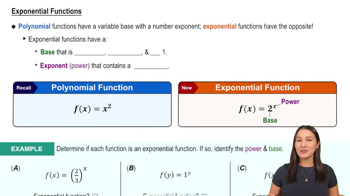
Exponential Functions

Exponential functions are mathematical expressions in the form of b^x, where b is a positive constant and x is a variable. These functions exhibit rapid growth or decay, depending on the base b. Understanding their properties is crucial for manipulating and transforming exponential expressions.
추천 영상:
6:13
Exponential Functions

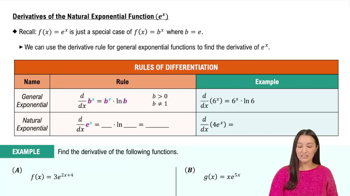
Natural Exponential Function

The natural exponential function, denoted as e^x, is a specific exponential function where the base e is approximately equal to 2.71828. It is fundamental in calculus due to its unique property that the derivative of e^x is itself, making it a key function in various applications, including growth models and compound interest.
추천 영상:
04:56
Derivative of the Natural Exponential Function (e^x)

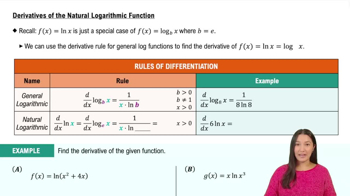
Natural Logarithm

The natural logarithm, represented as ln(b), is the logarithm to the base e. It is the inverse operation of the natural exponential function. The relationship between exponentials and logarithms is essential for transforming expressions, as it allows us to express b^x in terms of e, facilitating easier calculations and understanding of growth rates.
추천 영상:
05:18
Derivative of the Natural Logarithmic Function