Ch. 3 - Derivatives
Briggs - Calculus: Early Transcendentals 3rd Edition
Briggs3rd EditionCalculus: Early TranscendentalsISBN: 9780136847243당신이 사용하는 게 아니라요?교과서 변경
3장, 문제 55

Evaluate and simplify y'.
x = cos (x−y)

검증된 단계별 안내
1
First, identify the given equation: y' * x = cos(x - y). Here, y' represents the derivative of y with respect to x.
To solve for y', isolate y' by dividing both sides of the equation by x, resulting in y' = (cos(x - y)) / x.
Next, simplify the expression if possible. Check if there are any trigonometric identities or algebraic manipulations that can be applied to cos(x - y).
Consider the derivative rules that might apply to the expression. Since y' is the derivative of y with respect to x, think about how implicit differentiation might be used if y is a function of x.
Finally, ensure the expression is in its simplest form. Verify that all terms are simplified and that the expression is ready for further analysis or integration if needed.

비슷한 문제에 대한 검증된 영상 답변:

이 영상 해법은 위 문제에 도움이 된다고 튜터들이 추천한 것입니다.
영상 길이:
3m
도움이 되었나요?

주요 개념

질문에 올바르게 답하기 위해 반드시 이해해야 하는 핵심 개념들은 다음과 같습니다.

Implicit Differentiation

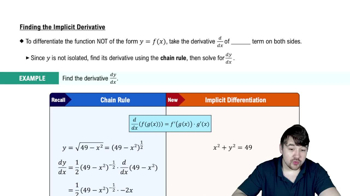
Implicit differentiation is a technique used to differentiate equations where the dependent and independent variables are not explicitly separated. In this case, we differentiate both sides of the equation x = cos(x - y) with respect to x, treating y as a function of x. This allows us to find the derivative y' without needing to solve for y explicitly.
추천 영상:
가이드 코스
05:14
Finding The Implicit Derivative

Chain Rule

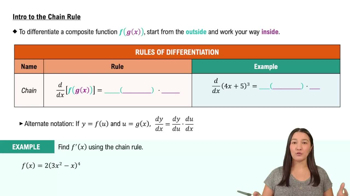
The chain rule is a fundamental principle in calculus that allows us to differentiate composite functions. When applying the chain rule, we differentiate the outer function and multiply it by the derivative of the inner function. In the context of the given equation, we will use the chain rule to differentiate cos(x - y) with respect to x, accounting for the derivative of y as well.
추천 영상:
05:02
Intro to the Chain Rule

Solving for y'

After applying implicit differentiation and the chain rule, we will obtain an equation that includes y' (the derivative of y with respect to x). The next step is to isolate y' on one side of the equation to express it explicitly. This process often involves algebraic manipulation to simplify the expression and solve for y' in terms of x and y.
추천 영상:
5:02
Solving Logarithmic Equations
관련 실천
교과서 질문

A capacitor is a device in an electrical circuit that stores charge. In one particular circuit, the charge on the capacitor Q varies in time as shown in the figure. <IMAGE>

b. Is Q′ positive or negative for t≥0?

175
views

교과서 질문

Where is the function continuous? Differentiable? Use the graph of f in the figure to do the following. <IMAGE>

c. Sketch a graph of f'.

146
views
교과서 질문

Where is the function continuous? Differentiable? Use the graph of f in the figure to do the following. <IMAGE>

b. Find the values of x in (0, 3) at which f is not differentiable.

188
views
교과서 질문

Robert Boyle (1627–1691) found that for a given quantity of gas at a constant temperature, the pressure P (in kPa) and volume V of the gas (in m³) are accurately approximated by the equation V=k/P, where k>0 is constant. Suppose the volume of an expanding gas is increasing at a rate of 0.15 m³/min when the volume V=0.5 m³ and the pressure is P=50 kPa. At what rate is pressure changing at this moment?

203
views
교과서 질문

An object oscillates along a vertical line, and its position in centimeters is given by y(t)=30(sint - 1), where t ≥ 0 is measured in seconds and y is positive in the upward direction.

At what times and positions is the velocity zero?

216
views
교과서 질문

A capacitor is a device in an electrical circuit that stores charge. In one particular circuit, the charge on the capacitor Q varies in time as shown in the figure. <IMAGE>

a. At what time is the rate of change of the charge Q' the greatest?

158
views