Ch. 4 - Applications of the Derivative
Briggs - Calculus: Early Transcendentals 3rd Edition
Briggs3rd EditionCalculus: Early TranscendentalsISBN: 9780136847243당신이 사용하는 게 아니라요?교과서 변경
4장, 문제 4.9.101

Acceleration to position Given the following acceleration functions of an object moving along a line, find the position function with the given initial velocity and position.


a(t) = 2 + 3 sin t; v(0) = 1, s(0) = 10

검증된 단계별 안내
1
Step 1: Understand the problem. The goal is to find the position function s(t) of the object. To do this, we need to integrate the acceleration function a(t) = 2 + 3 sin(t) to find the velocity function v(t), and then integrate v(t) to find the position function s(t). Initial conditions v(0) = 1 and s(0) = 10 will help determine the constants of integration.
Step 2: Integrate the acceleration function a(t) = 2 + 3 sin(t) to find the velocity function v(t). The integral of 2 is 2t, and the integral of 3 sin(t) is -3 cos(t). Add a constant of integration, C₁, to get v(t) = 2t - 3 cos(t) + C₁.
Step 3: Use the initial condition v(0) = 1 to solve for the constant C₁. Substitute t = 0 into v(t): v(0) = 2(0) - 3 cos(0) + C₁ = 1. Since cos(0) = 1, this simplifies to C₁ = 4. Thus, the velocity function is v(t) = 2t - 3 cos(t) + 4.
Step 4: Integrate the velocity function v(t) = 2t - 3 cos(t) + 4 to find the position function s(t). The integral of 2t is t², the integral of -3 cos(t) is -3 sin(t), and the integral of 4 is 4t. Add a constant of integration, C₂, to get s(t) = t² - 3 sin(t) + 4t + C₂.
Step 5: Use the initial condition s(0) = 10 to solve for the constant C₂. Substitute t = 0 into s(t): s(0) = (0)² - 3 sin(0) + 4(0) + C₂ = 10. Since sin(0) = 0, this simplifies to C₂ = 10. Thus, the position function is s(t) = t² - 3 sin(t) + 4t + 10.

비슷한 문제에 대한 검증된 영상 답변:

이 영상 해법은 위 문제에 도움이 된다고 튜터들이 추천한 것입니다.
영상 길이:
4m
도움이 되었나요?

주요 개념

질문에 올바르게 답하기 위해 반드시 이해해야 하는 핵심 개념들은 다음과 같습니다.

Acceleration Function

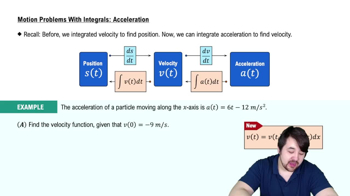
The acceleration function describes how the velocity of an object changes over time. In this case, the function a(t) = 2 + 3 sin t indicates that the acceleration is not constant but varies periodically with time due to the sine component. Understanding this function is crucial for determining how the object's velocity and position evolve.
추천 영상:
가이드 코스
08:14
Using The Acceleration Function

Integration

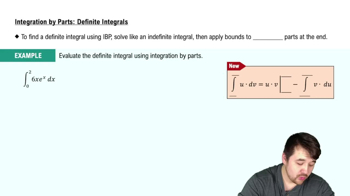
Integration is a fundamental concept in calculus used to find the accumulation of quantities, such as area under a curve or, in this case, the velocity and position from the acceleration function. To find the velocity function, we integrate the acceleration function, and to find the position function, we integrate the velocity function. This process is essential for solving the problem.
추천 영상:
가이드 코스
06:18
Integration by Parts for Definite Integrals

Initial Conditions

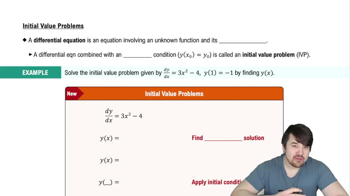
Initial conditions provide specific values at a given point in time, which are necessary for solving differential equations. In this problem, the initial velocity v(0) = 1 and initial position s(0) = 10 are used to determine the constants of integration after finding the velocity and position functions. These conditions ensure that the solutions are tailored to the specific scenario described.
추천 영상:
가이드 코스
05:03
Initial Value Problems