Ch. 4 - Applications of the Derivative
Briggs - Calculus: Early Transcendentals 3rd Edition
Briggs3rd EditionCalculus: Early TranscendentalsISBN: 9780136847243당신이 사용하는 게 아니라요?교과서 변경
4장, 문제 4.3.102

Designer functions Sketch the graph of a function f that is continuous on (-∞,∞) and satisfies the following sets of conditions.


f"(x) > 0 on (-∞,-2); f"(-2) = 0; f'(1) = 0; f"(2) = 0; f'(3) = 0; f"(x) > 0 on (4,∞)

검증된 단계별 안내
1
Start by understanding the conditions given for the function f. The function is continuous on (-∞, ∞), which means there are no breaks, jumps, or holes in the graph.
Analyze the second derivative conditions: f''(x) > 0 on (-∞, -2) and f''(x) > 0 on (4, ∞). This indicates that the function is concave up in these intervals, meaning the graph is curving upwards.
Consider the points where the second derivative is zero: f''(-2) = 0 and f''(2) = 0. These points are likely inflection points where the concavity changes. At x = -2, the graph transitions from concave up to possibly concave down, and at x = 2, it transitions from concave down to concave up.
Examine the first derivative conditions: f'(1) = 0 and f'(3) = 0. These points are critical points where the slope of the tangent to the graph is zero, indicating potential local maxima or minima.
Combine all these insights to sketch the graph. Start with the intervals of concavity, mark the inflection points, and identify the critical points. Ensure the graph is continuous and reflects the changes in concavity and slope as described by the conditions.

비슷한 문제에 대한 검증된 영상 답변:

이 영상 해법은 위 문제에 도움이 된다고 튜터들이 추천한 것입니다.
영상 길이:
8m
도움이 되었나요?

주요 개념

질문에 올바르게 답하기 위해 반드시 이해해야 하는 핵심 개념들은 다음과 같습니다.

Second Derivative Test

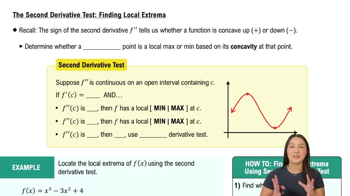
The second derivative test is a method used to determine the concavity of a function and identify local extrema. If the second derivative, f''(x), is positive at a point, the function is concave up, indicating a local minimum. Conversely, if f''(x) is negative, the function is concave down, suggesting a local maximum. If f''(x) equals zero, the test is inconclusive, and further analysis is needed.
추천 영상:
06:02
The Second Derivative Test: Finding Local Extrema

Critical Points

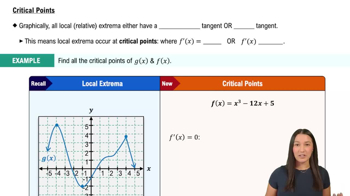
Critical points occur where the first derivative of a function, f'(x), is zero or undefined. These points are essential for finding local maxima and minima, as they indicate where the function's slope changes. In the context of the given question, identifying critical points helps in sketching the graph and understanding the behavior of the function at specific intervals.
추천 영상:
04:50
Critical Points

Continuity and Differentiability

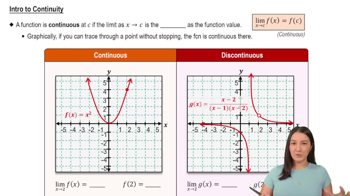
A function is continuous if there are no breaks, jumps, or holes in its graph, and it is differentiable if it has a defined derivative at all points in its domain. For the function f described in the question, continuity on (-∞, ∞) ensures that it can be analyzed using calculus techniques, while differentiability allows for the application of the first and second derivative tests to determine the function's behavior.
추천 영상:
05:34
Intro to Continuity