Ch. 5 - Integration
Briggs - Calculus: Early Transcendentals 3rd Edition
Briggs3rd EditionCalculus: Early TranscendentalsISBN: 9780136847243당신이 사용하는 게 아니라요?교과서 변경
5장, 문제 5.1.9

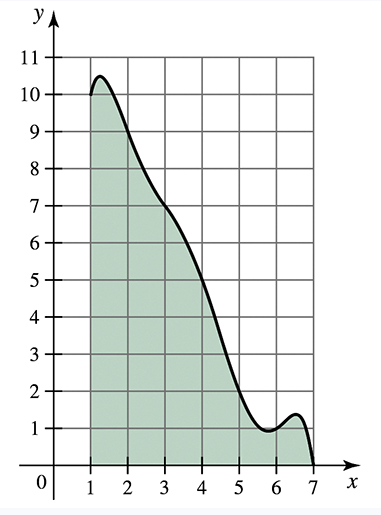
Approximating area from a graph Approximate the area of the region bounded by the graph (see figure) and the 𝓍-axis by dividing the interval [1, 7] into n = 6 subintervals. Use a left and right Riemann sum to obtain two different approximations.                                                                                                                                                                         
fig

검증된 단계별 안내
1
First, determine the width of each subinterval by dividing the total interval length by the number of subintervals: \(\Delta x = \frac{7 - 1}{6} = 1\).
Identify the left endpoints of each subinterval for the left Riemann sum: these are \(x = 1, 2, 3, 4, 5, 6\). For each of these points, find the corresponding function values \(f(x)\) from the graph.
Calculate the left Riemann sum by multiplying each function value at the left endpoints by the width \(\Delta x\) and summing them up: \(L = \sum_{i=0}^{5} f(x_i) \Delta x\) where \(x_i\) are the left endpoints.
Identify the right endpoints of each subinterval for the right Riemann sum: these are \(x = 2, 3, 4, 5, 6, 7\). For each of these points, find the corresponding function values \(f(x)\) from the graph.
Calculate the right Riemann sum by multiplying each function value at the right endpoints by the width \(\Delta x\) and summing them up: \(R = \sum_{i=1}^{6} f(x_i) \Delta x\) where \(x_i\) are the right endpoints.

비슷한 문제에 대한 검증된 영상 답변:

이 영상 해법은 위 문제에 도움이 된다고 튜터들이 추천한 것입니다.
영상 길이:
3m
도움이 되었나요?

주요 개념

질문에 올바르게 답하기 위해 반드시 이해해야 하는 핵심 개념들은 다음과 같습니다.

Riemann Sums

Riemann sums approximate the area under a curve by dividing the interval into subintervals and summing the areas of rectangles. The height of each rectangle is determined by the function value at specific points, such as the left or right endpoints of each subinterval.
추천 영상:
가이드 코스
06:11
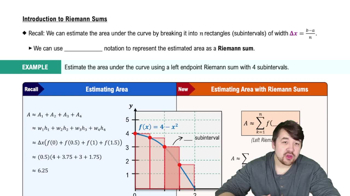
Introduction to Riemann Sums

Left and Right Endpoint Approximations

Left and right Riemann sums use the function values at the left or right endpoints of each subinterval to determine rectangle heights. Left sums may underestimate or overestimate the area depending on the function's behavior, while right sums provide a complementary approximation.
추천 영상:
가이드 코스
07:39
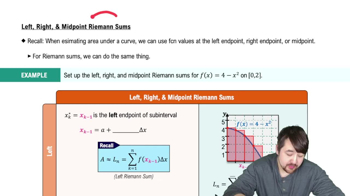
Left, Right, & Midpoint Riemann Sums

Partitioning the Interval

Dividing the interval [1, 7] into n = 6 equal subintervals means each subinterval has width Δx = (7-1)/6 = 1. This partitioning is essential for calculating the Riemann sums, as it defines the base of each rectangle used in the approximation.
추천 영상:
08:44
Interval of Convergence
관련 실천
교과서 질문

Left and right Riemann sums Use the figures to calculate the left and right Riemann sums for f on the given interval and for the given value of n.

ƒ(𝓍) = x + 1 on [1,6] ; n = 5

533
views

교과서 질문

Use the given substitution to evaluate the following indefinite integrals. Check your answer by differentiating.                                                                                              


 ∫ 8𝓍 cos (4𝓍² + 3) d𝓍, u = 4𝓍² + 3

53
views
교과서 질문

Symmetry in integrals Use symmetry to evaluate the following integrals.

∫²⁰⁰₋₂₀₀ 2x⁵ dx

109
views
교과서 질문

Definite integrals Evaluate the following integrals using the Fundamental Theorem of Calculus


∫¹₁/₂ (t⁻³ ― 8) dt

58
views
교과서 질문

Derivatives of integrals Simplify the following expressions.


d/dy ∫¹⁰ᵧ³ √(𝓍⁶ + 1) d𝓍

118
views
교과서 질문

Definite integrals Use a change of variables or Table 5.6 to evaluate the following definite integrals.                                                                                                                         


 ∫π/₁₆^π/⁸ 8 csc² 4𝓍 d𝓍

100
views