


Ch. 5 - Integration
Briggs - Calculus: Early Transcendentals 3rd Edition
Briggs3rd EditionCalculus: Early TranscendentalsISBN: 9780136847243당신이 사용하는 게 아니라요?교과서 변경
5장, 문제 5.3.82

Derivatives of integrals Simplify the following expressions.


d/dy ∫¹⁰ᵧ³ √(𝓍⁶ + 1) d𝓍

검증된 단계별 안내
1
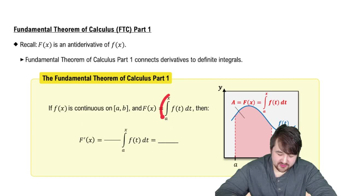
Step 1: Recognize that the problem involves the Fundamental Theorem of Calculus, which states that if F(x) is the antiderivative of f(x), then d/dx ∫ₐˣ f(t) dt = f(x).
Step 2: Observe that the integral has variable limits of integration (y³ as the lower limit and 10 as the upper limit). This requires the use of Leibniz's rule for differentiation under the integral sign.
Step 3: Apply Leibniz's rule: d/dy ∫ₐᵇ f(x) dx = f(b) * (db/dy) - f(a) * (da/dy), where a and b are functions of y. Here, a = y³ and b = 10.
Step 4: Substitute the limits into the formula. The upper limit (10) is constant, so db/dy = 0. For the lower limit (y³), da/dy = d(y³)/dy = 3y². The integrand is √(x⁶ + 1), so evaluate it at x = y³.
Step 5: Simplify the expression using the formula: d/dy ∫¹⁰ᵧ³ √(x⁶ + 1) dx = -√((y³)⁶ + 1) * 3y². The negative sign comes from the lower limit contribution.

비슷한 문제에 대한 검증된 영상 답변:

이 영상 해법은 위 문제에 도움이 된다고 튜터들이 추천한 것입니다.
영상 길이:
2m
도움이 되었나요?

주요 개념

질문에 올바르게 답하기 위해 반드시 이해해야 하는 핵심 개념들은 다음과 같습니다.

Fundamental Theorem of Calculus

The Fundamental Theorem of Calculus links differentiation and integration, stating that if F is an antiderivative of f on an interval [a, b], then the integral of f from a to b can be computed using F. It also establishes that the derivative of the integral of a function is the original function itself, which is crucial for simplifying expressions involving derivatives of integrals.
추천 영상:
06:11
Fundamental Theorem of Calculus Part 1

Chain Rule

The Chain Rule is a fundamental principle in calculus used to differentiate composite functions. When differentiating an integral with variable limits, the Chain Rule helps in applying the derivative to the upper limit while also considering the derivative of the limit itself. This is essential for correctly simplifying expressions where the limits of integration are functions of a variable.
추천 영상:
05:02
Intro to the Chain Rule

Definite Integral

A definite integral represents the accumulation of quantities, such as area under a curve, over a specific interval [a, b]. In the context of the given expression, understanding how to evaluate definite integrals and their properties is necessary for simplifying the expression involving the integral of √(𝓍⁶ + 1) from 1 to 3y. This knowledge is key to applying the Fundamental Theorem of Calculus effectively.
추천 영상:
05:43
Definition of the Definite Integral
관련 실천
교과서 질문

Approximating area from a graph Approximate the area of the region bounded by the graph (see figure) and the 𝓍-axis by dividing the interval [1, 7] into n = 6 subintervals. Use a left and right Riemann sum to obtain two different approximations.                                                                                                                                                                         

74
views
교과서 질문

Symmetry in integrals Use symmetry to evaluate the following integrals.

∫²⁰⁰₋₂₀₀ 2x⁵ dx

109
views
교과서 질문

Definite integrals Evaluate the following integrals using the Fundamental Theorem of Calculus


∫¹₁/₂ (t⁻³ ― 8) dt

58
views
교과서 질문

Definite integrals Use a change of variables or Table 5.6 to evaluate the following definite integrals.                                                                                                                         


 ∫π/₁₆^π/⁸ 8 csc² 4𝓍 d𝓍

100
views
교과서 질문

Average values Find the average value of the following functions on the given interval. Draw a graph of the function and indicate the average value.

ƒ(𝓍) = 1/(𝓍² + 1) on [―1, 1]

83
views
교과서 질문

Areas of regions Find the area of the following regions.                                                                                                                   

                                                                                                                                                                 The region bounded by the graph of ƒ(𝓍) = (𝓍―4)⁴ and the 𝓍-axis between and 𝓍 = 2 and 𝓍= 6

63
views