

Ch. 5 - Integration
Briggs - Calculus: Early Transcendentals 3rd Edition
Briggs3rd EditionCalculus: Early TranscendentalsISBN: 9780136847243당신이 사용하는 게 아니라요?교과서 변경
5장, 문제 5.2.73a

{Use of Tech} Approximating definite integrals with a calculator Consider the following definite integrals.
(a) Write the left and right Riemann sums in sigma notation for an arbitrary value of n.


∫₀¹ cos ⁻¹ 𝓍 d𝓍

검증된 단계별 안내
1
Step 1: Understand the problem. The goal is to approximate the definite integral ∫₀¹ cos⁻¹(𝓍) d𝓍 using Riemann sums. A Riemann sum is a method for approximating the area under a curve by dividing the interval into subintervals and summing up the areas of rectangles formed within those subintervals.
Step 2: Define the interval and subintervals. The integral is over the interval [0, 1]. Divide this interval into n subintervals of equal width. The width of each subinterval is Δ𝓍 = (1 - 0)/n = 1/n.
Step 3: Write the left Riemann sum in sigma notation. For the left Riemann sum, the height of each rectangle is determined by the function value at the left endpoint of each subinterval. The left Riemann sum can be expressed as: i1n(cos1(a....
Step 4: Right sum sigma notation
Step 5: wrap up

비슷한 문제에 대한 검증된 영상 답변:

이 영상 해법은 위 문제에 도움이 된다고 튜터들이 추천한 것입니다.
영상 길이:
4m
도움이 되었나요?

주요 개념

질문에 올바르게 답하기 위해 반드시 이해해야 하는 핵심 개념들은 다음과 같습니다.

Definite Integrals

A definite integral represents the signed area under a curve between two points on the x-axis. It is denoted as ∫_a^b f(x) dx, where 'a' and 'b' are the limits of integration. The value of a definite integral can be interpreted as the accumulation of quantities, such as area, over the interval [a, b].
추천 영상:
가이드 코스
05:43
Definition of the Definite Integral

Riemann Sums

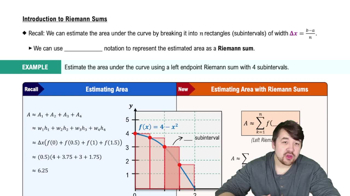
Riemann sums are a method for approximating the value of a definite integral by dividing the area under a curve into rectangles. The left Riemann sum uses the left endpoints of subintervals to determine the height of the rectangles, while the right Riemann sum uses the right endpoints. As the number of rectangles (n) increases, the Riemann sums converge to the exact value of the definite integral.
추천 영상:
가이드 코스
06:11
Introduction to Riemann Sums

Sigma Notation

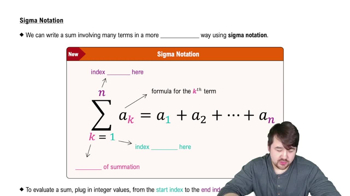
Sigma notation is a concise way to represent the sum of a sequence of terms. It uses the Greek letter sigma (Σ) to indicate summation, along with an index of summation that specifies the starting and ending values. In the context of Riemann sums, sigma notation is used to express the sum of the areas of the rectangles formed in the approximation of the integral.
추천 영상:
관련 실천
교과서 질문

Properties of integrals Consider two functions ƒ and g on [1,6] such that ∫₁⁶ƒ(𝓍) d𝓍 = 10 and ∫₁⁶g(𝓍) d𝓍 = 5, ∫₄⁶ƒ(𝓍) d𝓍 = 5 , and ∫₁⁴g(𝓍) d𝓍 = 2. Evaluate the following integrals.


(a) ∫₁⁴ 3f(𝓍) d𝓍

61
views
교과서 질문

The velocity in ft/s of an object moving along a line is given by v = ƒ(t) on the interval 0 ≤ t ≤ 8 (see figure), where t is measured in seconds.

a) Divide the interval [0,8] into n = 2 subintervals, [0,4] and [4,8]. On each subinterval, assume the object moves at a constant velocity equal to the value of v evaluated at the midpoint of the subinterval, and use these approximations to estimate the displacement of the object on [0,8] (see part (a) of the figure)                                                                                                             


89
views
교과서 질문

Working with area functions Consider the function ƒ and the points a, b, and c.

(a) Find the area function A (𝓍) = ∫ₐˣ ƒ(t) dt using the Fundamental Theorem.

ƒ(𝓍) = ― 12𝓍 (𝓍―1) (𝓍― 2) ; a = 0 , b = 1 , c = 2

51
views
교과서 질문

Average value with a parameter Consider the function ƒ(𝓍) = a𝓍 (1―𝓍) on the interval [0, 1], where a is a positive real number.

(a) Find the average value of ƒ as a function of a .

84
views
교과서 질문

Working with area functions Consider the function ƒ and the points a, b, and c.

(a) Find the area function A (𝓍) = ∫ₐˣ ƒ(t) dt using the Fundamental Theorem.

ƒ(𝓍) = cos 𝓍 ; a = 0 , b = π/2 , c = π

38
views
교과서 질문

Approximating areas Estimate the area of the region bounded by the graph of ƒ(𝓍) = x² + 2 and the x-axis on [0, 2] in the following ways.

(a) Divide [0, 2] into n = 4 subintervals and approximate the area of the region using a left Riemann sum. Illustrate the solution geometrically.

47
views