Ch. 5 - Integration
Briggs - Calculus: Early Transcendentals 3rd Edition
Briggs3rd EditionCalculus: Early TranscendentalsISBN: 9780136847243당신이 사용하는 게 아니라요?교과서 변경
5장, 문제 5.5.95a

Explain why or why not Determine whether the following statements are true and give an explanation or counterexample. Assume ƒ, ƒ', and ƒ'' are continuous functions for all real numbers.                                                                                                                                                           
                                                                                                                                                                    
(a) ∫ ƒ(𝓍) ƒ'(𝓍) d𝓍 = ½ (ƒ(𝓍))² + C.

검증된 단계별 안내
1
Step 1: Recall the integration by substitution method. To evaluate ∫ ƒ(𝓍) ƒ'(𝓍) d𝓍, consider substituting u = ƒ(𝓍). This substitution simplifies the integral.
Step 2: Compute the derivative of u with respect to 𝓍. Since u = ƒ(𝓍), then du/d𝓍 = ƒ'(𝓍), or equivalently, du = ƒ'(𝓍) d𝓍.
Step 3: Rewrite the integral in terms of u. Substituting u = ƒ(𝓍) and du = ƒ'(𝓍) d𝓍, the integral becomes ∫ u du.
Step 4: Solve the integral ∫ u du. The antiderivative of u with respect to u is (1/2)u² + C, where C is the constant of integration.
Step 5: Substitute back u = ƒ(𝓍) into the result. This gives (1/2)(ƒ(𝓍))² + C, which matches the given statement. Therefore, the statement is true.

비슷한 문제에 대한 검증된 영상 답변:

이 영상 해법은 위 문제에 도움이 된다고 튜터들이 추천한 것입니다.
영상 길이:
1m
도움이 되었나요?

주요 개념

질문에 올바르게 답하기 위해 반드시 이해해야 하는 핵심 개념들은 다음과 같습니다.

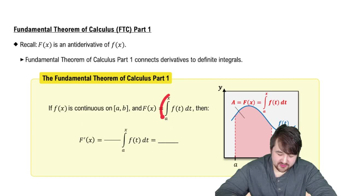
Fundamental Theorem of Calculus

The Fundamental Theorem of Calculus links the concept of differentiation and integration, stating that if a function is continuous on an interval, then the integral of its derivative over that interval equals the change in the function's values. This theorem is crucial for evaluating definite integrals and understanding the relationship between a function and its antiderivative.
추천 영상:
가이드 코스
06:11
Fundamental Theorem of Calculus Part 1

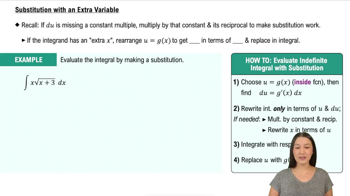
Integration by Substitution

Integration by substitution is a technique used to simplify the process of integration by changing the variable of integration. It involves substituting a part of the integrand with a new variable, which can make the integral easier to solve. This method is particularly useful when dealing with composite functions.
추천 영상:
04:27
Substitution With an Extra Variable

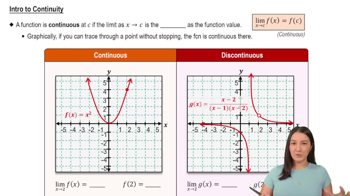
Continuous Functions

A function is continuous if it does not have any breaks, jumps, or holes in its graph. For the statements in the question, the continuity of the functions ƒ, ƒ', and ƒ'' ensures that the properties of limits and integrals apply, allowing for the application of the Fundamental Theorem of Calculus and ensuring that the results derived from these functions are valid.
추천 영상:
05:34
Intro to Continuity
관련 실천
교과서 질문

Displacement from a velocity graph Consider the velocity function for an object moving along a line (see figure).

(a) Describe the motion of the object over the interval [0,6].

76
views
교과서 질문

Explain why or why not Determine whether the following statements are true and give an explanation or counterexample.

(a) If ƒ is symmetric about the line 𝓍 = 2 , then ∫₀⁴ ƒ(𝓍) d𝓍 = 2 ∫₀² ƒ(𝓍) d𝓍.

64
views
교과서 질문

Explain why or why not Determine whether the following statements are true and give an explanation or counterexample.

(a) Consider the linear function ƒ(𝓍) = 2x + 5 and the region bounded by its graph and the x-axis on the interval [3,6]. Suppose the area of this region is approximated using midpoint Riemann sums. Then the approximations give the exact area of the region for any number of subintervals.

52
views
교과서 질문

Area functions for constant functions Consider the following functions ƒ and real numbers a (see figure).

(a) Find and graph the area function A(𝓍) = ∫ₐˣ ƒ(t) dt for ƒ.

ƒ(t) = 5 , a = 0

108
views
교과서 질문

Approximating displacement The velocity in ft/s of an object moving along a line is given by v = 3t² + 1 on the interval 0 ≤ t ≤ 4, where t is measured in seconds.

(a) Divide the interval [0,4] into n = 4 subintervals, [0,1] , [1.2] , [2,3] , and [3,4]. On each subinterval, assume the object moves at a constant velocity equal to v evaluated at the midpoint of the subinterval, and use these approximations to estimate the displacement of the object on [0, 4] (see part (a) of the figure)

71
views
교과서 질문

Working with area functions Consider the function ƒ and the points a, b, and c.

(a) Find the area function A (𝓍) = ∫ₐˣ ƒ(t) dt using the Fundamental Theorem.

ƒ(𝓍) = sin 𝓍 ; a = 0 , b = π/2 , c = π

51
views