
Ch. 6 - Applications of Integration
Briggs - Calculus: Early Transcendentals 3rd Edition
Briggs3rd EditionCalculus: Early TranscendentalsISBN: 9780136847243당신이 사용하는 게 아니라요?교과서 변경
6장, 문제 6.1.68b

Variable gravity At Earth’s surface, the acceleration due to gravity is approximately g=9.8 m/s² (with local variations). However, the acceleration decreases with distance from the surface according to Newton’s law of gravitation. At a distance of y meters from Earth’s surface, the acceleration is given by a(y) = - g / (1+y/R)², where R=6.4×10⁶ m is the radius of Earth.


b. Use the Chain Rule to show that dv/dt = 1/2 d/dy(v²).

검증된 단계별 안내
1
Recall that velocity \(v\) is a function of time \(t\), and position \(y\) is also a function of time \(t\). Therefore, \(v = \frac{dy}{dt}\) and \(v\) can be considered as \(v(y(t))\).
Start with the expression \(\frac{d}{dt}(v^2)\). Using the Chain Rule, this derivative can be written as \(\frac{d}{dt}(v^2) = \frac{d}{dy}(v^2) \cdot \frac{dy}{dt}\).
Since \(\frac{dy}{dt} = v\), substitute this into the expression to get \(\frac{d}{dt}(v^2) = \frac{d}{dy}(v^2) \cdot v\).
Now, solve for \(\frac{dv}{dt}\) by differentiating \(v^2 = (v)^2\) with respect to \(t\): \(\frac{d}{dt}(v^2) = 2v \frac{dv}{dt}\).
Equate the two expressions for \(\frac{d}{dt}(v^2)\): \(2v \frac{dv}{dt} = \frac{d}{dy}(v^2) \cdot v\). Divide both sides by \$2v$ (assuming \(v \neq 0\)) to isolate \(\frac{dv}{dt}\), yielding \(\frac{dv}{dt} = \frac{1}{2} \frac{d}{dy}(v^2)\).

비슷한 문제에 대한 검증된 영상 답변:

이 영상 해법은 위 문제에 도움이 된다고 튜터들이 추천한 것입니다.
영상 길이:
3m
도움이 되었나요?

주요 개념

질문에 올바르게 답하기 위해 반드시 이해해야 하는 핵심 개념들은 다음과 같습니다.

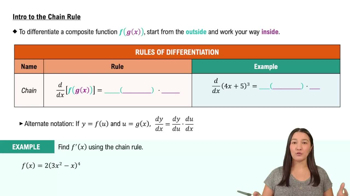
Chain Rule

The Chain Rule is a fundamental differentiation technique used to compute the derivative of a composite function. It states that if a variable depends on an intermediate variable, which in turn depends on another variable, the derivative is the product of the derivatives along the chain. In this problem, it helps relate derivatives with respect to time and position.
추천 영상:
05:02
Intro to the Chain Rule

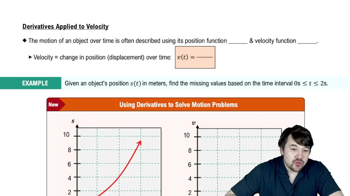
Relationship Between Velocity and Position

Velocity (v) is the rate of change of position (y) with respect to time (t), expressed as v = dy/dt. This relationship allows us to connect derivatives with respect to time and position, which is essential when applying the Chain Rule to rewrite dv/dt in terms of derivatives with respect to y.
추천 영상:
가이드 코스
06:29
Derivatives Applied To Velocity

Derivative of a Function Squared

When differentiating the square of a function, such as v², the power rule combined with the Chain Rule applies: d/dy(v²) = 2v dv/dy. Recognizing this helps transform expressions involving dv/dt into forms involving d/dy(v²), facilitating the proof requested in the question.
추천 영상:
06:30
Derivatives of Other Trig Functions
관련 실천
교과서 질문

6–8. Let R be the region bounded by the curves y = 2−√x,y=2, and x=4 in the first quadrant.

Suppose the shell method is used to determine the volume of the solid generated by revolving R about the line x=4.


b. What is the height of a cylindrical shell at a point x in [0, 4]?

88
views
교과서 질문

For the given regions R₁ and R₂, complete the following steps.


b. Find the area of region R₂ using geometry and the answer to part (a).


R₁is the region in the first quadrant bounded by the line x=1 and the curve y=6x(2−x^2)^2; R₂ is the region in the first quadrant bounded the curve y=6x(2−x^2)^2and the line y=6x.

40
views
교과서 질문

40–43. Population growth


Starting with an initial value of P(0)=55, the population of a prairie dog community grows at a rate of P′(t)=20−t/5 (prairie dogs/month), for 0≤t≤200, where t is measured in months.


b. Find the population P(t), for 0≤t≤200.

22
views
교과서 질문

Cycling distance A cyclist rides down a long straight road with a velocity (in m/min) given by v(t) = 400−20t, for 0≤t≤10, where t is measured in minutes.


b. How far does the cyclist travel in the first 10 min?

49
views
교과서 질문

Blood flow A typical human heart pumps 70 mL of blood (the stroke volume) with each beat. Assuming a heart rate of 60 beats/min (1 beat/s), a reasonable model for the outflow rate of the heart is V′(t)=70(1+sin 2πt), where V(t) is the amount of blood (in milliliters) pumped over the interval [0,t],V(0)=0 and t is measured in seconds.


b. Find the function that gives the total blood pumped between t=0 and a future time t>0.

30
views
교과서 질문

55–58. Marginal cost Consider the following marginal cost functions.


b. Find the additional cost incurred in dollars when production is increased from 500 units to 550 units.


C′(x) = 300+10x−0.01x²

50
views