
Ch. 8 - Integration Techniques
Briggs - Calculus: Early Transcendentals 3rd Edition
Briggs3rd EditionCalculus: Early TranscendentalsISBN: 9780136847243당신이 사용하는 게 아니라요?교과서 변경
8장, 문제 8.5.3c

3. What term(s) should appear in the partial fraction decomposition of a proper rational function with each of the following?
c. A factor of (x² + 2x + 6) in the denominator

검증된 단계별 안내
1
Identify that the factor given, \(x^2 + 2x + 6\), is an irreducible quadratic factor because its discriminant \(\Delta = b^2 - 4ac = 2^2 - 4 \cdot 1 \cdot 6 = 4 - 24 = -20 < 0\), which means it cannot be factored further over the real numbers.
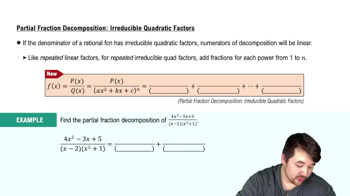
Recall that for an irreducible quadratic factor \(ax^2 + bx + c\) in the denominator, the corresponding term in the partial fraction decomposition has the form \(\frac{Ax + B}{ax^2 + bx + c}\), where \(A\) and \(B\) are constants to be determined.
If the factor \(x^2 + 2x + 6\) appears with multiplicity 1 (i.e., it is not repeated), then the partial fraction term is simply \(\frac{Ax + B}{x^2 + 2x + 6}\).
If the factor appears with multiplicity greater than 1, say \(n\), then the decomposition includes terms for each power from 1 up to \(n\): \(\frac{A_1x + B_1}{x^2 + 2x + 6} + \frac{A_2x + B_2}{(x^2 + 2x + 6)^2} + \cdots + \frac{A_nx + B_n}{(x^2 + 2x + 6)^n}\).
Summarize that the key point is that each irreducible quadratic factor in the denominator corresponds to a numerator that is a linear polynomial \(Ax + B\) over that quadratic factor in the partial fraction decomposition.

비슷한 문제에 대한 검증된 영상 답변:

이 영상 해법은 위 문제에 도움이 된다고 튜터들이 추천한 것입니다.
영상 길이:
2m
도움이 되었나요?

주요 개념

질문에 올바르게 답하기 위해 반드시 이해해야 하는 핵심 개념들은 다음과 같습니다.

Partial Fraction Decomposition

Partial fraction decomposition is a method used to express a proper rational function as a sum of simpler fractions whose denominators are factors of the original denominator. This technique simplifies integration and other operations by breaking complex fractions into manageable parts.
추천 영상:
10:07
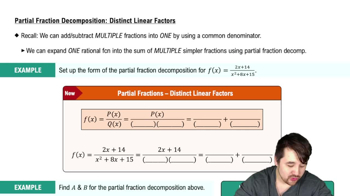
Partial Fraction Decomposition: Distinct Linear Factors

Irreducible Quadratic Factors

An irreducible quadratic factor is a quadratic polynomial that cannot be factored further over the real numbers. In partial fraction decomposition, such factors in the denominator correspond to terms with linear numerators, for example, (Ax + B)/(quadratic factor).
추천 영상:
13:42
Partial Fraction Decomposition: Irreducible Quadratic Factors

Proper Rational Function

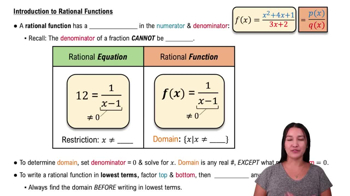
A proper rational function is a fraction where the degree of the numerator is less than the degree of the denominator. This condition ensures that partial fraction decomposition can be applied directly without polynomial division.
추천 영상:
6:04
Intro to Rational Functions
관련 실천
교과서 질문

45–48. {Use of Tech} Trapezoid Rule and Simpson’s Rule Consider the following integrals and the given values of n.

46. ∫(0 to 2) x⁴ dx; n = 30

c. Compute the absolute errors in the Trapezoid Rule and Simpson’s Rule with 2n subintervals.

68
views
교과서 질문

82. A family of exponentials The curves y = x * e^(-a * x) are shown in the figure for a = 1, 2, and 3.

c. Find the area of the region bounded by y = x * e^(-a * x) and the x-axis on the interval [0, b]. Because this area depends on a and b, we call it A(a, b).

73
views
교과서 질문

Gaussians An important function in statistics is the Gaussian (or normal distribution, or bell-shaped curve), f(x) = e^(-ax²).

c. Complete the square to evaluate ∫ from -∞ to ∞ of e^(-(ax² + bx + c)) dx, where a > 0, b, and c are real numbers.

78
views
교과서 질문

75. Exploring powers of sine and cosine

c. Prove that ∫₀ᵖⁱ sin²(nx) dx has the same value for all positive integers n.

89
views
교과서 질문

Prove the following orthogonality relations (which are used to generate Fourier series). Assume m and n are integers with m ≠ n.

c.

π

∫ sin(mx) cos(nx) dx = 0, when |m + n| is even

0

85
views
교과서 질문

94. [Use of Tech] Skydiving A skydiver has a downward velocity given by v(t) = V_T [(1 - e^(-2gt/V_T))/(1 + e^(-2gt/V_T))],

where t = 0 is the instant the skydiver starts falling, g = 9.8 m/s² is the acceleration due to gravity, and V_T is the terminal velocity of the skydiver.

c. Verify by integration that the position function is given by

s(t) = V_T t + (V_T²/g) ln[(1 + e^(-2gt/V_T))/2],

where s'(t) = v(t) and s(0) = 0.

59
views