

Ch. 8 - Integration Techniques
Briggs - Calculus: Early Transcendentals 3rd Edition
Briggs3rd EditionCalculus: Early TranscendentalsISBN: 9780136847243당신이 사용하는 게 아니라요?교과서 변경
8장, 문제 8.2.82c

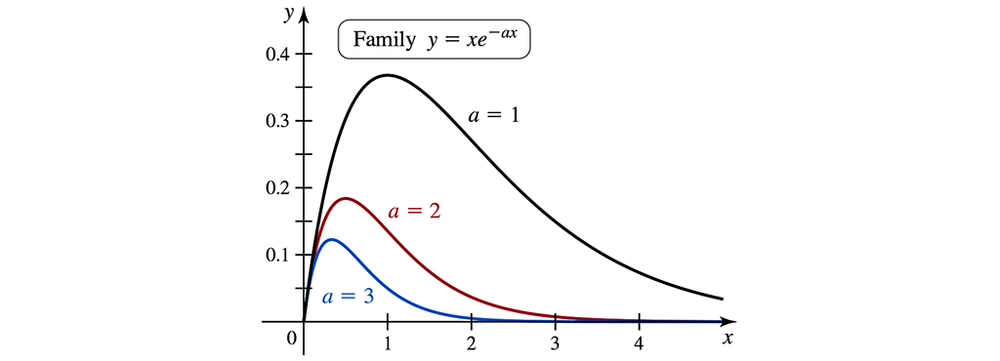
82. A family of exponentials The curves y = x * e^(-a * x) are shown in the figure for a = 1, 2, and 3.
c. Find the area of the region bounded by y = x * e^(-a * x) and the x-axis on the interval [0, b]. Because this area depends on a and b, we call it A(a, b).
Graph showing three curves of y = x * e^(-a * x) for a = 1, 2, and 3, all approaching the x-axis.

검증된 단계별 안내
1
Identify the function and the interval for the area calculation. The function is given by \(y = x e^{-a x}\), and the area \(A(a, b)\) is the integral of this function from \(0\) to \(b\).
Set up the definite integral to find the area under the curve and above the x-axis on the interval \([0, b]\): \(A(a, b) = \int_0^b x e^{-a x} \, dx\)
To solve the integral, use integration by parts. Let \(u = x\) and $dv = e^{-a x} dx$. Then, compute $du = dx$ and find \(v\) by integrating \(dv\): \(v = \int e^{-a x} dx = -\frac{1}{a} e^{-a x}\)
Apply the integration by parts formula: \(\int u \, dv = uv - \int v \, du\), which gives \(\int_0^b x e^{-a x} dx = \left. -\frac{x}{a} e^{-a x} \right|_0^b + \frac{1}{a} \int_0^b e^{-a x} dx\)
Evaluate the remaining integral \(\int_0^b e^{-a x} dx\) and then substitute the limits \(0\) and \(b\) into the expression to write \(A(a, b)\) explicitly in terms of \(a\) and \(b\).

비슷한 문제에 대한 검증된 영상 답변:

이 영상 해법은 위 문제에 도움이 된다고 튜터들이 추천한 것입니다.
영상 길이:
6m

주요 개념

질문에 올바르게 답하기 위해 반드시 이해해야 하는 핵심 개념들은 다음과 같습니다.

Definite Integral and Area Under a Curve

The definite integral of a function over an interval [0, b] represents the area under the curve between those points. For the function y = x * e^(-a * x), integrating from 0 to b calculates the area bounded by the curve and the x-axis, which depends on both parameters a and b.
추천 영상:
가이드 코스
05:43
Definition of the Definite Integral

Integration of Exponential Functions

Integrating functions involving exponentials like e^(-a * x) often requires techniques such as integration by parts. Since y = x * e^(-a * x) is a product of x and an exponential, applying integration by parts helps to find an explicit formula for the integral and thus the area A(a, b).
추천 영상:
05:11
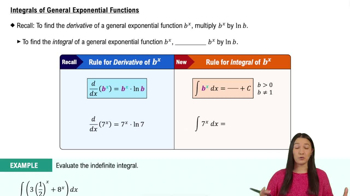
Integrals of General Exponential Functions

Parameter Dependence in Families of Functions

The parameter 'a' in y = x * e^(-a * x) affects the shape and decay rate of the curve. Understanding how the integral (area) changes with 'a' and the upper limit 'b' is crucial for analyzing the family of curves and how the bounded area varies with these parameters.
추천 영상:
05:59
Eliminating the Parameter
관련 실천
교과서 질문

Gaussians An important function in statistics is the Gaussian (or normal distribution, or bell-shaped curve), f(x) = e^(-ax²).

c. Complete the square to evaluate ∫ from -∞ to ∞ of e^(-(ax² + bx + c)) dx, where a > 0, b, and c are real numbers.

78
views
교과서 질문

45–48. {Use of Tech} Trapezoid Rule and Simpson’s Rule Consider the following integrals and the given values of n.

45. ∫(0 to 1) e^(2x) dx; n = 25

c. Compute the absolute errors in the Trapezoid Rule and Simpson’s Rule with 2n subintervals.

67
views
교과서 질문

75. Exploring powers of sine and cosine

c. Prove that ∫₀ᵖⁱ sin²(nx) dx has the same value for all positive integers n.

89
views
교과서 질문

Prove the following orthogonality relations (which are used to generate Fourier series). Assume m and n are integers with m ≠ n.

c.

π

∫ sin(mx) cos(nx) dx = 0, when |m + n| is even

0

85
views
교과서 질문

3. What term(s) should appear in the partial fraction decomposition of a proper rational function with each of the following?

c. A factor of (x² + 2x + 6) in the denominator

62
views
교과서 질문

94. [Use of Tech] Skydiving A skydiver has a downward velocity given by v(t) = V_T [(1 - e^(-2gt/V_T))/(1 + e^(-2gt/V_T))],

where t = 0 is the instant the skydiver starts falling, g = 9.8 m/s² is the acceleration due to gravity, and V_T is the terminal velocity of the skydiver.

c. Verify by integration that the position function is given by

s(t) = V_T t + (V_T²/g) ln[(1 + e^(-2gt/V_T))/2],

where s'(t) = v(t) and s(0) = 0.

59
views