

Ch. 8 - Integration Techniques
Briggs - Calculus: Early Transcendentals 3rd Edition
Briggs3rd EditionCalculus: Early TranscendentalsISBN: 9780136847243당신이 사용하는 게 아니라요?교과서 변경
8장, 문제 8.3.75c

75. Exploring powers of sine and cosine
c. Prove that ∫₀ᵖⁱ sin²(nx) dx has the same value for all positive integers n.

검증된 단계별 안내
1
Step 1: Begin by recalling the trigonometric identity for sine squared: sin²(x) = (1 - cos(2x))/2. This identity will simplify the integral.
Step 2: Substitute sin²(nx) in the integral with the identity: ∫₀ᵖⁱ sin²(nx) dx = ∫₀ᵖⁱ (1 - cos(2nx))/2 dx. Split the integral into two parts: ∫₀ᵖⁱ (1/2) dx - ∫₀ᵖⁱ (cos(2nx)/2) dx.
Step 3: Evaluate the first integral ∫₀ᵖⁱ (1/2) dx. Since this is a constant, the result is straightforward: (1/2) * x evaluated from 0 to π.
Step 4: For the second integral ∫₀ᵖⁱ (cos(2nx)/2) dx, recall that the integral of cosine over a full period (or multiples of π) is zero. Specifically, ∫₀ᵖⁱ cos(2nx) dx = 0 for any positive integer n.
Step 5: Combine the results from Step 3 and Step 4. The first integral contributes a constant value, while the second integral contributes zero. Therefore, the value of ∫₀ᵖⁱ sin²(nx) dx is independent of n and remains the same for all positive integers.

비슷한 문제에 대한 검증된 영상 답변:

이 영상 해법은 위 문제에 도움이 된다고 튜터들이 추천한 것입니다.
영상 길이:
3m
도움이 되었나요?

주요 개념

질문에 올바르게 답하기 위해 반드시 이해해야 하는 핵심 개념들은 다음과 같습니다.

Definite Integrals

A definite integral calculates the accumulation of a function's values over a specific interval, providing the net area under the curve. In this case, the integral ∫₀ᵖⁱ sin²(nx) dx evaluates the area under the sine squared function from 0 to π, which is crucial for proving the equality for different values of n.
추천 영상:
05:43
Definition of the Definite Integral

Trigonometric Identities

Trigonometric identities are equations involving trigonometric functions that hold true for all values of the variables. The identity sin²(x) = (1 - cos(2x))/2 is particularly useful in this context, as it simplifies the integral of sin²(nx) and allows for easier evaluation across different integer values of n.
추천 영상:
7:17
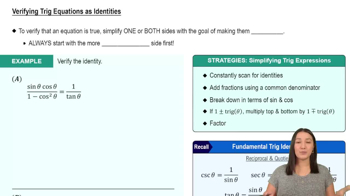
Verifying Trig Equations as Identities

Periodicity of Sine Function

The sine function is periodic, meaning it repeats its values in regular intervals. For sin²(nx), the period is π/n, which implies that as n changes, the function still retains a consistent average value over the interval [0, π]. This periodicity is key to demonstrating that the integral yields the same result for all positive integers n.
추천 영상:
5:53
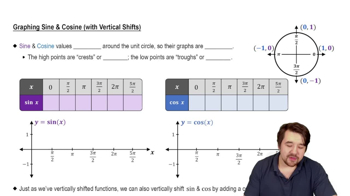
Graph of Sine and Cosine Function
관련 실천
교과서 질문

82. A family of exponentials The curves y = x * e^(-a * x) are shown in the figure for a = 1, 2, and 3.

c. Find the area of the region bounded by y = x * e^(-a * x) and the x-axis on the interval [0, b]. Because this area depends on a and b, we call it A(a, b).

73
views
교과서 질문

Gaussians An important function in statistics is the Gaussian (or normal distribution, or bell-shaped curve), f(x) = e^(-ax²).

c. Complete the square to evaluate ∫ from -∞ to ∞ of e^(-(ax² + bx + c)) dx, where a > 0, b, and c are real numbers.

78
views
교과서 질문

45–48. {Use of Tech} Trapezoid Rule and Simpson’s Rule Consider the following integrals and the given values of n.

45. ∫(0 to 1) e^(2x) dx; n = 25

c. Compute the absolute errors in the Trapezoid Rule and Simpson’s Rule with 2n subintervals.

67
views
교과서 질문

3. What term(s) should appear in the partial fraction decomposition of a proper rational function with each of the following?

c. A factor of (x² + 2x + 6) in the denominator

62
views
교과서 질문

60. Two Methods

c. Verify that your answers to parts (a) and (b) are consistent.

37
views
교과서 질문

94. [Use of Tech] Skydiving A skydiver has a downward velocity given by v(t) = V_T [(1 - e^(-2gt/V_T))/(1 + e^(-2gt/V_T))],

where t = 0 is the instant the skydiver starts falling, g = 9.8 m/s² is the acceleration due to gravity, and V_T is the terminal velocity of the skydiver.

c. Verify by integration that the position function is given by

s(t) = V_T t + (V_T²/g) ln[(1 + e^(-2gt/V_T))/2],

where s'(t) = v(t) and s(0) = 0.

59
views