
Ch. 8 - Integration Techniques
Briggs - Calculus: Early Transcendentals 3rd Edition
Briggs3rd EditionCalculus: Early TranscendentalsISBN: 9780136847243당신이 사용하는 게 아니라요?교과서 변경
8장, 문제 8.8.45c

45–48. {Use of Tech} Trapezoid Rule and Simpson’s Rule Consider the following integrals and the given values of n.
45. ∫(0 to 1) e^(2x) dx; n = 25
c. Compute the absolute errors in the Trapezoid Rule and Simpson’s Rule with 2n subintervals.

검증된 단계별 안내
1
Step 1: Understand the problem. You are tasked with computing the absolute errors in the Trapezoid Rule and Simpson’s Rule for the integral ∫(0 to 1) e^(2x) dx, using 2n subintervals where n = 25. This means you will use 50 subintervals for both methods.
Step 2: Recall the formulas for the Trapezoid Rule and Simpson’s Rule. The Trapezoid Rule approximates the integral as a sum of trapezoidal areas, while Simpson’s Rule uses parabolic segments for approximation. Both methods depend on the number of subintervals and the function values at specific points.
Step 3: Compute the exact value of the integral ∫(0 to 1) e^(2x) dx analytically. Use the formula for integration of exponential functions: ∫e^(kx) dx = (1/k)e^(kx) + C. For this integral, the exact value is [(1/2)e^(2x)] evaluated from 0 to 1.
Step 4: Apply the Trapezoid Rule and Simpson’s Rule with 50 subintervals. For the Trapezoid Rule, calculate the step size h = (b - a)/n = (1 - 0)/50 = 1/50. Then, compute the approximation using the formula: T ≈ h/2 [f(x_0) + 2Σf(x_i) + f(x_n)], where x_i are the subinterval points. For Simpson’s Rule, use the formula: S ≈ h/3 [f(x_0) + 4Σf(x_odd) + 2Σf(x_even) + f(x_n)].
Step 5: Compute the absolute errors for both methods. The absolute error is defined as |Exact Value - Approximation|. Subtract the numerical results obtained from the Trapezoid Rule and Simpson’s Rule from the exact value of the integral to find the absolute errors.

비슷한 문제에 대한 검증된 영상 답변:

이 영상 해법은 위 문제에 도움이 된다고 튜터들이 추천한 것입니다.
영상 길이:
4m
도움이 되었나요?

주요 개념

질문에 올바르게 답하기 위해 반드시 이해해야 하는 핵심 개념들은 다음과 같습니다.

Trapezoid Rule

The Trapezoid Rule is a numerical method for approximating the definite integral of a function. It works by dividing the area under the curve into trapezoids rather than rectangles, providing a better approximation. The formula involves calculating the average of the function values at the endpoints of each subinterval and multiplying by the width of the subintervals. This method is particularly useful when an analytical solution is difficult to obtain.
추천 영상:

Simpson’s Rule

Simpson’s Rule is another numerical integration technique that provides a more accurate approximation than the Trapezoid Rule by using parabolic segments instead of straight lines. It requires an even number of subintervals and combines the function values at the endpoints and midpoints of the intervals. The formula is derived from the idea of fitting a quadratic polynomial to the function over each pair of subintervals, which enhances the accuracy of the approximation for smooth functions.
추천 영상:

Absolute Error

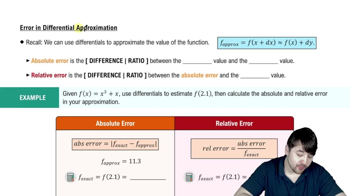
Absolute error measures the difference between the exact value of an integral and the approximate value obtained using numerical methods like the Trapezoid Rule or Simpson’s Rule. It is calculated as the absolute value of the exact integral minus the approximate integral. Understanding absolute error is crucial for assessing the accuracy of numerical methods and determining how well they approximate the true value, especially as the number of subintervals increases.
추천 영상:
04:57
Determining Error and Relative Error