Ch. 8 - Integration Techniques
Briggs - Calculus: Early Transcendentals 3rd Edition
Briggs3rd EditionCalculus: Early TranscendentalsISBN: 9780136847243당신이 사용하는 게 아니라요?교과서 변경
8장, 문제 8.1.7

7–64. Integration review Evaluate the following integrals.
7. ∫ dx / (3 - 5x)^4

검증된 단계별 안내
1
Recognize that the integral ∫ dx / (3 - 5x)^4 involves a rational function with a power of a linear term in the denominator. This suggests using a substitution to simplify the integral.
Let u = 3 - 5x. Then, compute the derivative of u with respect to x: du/dx = -5, or equivalently, dx = -du/5.
Substitute u and dx into the integral. The integral becomes ∫ (-1/5) du / u^4, where the factor -1/5 comes from the substitution for dx.
Simplify the integral to ∫ -1/5 * u^(-4) du. Rewrite the integrand as -1/5 * u^(-4) to prepare for applying the power rule of integration.
Apply the power rule for integration: ∫ u^n du = u^(n+1) / (n+1), for n ≠ -1. Here, n = -4, so the integral becomes (-1/5) * (u^(-4+1) / (-4+1)). Simplify the expression and substitute back u = 3 - 5x to return to the original variable.

비슷한 문제에 대한 검증된 영상 답변:

이 영상 해법은 위 문제에 도움이 된다고 튜터들이 추천한 것입니다.
영상 길이:
4m
도움이 되었나요?

주요 개념

질문에 올바르게 답하기 위해 반드시 이해해야 하는 핵심 개념들은 다음과 같습니다.

Integration Techniques

Integration techniques are methods used to find the integral of a function. Common techniques include substitution, integration by parts, and partial fractions. In this case, substitution is particularly useful for simplifying the integral of a rational function, allowing for easier evaluation.
추천 영상:
06:18
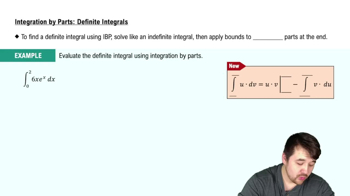
Integration by Parts for Definite Integrals

Substitution Method

The substitution method involves replacing a variable in the integral with another variable to simplify the expression. For the integral ∫ dx / (3 - 5x)^4, we can let u = 3 - 5x, which transforms the integral into a more manageable form. This method is essential for integrals involving composite functions.
추천 영상:
07:33
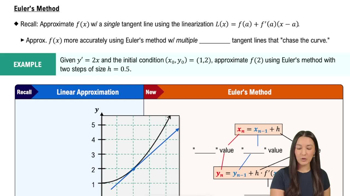
Euler's Method

Power Rule for Integration

The power rule for integration states that ∫ x^n dx = (x^(n+1))/(n+1) + C, where n ≠ -1. This rule is applicable when integrating functions of the form u^n, where u is a function of x. In the given integral, after substitution, applying the power rule will help in finding the antiderivative of the transformed function.
추천 영상:
04:04
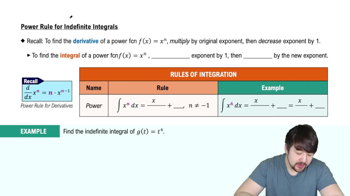
Power Rule for Indefinite Integrals