Ch. 9 - Differential Equations
Briggs - Calculus: Early Transcendentals 3rd Edition
Briggs3rd EditionCalculus: Early TranscendentalsISBN: 9780136847243당신이 사용하는 게 아니라요?교과서 변경
9장, 문제 9.1.12

7–16. Verifying general solutions Verify that the given function is a solution of the differential equation that follows it. Assume C, C1, C2 and C3 are arbitrary constants.
u(t) = C₁eᵗ + C₂teᵗ; u''(t) - 2u'(t) + u(t) = 0

검증된 단계별 안내
1
Identify the given function: \(u(t) = C_1 e^t + C_2 t e^t\), where \(C_1\) and \(C_2\) are arbitrary constants.
Compute the first derivative \(u'(t)\) using the product rule for the term \(C_2 t e^t\): \(u'(t) = \frac{d}{dt}(C_1 e^t) + \frac{d}{dt}(C_2 t e^t) = C_1 e^t + C_2 \left( e^t + t e^t \right)\).
Simplify the first derivative: \(u'(t) = C_1 e^t + C_2 e^t + C_2 t e^t = (C_1 + C_2) e^t + C_2 t e^t\).
Compute the second derivative \(u''(t)\) by differentiating \(u'(t)\) again, applying the product rule to the \(C_2 t e^t\) term: \(u''(t) = \frac{d}{dt} \left( (C_1 + C_2) e^t + C_2 t e^t \right) = (C_1 + C_2) e^t + C_2 \left( e^t + t e^t \right)\).
Substitute \(u(t)\), \(u'(t)\), and \(u''(t)\) into the differential equation \(u''(t) - 2 u'(t) + u(t) = 0\) and simplify the expression. If the left-hand side simplifies to zero for all \(t\), then \(u(t)\) is a solution to the differential equation.

비슷한 문제에 대한 검증된 영상 답변:

이 영상 해법은 위 문제에 도움이 된다고 튜터들이 추천한 것입니다.
영상 길이:
11m
도움이 되었나요?

주요 개념

질문에 올바르게 답하기 위해 반드시 이해해야 하는 핵심 개념들은 다음과 같습니다.

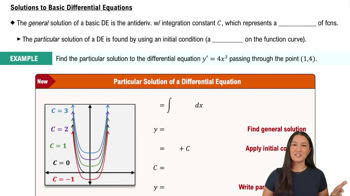
General Solution of a Differential Equation

The general solution of a differential equation includes all possible solutions and typically contains arbitrary constants. It represents the complete set of functions that satisfy the equation, allowing for initial conditions to specify a unique solution.
추천 영상:
04:00
Solutions to Basic Differential Equations

Verification by Substitution

To verify a solution, substitute the given function and its derivatives into the differential equation. If the equation holds true for all values in the domain, the function is a valid solution.
추천 영상:
04:27
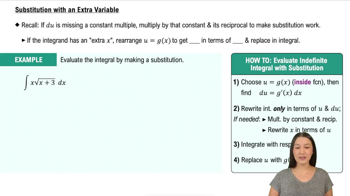
Substitution With an Extra Variable

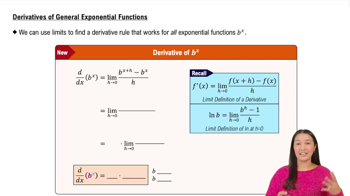
Derivatives of Exponential Functions

Understanding how to compute derivatives of functions involving exponentials and products, such as te^t, is essential. Use the product rule for derivatives when differentiating terms like C₂teᵗ.
추천 영상:
04:50
Derivatives of General Exponential Functions
관련 실천
교과서 질문

17–32. Solving initial value problems Determine whether the following equations are separable. If so, solve the initial value problem.

y'(t) = y³sin t, y(0) = 1

59
views

교과서 질문

Explain how the growth rate function determines the solution of a population model.

40
views
교과서 질문

The general solution of a first-order linear differential equation is y(t) = Ce⁻¹⁰ᵗ − 13. What solution satisfies the initial condition y(0) = 4?

84
views
교과서 질문

9–14. Growth rate functions Make a sketch of the population function P (as a function of time) that results from the following growth rate functions. Assume the population at time t = 0 begins at some positive value.


39
views
교과서 질문

45–48. General first-order linear equations Consider the general first-order linear equation y'(t)+a(t)y(t)=f(t). This equation can be solved, in principle, by defining the integrating factor p(t)=exp(∫a(t)dt). Here is how the integrating factor works. Multiply both sides of the equation by p (which is always positive) and show that the left side becomes an exact derivative. Therefore, the equation becomes


p(t)(y′(t) + a(t)y(t)) = d/dt(p(t)y(t)) = p(t)f(t).


Now integrate both sides of the equation with respect to t to obtain the solution. Use this method to solve the following initial value problems. Begin by computing the required integrating factor.


y′(t) + (2t)/(t² + 1)y(t) = 1 + 3t², y(1) = 4

75
views
교과서 질문

21–32. Finding general solutions Find the general solution of each differential equation. Use C,C1,C2... to denote arbitrary constants.

y'(t) = t lnt + 1

38
views