Ch. 9 - Differential Equations
Briggs - Calculus: Early Transcendentals 3rd Edition
Briggs3rd EditionCalculus: Early TranscendentalsISBN: 9780136847243당신이 사용하는 게 아니라요?교과서 변경
9장, 문제 9.5.9

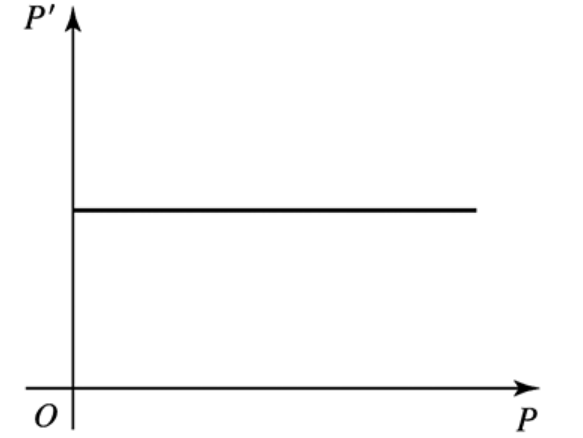
9–14. Growth rate functions Make a sketch of the population function P (as a function of time) that results from the following growth rate functions. Assume the population at time t = 0 begins at some positive value.


<IMAGE>

검증된 단계별 안내
1
Step 1: Understand the graph provided. The graph shows the growth rate function \(P'\) plotted against the population \(P\). Here, \(P'\) is constant and positive, meaning the rate of change of the population does not depend on the population size and remains steady over time.
Step 2: Translate the constant positive growth rate into a differential equation. Since \(P'\) is constant, we can write \(\displaystyle \frac{dP}{dt} = k\), where \(k\) is a positive constant representing the constant growth rate.
Step 3: Solve the differential equation. Integrate both sides with respect to \(t\) to find \(P(t)\): \(\displaystyle P(t) = kt + C\), where \(C\) is the initial population at time \(t=0\).
Step 4: Interpret the solution. The population function \(P(t)\) is a linear function of time with a positive slope \(k\), indicating the population increases steadily and linearly over time.
Step 5: Sketch the population function \(P(t)\). Start at the initial population \(C\) on the vertical axis at \(t=0\) and draw a straight line with positive slope \(k\) extending to the right, showing continuous linear growth.

비슷한 문제에 대한 검증된 영상 답변:

이 영상 해법은 위 문제에 도움이 된다고 튜터들이 추천한 것입니다.
영상 길이:
4m
도움이 되었나요?

주요 개념

질문에 올바르게 답하기 위해 반드시 이해해야 하는 핵심 개념들은 다음과 같습니다.

Population Growth Rate Function

The growth rate function P' represents the rate of change of the population P with respect to time. Understanding how P' behaves (constant, increasing, or decreasing) helps determine the shape of the population function P(t). For example, a constant positive P' means the population grows linearly over time.
추천 영상:
04:16
Intro To Related Rates

Relationship Between Derivative and Function Shape

The derivative P' indicates the slope of the population function P at any point. If P' is constant and positive, P increases linearly. If P' is zero, P is constant. If P' is negative, P decreases. This relationship allows us to sketch P based on the graph of P'.
추천 영상:
06:30
Derivatives of Other Trig Functions

Initial Conditions in Differential Equations

The initial population value at time t=0 sets the starting point for the population function P(t). Given P(0) > 0 and a known growth rate P', we can integrate P' to find P(t) and sketch its behavior over time, ensuring the graph reflects the initial population.
추천 영상:
04:00
Solutions to Basic Differential Equations
관련 실천
교과서 질문

Explain how the growth rate function determines the solution of a population model.

40
views

교과서 질문

7–16. Verifying general solutions Verify that the given function is a solution of the differential equation that follows it. Assume C, C1, C2 and C3 are arbitrary constants.

u(t) = C₁eᵗ + C₂teᵗ; u''(t) - 2u'(t) + u(t) = 0

41
views
교과서 질문

The general solution of a first-order linear differential equation is y(t) = Ce⁻¹⁰ᵗ − 13. What solution satisfies the initial condition y(0) = 4?

84
views
교과서 질문

9–14. Growth rate functions Make a sketch of the population function P (as a function of time) that results from the following growth rate functions. Assume the population at time t = 0 begins at some positive value.


22
views
교과서 질문

33–42. Solving initial value problems Solve the following initial value problems.

y''(t) = teᵗ, y(0) = 0, y'(0) = 1

69
views
교과서 질문

45–48. General first-order linear equations Consider the general first-order linear equation y'(t)+a(t)y(t)=f(t). This equation can be solved, in principle, by defining the integrating factor p(t)=exp(∫a(t)dt). Here is how the integrating factor works. Multiply both sides of the equation by p (which is always positive) and show that the left side becomes an exact derivative. Therefore, the equation becomes


p(t)(y′(t) + a(t)y(t)) = d/dt(p(t)y(t)) = p(t)f(t).


Now integrate both sides of the equation with respect to t to obtain the solution. Use this method to solve the following initial value problems. Begin by computing the required integrating factor.


y′(t) + (2t)/(t² + 1)y(t) = 1 + 3t², y(1) = 4

75
views