
Ch. 9 - Differential Equations
Briggs - Calculus: Early Transcendentals 3rd Edition
Briggs3rd EditionCalculus: Early TranscendentalsISBN: 9780136847243당신이 사용하는 게 아니라요?교과서 변경
9장, 문제 9.R.33b

A second-order equation Consider the equation


t² y′′(t) + 2ty′(t) − 12y(t) = 0


b. Assuming the general solution of the equation is


y(t) = C₁ tᵖ¹ + C₂ tᵖ²,


find the solution that satisfies the conditions


y(1) = 0, y′(1) = 7

검증된 단계별 안내
1
Rewrite the given differential equation: \(t^{2} y''(t) + 2t y'(t) - 12 y(t) = 0\). This is a Cauchy-Euler (or equidimensional) equation, which suggests trying a solution of the form \(y(t) = t^{p}\).
Substitute \(y(t) = t^{p}\) into the differential equation. Compute the derivatives: \(y'(t) = p t^{p-1}\) and \(y''(t) = p (p-1) t^{p-2}\). Substitute these into the equation to get an algebraic equation in terms of \(p\).
After substitution, the equation becomes \(t^{2} imes p (p-1) t^{p-2} + 2t imes p t^{p-1} - 12 t^{p} = 0\). Simplify powers of \(t\) to get \(p (p-1) t^{p} + 2 p t^{p} - 12 t^{p} = 0\), which simplifies to \((p^{2} + p - 12) t^{p} = 0\).
Since \(t^{p} eq 0\) for \(t > 0\), set the characteristic equation \(p^{2} + p - 12 = 0\). Solve this quadratic equation to find the roots \(p_1\) and \(p_2\).
Write the general solution as \(y(t) = C_1 t^{p_1} + C_2 t^{p_2}\). Use the initial conditions \(y(1) = 0\) and \(y'(1) = 7\) to form a system of equations in \(C_1\) and \(C_2\). Compute \(y'(t)\), substitute \(t=1\), and solve the system to find \(C_1\) and \(C_2\).

비슷한 문제에 대한 검증된 영상 답변:

이 영상 해법은 위 문제에 도움이 된다고 튜터들이 추천한 것입니다.
영상 길이:
5m
도움이 되었나요?

주요 개념

질문에 올바르게 답하기 위해 반드시 이해해야 하는 핵심 개념들은 다음과 같습니다.

Second-Order Linear Differential Equations

These are differential equations involving the second derivative of a function. The given equation is linear and homogeneous, meaning it can be solved by finding characteristic solutions that satisfy the equation. Understanding the structure helps in applying appropriate solution methods.
추천 영상:
07:39
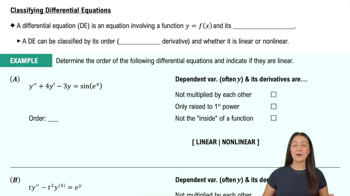
Classifying Differential Equations

Characteristic Equation and Power Solutions

For equations of the form t²y'' + 2ty' - 12y = 0, solutions often take the form y = t^p. Substituting this form leads to a characteristic equation in terms of p, whose roots determine the general solution. This method transforms the differential equation into an algebraic problem.
추천 영상:
04:00
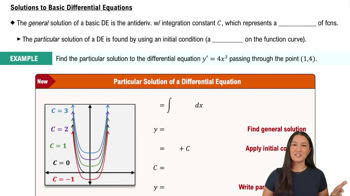
Solutions to Basic Differential Equations

Initial Conditions and Solving for Constants

Initial conditions like y(1) = 0 and y'(1) = 7 allow us to find the specific constants C₁ and C₂ in the general solution. By substituting t = 1 into y(t) and y'(t), we create a system of equations to solve for these constants, yielding the particular solution.
추천 영상:
가이드 코스
05:03
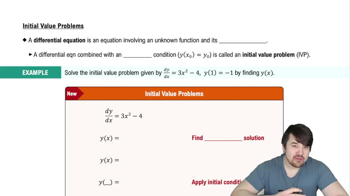
Initial Value Problems