
Ch. 9 - Differential Equations
Briggs - Calculus: Early Transcendentals 3rd Edition
Briggs3rd EditionCalculus: Early TranscendentalsISBN: 9780136847243당신이 사용하는 게 아니라요?교과서 변경
9장, 문제 9.R.23

22–25. Equilibrium solutions Find the equilibrium solutions of the following equations and determine whether each solution is stable or unstable.
y′(t) = y(3+y)(y-5)

검증된 단계별 안내
1
Identify the equilibrium solutions by setting the derivative equal to zero: solve the equation \(y'(t) = y(3 + y)(y - 5) = 0\) for \(y\).
Find the values of \(y\) that satisfy \(y = 0\), \(3 + y = 0\), and \(y - 5 = 0\). These will give the equilibrium points.
Determine the stability of each equilibrium by analyzing the sign of \(y'(t)\) around each equilibrium point. This can be done by choosing test values slightly less and greater than each equilibrium and evaluating the sign of \(y'(t)\).
Alternatively, compute the derivative of the right-hand side function \(f(y) = y(3 + y)(y - 5)\) with respect to \(y\), denoted \(f'(y)\), and evaluate it at each equilibrium point. The sign of \(f'(y)\) at the equilibrium indicates stability: if \(f'(y) < 0\), the equilibrium is stable; if \(f'(y) > 0\), it is unstable.
Summarize the equilibrium points along with their stability classification based on the sign analysis or derivative test.

비슷한 문제에 대한 검증된 영상 답변:

이 영상 해법은 위 문제에 도움이 된다고 튜터들이 추천한 것입니다.
영상 길이:
4m
도움이 되었나요?

주요 개념

질문에 올바르게 답하기 위해 반드시 이해해야 하는 핵심 개념들은 다음과 같습니다.

Equilibrium Solutions

Equilibrium solutions are constant solutions to a differential equation where the derivative equals zero. For y′(t) = f(y), these occur at values of y where f(y) = 0. They represent points where the system remains steady over time.
추천 영상:
04:00
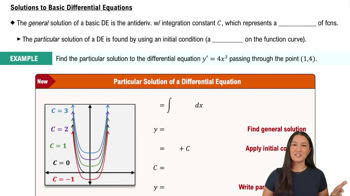
Solutions to Basic Differential Equations

Stability of Equilibrium Solutions

Stability refers to whether solutions near an equilibrium point move towards or away from it over time. If small perturbations decay and solutions return to equilibrium, it is stable; if they grow away, it is unstable. This is often analyzed using the sign of the derivative of f(y) at the equilibrium.
추천 영상:
04:00
Solutions to Basic Differential Equations

Sign Analysis of the Derivative Function

To determine stability, analyze the sign of f(y) = y(3+y)(y-5) around equilibrium points. By checking intervals between roots, you can see if solutions increase or decrease, indicating whether the equilibrium attracts or repels nearby solutions.
추천 영상:
06:30
Derivatives of Other Trig Functions