Ch. 9 - Differential Equations
Briggs - Calculus: Early Transcendentals 3rd Edition
Briggs3rd EditionCalculus: Early TranscendentalsISBN: 9780136847243당신이 사용하는 게 아니라요?교과서 변경
9장, 문제 9.R.27c

Logistic growth parameters A cell culture has a population of 20 when a nutrient solution is added at t=0. After 20 hours, the cell population is 80 and the carrying capacity of the culture is estimated to be 1600 cells.
c. After how many hours does the population reach half of the carrying capacity

검증된 단계별 안내
1
Identify the logistic growth model formula: \(P(t) = \frac{K}{1 + Ae^{-rt}}\), where \(P(t)\) is the population at time \(t\), \(K\) is the carrying capacity, \(A\) and \(r\) are parameters to be determined.
Use the initial condition at \(t=0\) where \(P(0) = 20\) to find \(A\). Substitute \(t=0\) and \(P(0)=20\) into the formula: \(20 = \frac{1600}{1 + A}\), then solve for \(A\).
Use the population at \(t=20\) hours, \(P(20) = 80\), to find the growth rate \(r\). Substitute \(t=20\), \(P(20)=80\), \(K=1600\), and the previously found \(A\) into the logistic equation and solve for \(r\).
Set \(P(t)\) equal to half the carrying capacity, which is \(\frac{1600}{2} = 800\), and write the equation: \(800 = \frac{1600}{1 + Ae^{-rt}}\).
Solve the equation from step 4 for \(t\) to find the time when the population reaches half the carrying capacity.

비슷한 문제에 대한 검증된 영상 답변:

이 영상 해법은 위 문제에 도움이 된다고 튜터들이 추천한 것입니다.
영상 길이:
7m
도움이 되었나요?

주요 개념

질문에 올바르게 답하기 위해 반드시 이해해야 하는 핵심 개념들은 다음과 같습니다.

Logistic Growth Model

The logistic growth model describes how a population grows rapidly at first and then slows as it approaches a maximum limit called the carrying capacity. It is often expressed by the equation P(t) = K / (1 + Ae^(-rt)), where P(t) is the population at time t, K is the carrying capacity, r is the growth rate, and A is a constant related to initial conditions.
추천 영상:
09:29
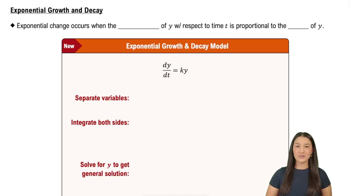
Exponential Growth & Decay

Carrying Capacity

Carrying capacity is the maximum population size that an environment can sustain indefinitely given the available resources. In logistic growth, it acts as an upper bound, causing the growth rate to decrease as the population nears this limit, preventing unlimited exponential growth.
추천 영상:
07:39
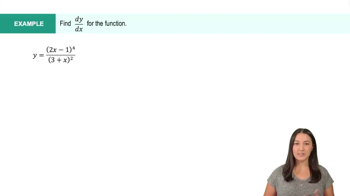
Intro to the Chain Rule Example 2

Solving for Time in Logistic Growth

To find the time when the population reaches a specific value, such as half the carrying capacity, you substitute that population value into the logistic growth equation and solve for t. This typically involves algebraic manipulation and taking natural logarithms to isolate the time variable.
추천 영상:
09:29
Exponential Growth & Decay