Ch.12 - Parametric and Polar Curves
Briggs - Calculus: Early Transcendentals 3rd Edition
Briggs3rd EditionCalculus: Early TranscendentalsISBN: 9780136847243당신이 사용하는 게 아니라요?교과서 변경
12장, 문제 12.1.49

37–52. Curves to parametric equations Find parametric equations for the following curves. Include an interval for the parameter values. Answers are not unique.


The line that passes through the points P(1, 1) and Q(3, 5), oriented in the direction of increasing x

검증된 단계별 안내
1
Identify the two given points: P(1, 1) and Q(3, 5). These points lie on the line we want to parametrize.
Calculate the direction vector \( \vec{d} \) of the line by subtracting the coordinates of P from Q: \( \vec{d} = (3 - 1, 5 - 1) = (2, 4) \). This vector points in the direction of increasing x.
Set up the parametric equations using point P as the initial point and \( t \) as the parameter: \( x(t) = 1 + 2t \) and \( y(t) = 1 + 4t \). Here, \( t \) represents how far along the line you move from point P.
Determine the interval for \( t \) based on the problem context. Since the line extends infinitely in both directions, \( t \) can be any real number, but to keep the orientation in the direction of increasing x, \( t \) should be chosen such that \( x(t) \) increases as \( t \) increases, so \( t \in \mathbb{R} \).
Summarize the parametric form: \( x(t) = 1 + 2t \), \( y(t) = 1 + 4t \), with \( t \in (-\infty, \infty) \). This fully describes the line passing through P and Q oriented in the direction of increasing x.

비슷한 문제에 대한 검증된 영상 답변:

이 영상 해법은 위 문제에 도움이 된다고 튜터들이 추천한 것입니다.
영상 길이:
3m
도움이 되었나요?

주요 개념

질문에 올바르게 답하기 위해 반드시 이해해야 하는 핵심 개념들은 다음과 같습니다.

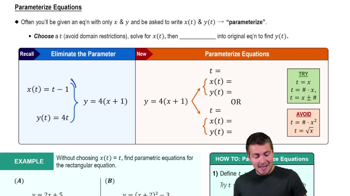
Parametric Equations of a Line

Parametric equations express the coordinates of points on a curve as functions of a parameter, often denoted t. For a line through two points, the equations are derived by setting x and y as linear functions of t, representing movement from one point to another.
추천 영상:
가이드 코스
08:02
Parameterizing Equations

Vector Form and Direction of a Line

The direction vector of a line is found by subtracting the coordinates of the initial point from the terminal point. This vector determines the line's orientation, and the parameter t scales this vector to generate all points along the line.
추천 영상:
05:14
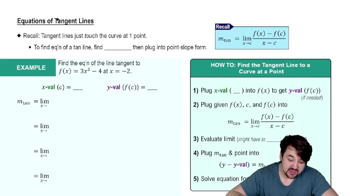
Equations of Tangent Lines

Parameter Interval and Orientation

The parameter interval defines the range of t values for which the parametric equations are valid. Choosing an interval consistent with the direction of increasing x ensures the line is oriented correctly, reflecting the problem's requirement.
추천 영상:
가이드 코스
05:59
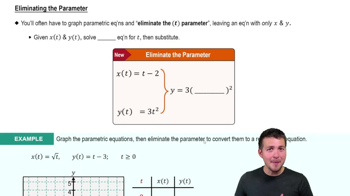
Eliminating the Parameter