Ch.12 - Parametric and Polar Curves
Briggs - Calculus: Early Transcendentals 3rd Edition
Briggs3rd EditionCalculus: Early TranscendentalsISBN: 9780136847243당신이 사용하는 게 아니라요?교과서 변경
12장, 문제 12.1.54

53–56. Circular motion Find parametric equations that describe the circular path of the following objects. For Exercises 53–55, assume (x, y) denotes the position of the object relative to the origin at the center of the circle. Use the units of time specified in the problem. There are many ways to describe any circle.


The tip of the 15-inch second hand of a clock completes one revolution in 60 seconds.

검증된 단계별 안내
1
Identify the radius of the circular path, which is the length of the second hand. Here, the radius \(r\) is 15 inches.
Determine the angular velocity \(\omega\) of the second hand. Since it completes one full revolution (which is \(2\pi\) radians) in 60 seconds, calculate \(\omega\) as \(\omega = \frac{2\pi}{60}\) radians per second.
Set up the parametric equations for the circular motion. The general form for a circle centered at the origin is \(x(t) = r \cos(\omega t)\) and \(y(t) = r \sin(\omega t)\), where \(t\) is time in seconds.
Substitute the known values of \(r\) and \(\omega\) into the parametric equations to express \(x(t)\) and \(y(t)\) explicitly in terms of \(t\).
Interpret the parametric equations: as \(t\) increases from 0 to 60, the point \((x(t), y(t))\) traces the circular path of the second hand exactly once.

비슷한 문제에 대한 검증된 영상 답변:

이 영상 해법은 위 문제에 도움이 된다고 튜터들이 추천한 것입니다.
영상 길이:
3m
도움이 되었나요?

주요 개념

질문에 올바르게 답하기 위해 반드시 이해해야 하는 핵심 개념들은 다음과 같습니다.

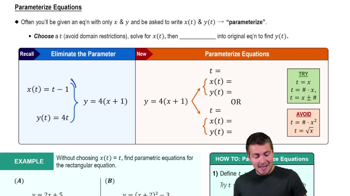
Parametric Equations for Circular Motion

Parametric equations express the coordinates of a point on a circle as functions of time, typically using sine and cosine functions. For a circle centered at the origin with radius r, the position (x, y) can be described as x = r cos(θ(t)) and y = r sin(θ(t)), where θ(t) is the angle as a function of time.
추천 영상:
가이드 코스
08:02
Parameterizing Equations

Angular Velocity and Period

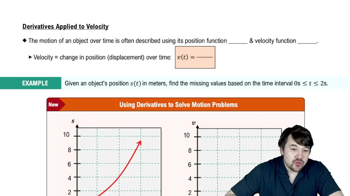
Angular velocity (ω) measures how fast an object rotates, defined as the angle covered per unit time. It relates to the period (T), the time for one full revolution, by ω = 2π / T. For the clock's second hand, completing one revolution in 60 seconds means ω = 2π / 60 radians per second.
추천 영상:
06:29
Derivatives Applied To Velocity

Relationship Between Linear and Angular Quantities

The linear position on the circle depends on the radius and the angular position. The radius is the length from the center to the point (here, 15 inches), and the angular position changes over time according to angular velocity. This relationship allows converting rotational motion into x and y coordinates.
추천 영상:
07:17
Linearization
관련 실천
교과서 질문

11–20. Slopes of tangent lines Find the slope of the line tangent to the following polar curves at the given points.


r = 4 cos 2θ; at the tips of the leaves

68
views

교과서 질문

13–30. Graphing conic sections Determine whether the following equations describe a parabola, an ellipse, or a hyperbola, and then sketch a graph of the curve. For each parabola, specify the location of the focus and the equation of the directrix; for each ellipse, label the coordinates of the vertices and foci, and find the lengths of the major and minor axes; for each hyperbola, label the coordinates of the vertices and foci, and find the equations of the asymptotes.


4x = -y²

89
views
교과서 질문

Circles in general Show that the polar equation

r² - 2r r₀ cos(θ - θ₀) = R² - r₀²

describes a circle of radius R whose center has polar coordinates (r₀, θ₀)

76
views
교과서 질문

90–94. Focal chords A focal chord of a conic section is a line through a focus joining two points of the curve. The latus rectum is the focal chord perpendicular to the major axis of the conic. Prove the following properties.

The length of the latus rectum of the parabola y ² =4px or x ² =4py is 4|p|.

119
views
교과서 질문

37–52. Curves to parametric equations Find parametric equations for the following curves. Include an interval for the parameter values. Answers are not unique.


The line that passes through the points P(1, 1) and Q(3, 5), oriented in the direction of increasing x

42
views
교과서 질문

81–88. Arc length Find the arc length of the following curves on the given interval.


x = eᵗ sin t, y = eᵗ cos t; 0 ≤ t ≤ 2π

61
views