
교과서 질문
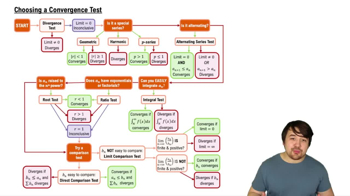
Use the Integral Test to show that the series
∑ (from n=0 to ∞) e^(−n²)
converges.

 검증된 단계별 안내
 07:15
07:15
 07:51
07:51 06:13
06:13Use the Integral Test to show that the series
∑ (from n=0 to ∞) e^(−n²)
converges.
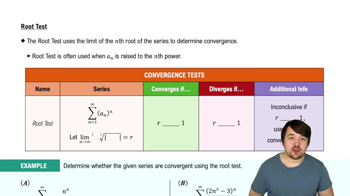
Using the Root Test
In Exercises 9–16, use the Root Test to determine if each series converges absolutely or diverges.
∑(from n=1 to ∞) [(-1)ⁿ (1 − 1/n)ⁿ^²]
(Hint: lim (n→∞) (1 + x/n)ⁿ = eˣ)
Convergence and Divergence
Which of the sequences {aₙ} in Exercises 31–100 converge, and which diverge? Find the limit of each convergent sequence.
aₙ = nπ cos(nπ)
Uniqueness of limits Prove that limits of sequences are unique. That is, show that if L₁ and L₂ are numbers such that aₙ → L₁ and aₙ → L₂, then L₁ = L₂.
Convergence and Divergence
Which of the sequences {aₙ} in Exercises 31–100 converge, and which diverge? Find the limit of each convergent sequence.
aₙ = (n + 3) / (n² + 5n + 6)
Find the value of b for which
1 + eᵇ + e²ᵇ + e³ᵇ + ⋯ = 9.