Ch. 10 - Infinite Sequences and Series
Hass - Thomas' Calculus 15th Edition
Hass15th EditionThomas' CalculusISBN: 9780137616077당신이 사용하는 게 아니라요?교과서 변경
10장, 문제 10.5.15

Using the Root Test
In Exercises 9–16, use the Root Test to determine if each series converges absolutely or diverges.
∑(from n=1 to ∞) [(-1)ⁿ (1 − 1/n)ⁿ^²]
(Hint: lim (n→∞) (1 + x/n)ⁿ = eˣ)

검증된 단계별 안내
1
Identify the general term of the series: \(a_n = (-1)^n \left(1 - \frac{1}{n}\right)^{n^2}\).
Apply the Root Test, which involves computing the limit \(L = \lim_{n \to \infty} \sqrt[n]{|a_n|}\). Since \(|a_n| = \left(1 - \frac{1}{n}\right)^{n^2}\), we have \(\sqrt[n]{|a_n|} = \left(\left(1 - \frac{1}{n}\right)^{n^2}\right)^{\frac{1}{n}} = \left(1 - \frac{1}{n}\right)^n\).
Evaluate the limit \(L = \lim_{n \to \infty} \left(1 - \frac{1}{n}\right)^n\). Using the hint, recall that \(\lim_{n \to \infty} \left(1 + \frac{x}{n}\right)^n = e^x\). Here, \(x = -1\), so \(L = e^{-1}\).
Interpret the Root Test result: If \(L < 1\), the series converges absolutely; if \(L > 1\), it diverges; if \(L = 1\), the test is inconclusive. Since \(e^{-1} < 1\), the series converges absolutely.
Conclude that the series \(\sum_{n=1}^\infty (-1)^n \left(1 - \frac{1}{n}\right)^{n^2}\) converges absolutely by the Root Test.

비슷한 문제에 대한 검증된 영상 답변:

이 영상 해법은 위 문제에 도움이 된다고 튜터들이 추천한 것입니다.
영상 길이:
2m
도움이 되었나요?

주요 개념

질문에 올바르게 답하기 위해 반드시 이해해야 하는 핵심 개념들은 다음과 같습니다.

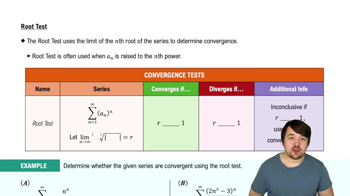
Root Test for Series Convergence

The Root Test determines the convergence of a series by examining the nth root of the absolute value of its terms. Specifically, if the limit of the nth root is less than 1, the series converges absolutely; if greater than 1, it diverges; and if equal to 1, the test is inconclusive.
추천 영상:
07:15
Root Test

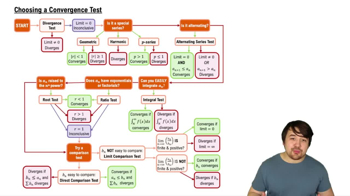
Absolute Convergence

A series converges absolutely if the series of the absolute values of its terms converges. Absolute convergence implies convergence regardless of the sign of terms, which is crucial when applying tests like the Root Test that consider absolute values.
추천 영상:
07:51
Choosing a Convergence Test

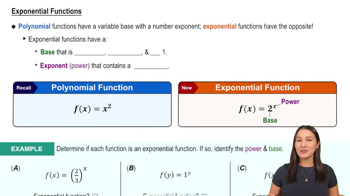
Limit Definition of the Exponential Function

The limit lim (n→∞) (1 + x/n)^n = e^x defines the exponential function and is used to evaluate limits involving expressions raised to the nth power. This concept helps simplify the limit in the Root Test when terms involve expressions like (1 - 1/n) raised to powers involving n.
추천 영상:
6:13
Exponential Functions