
교과서 질문
In Exercises 5–10, find an equation for the tangent line to the curve at the given point. Then sketch the curve and tangent line together.
y = (1 / x²), (−1, 1)
209
views

 검증된 단계별 안내
 05:02
05:02
 6:04
6:04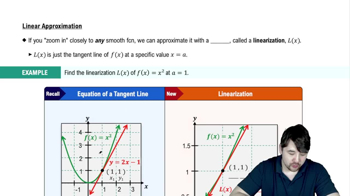 07:17
07:17In Exercises 5–10, find an equation for the tangent line to the curve at the given point. Then sketch the curve and tangent line together.
y = (1 / x²), (−1, 1)
In Exercises 41–44, determine whether the piecewise-defined function is differentiable at x = 0.
f(x) = { 2x − 1, x ≥ 0
x² + 2x + 7, x < 0
Find the derivatives of the functions in Exercises 1–42.
𝔂 = x⁻¹/² sec (2x)²
Second Derivatives
Find y'' in Exercises 59–64.
y = x(2x + 1)⁴
Find the derivatives of the functions in Exercises 1–42.
𝔂 = (x + 1)² (x² + 2x)
The best quantity to order One of the formulas for inventory management says that the average weekly cost of ordering, paying for, and holding merchandise is
A(q) = (km / q) + cm + (hq / 2),
where q is the quantity you order when things run low (shoes, TVs, brooms, or whatever the item might be); k is the cost of placing an order (the same, no matter how often you order); c is the cost of one item (a constant); m is the number of items sold each week (a constant); and h is the weekly holding cost per item (a constant that takes into account things such as space, utilities, insurance, and security).
Find dA/dq and d²A/dq².