Solve each radical equation in Exercises 88–89. √ (2x-3) + x = 3
Ch. 1 - Equations and Inequalities

2장, 문제 89a
The equations in Exercises 79–90 combine the types of equations we have discussed in this section. Solve each equation. Then state whether the equation is an identity, a conditional equation, or an inconsistent equation. 4x/(x + 3) - 12/(x - 3) = (4x2 + 36)/(x2 - 9)
검증된 단계별 안내1
Rewrite the equation to identify the denominators. Notice that the denominators are \(x + 3\), \(x - 3\), and \(x^2 - 9\). Recognize that \(x^2 - 9\) is a difference of squares and can be factored as \((x + 3)(x - 3)\).
Multiply through the entire equation by the least common denominator (LCD), which is \((x + 3)(x - 3)\), to eliminate the fractions. This will simplify the equation significantly.
Distribute the LCD to each term in the equation. For the first term, \(\frac{4x}{x + 3}\), multiplying by \((x + 3)(x - 3)\) leaves \(4x(x - 3)\). For the second term, \(\frac{-12}{x - 3}\), multiplying by \((x + 3)(x - 3)\) leaves \(-12(x + 3)\). For the right-hand side, \(\frac{4x^2 + 36}{x^2 - 9}\), multiplying by \((x + 3)(x - 3)\) leaves \(4x^2 + 36\).
Simplify the resulting equation by distributing and combining like terms. Expand \(4x(x - 3)\) and \(-12(x + 3)\), then combine all terms on one side of the equation to form a standard quadratic equation.
Solve the quadratic equation using factoring, the quadratic formula, or completing the square. After finding the solutions, check for any restrictions on \(x\) (e.g., \(x \neq -3\) and \(x \neq 3\) because these values make the original denominators undefined). Determine whether the equation is an identity (true for all values of \(x\)), a conditional equation (true for specific \(x\) values), or inconsistent (no solution).

비슷한 문제에 대한 검증된 영상 답변:
이 영상 해법은 위 문제에 도움이 된다고 튜터들이 추천한 것입니다.
영상 길이:
5m주요 개념
질문에 올바르게 답하기 위해 반드시 이해해야 하는 핵심 개념들은 다음과 같습니다.
Types of Equations
In algebra, equations can be classified into three main types: identities, conditional equations, and inconsistent equations. An identity holds true for all values of the variable, a conditional equation is true for specific values, and an inconsistent equation has no solutions. Understanding these classifications is crucial for determining the nature of the given equation.
추천 영상:
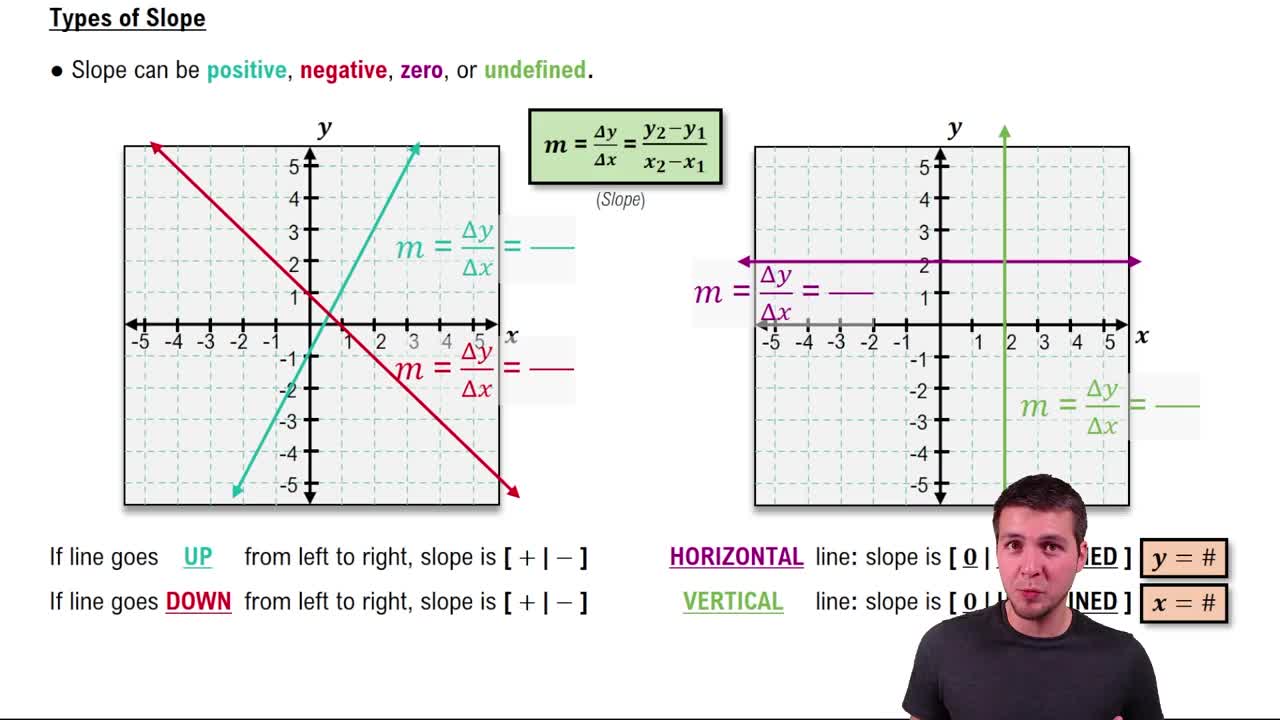
Types of Slope
Rational Expressions
Rational expressions are fractions where the numerator and denominator are polynomials. In the given equation, the presence of rational expressions requires careful manipulation, such as finding a common denominator or simplifying the expressions. Mastery of operations with rational expressions is essential for solving the equation accurately.
추천 영상:
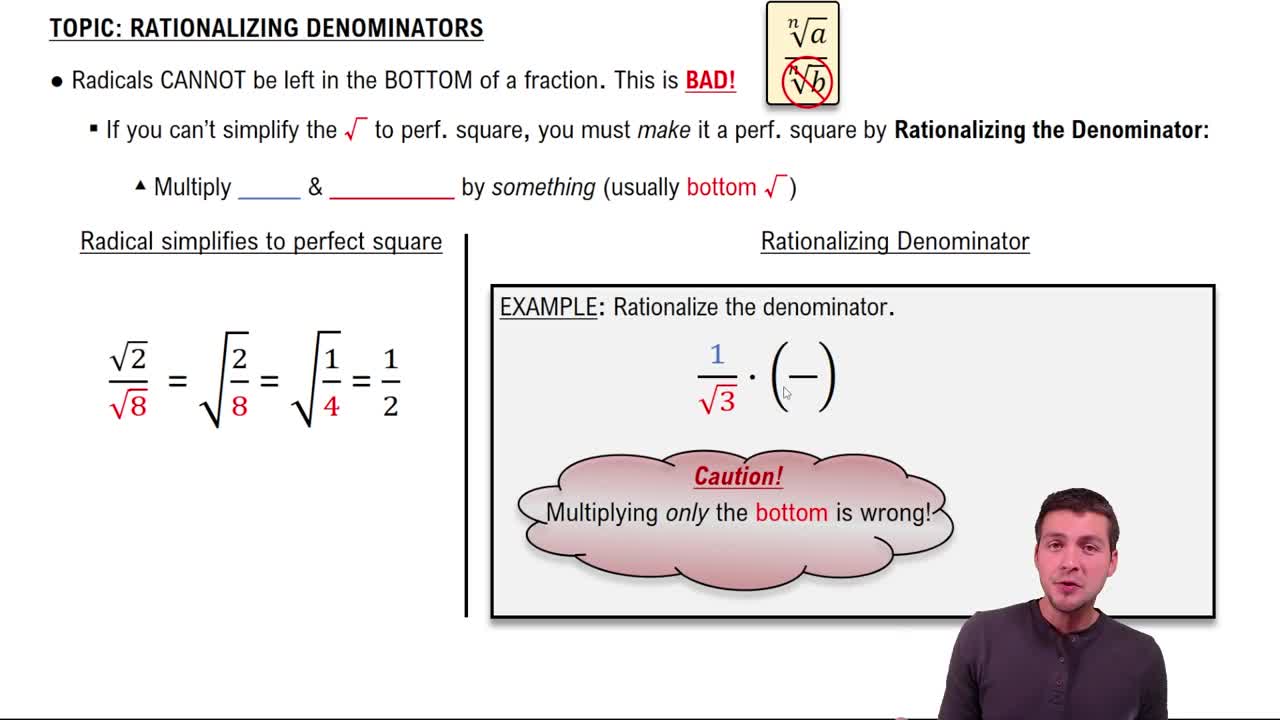
Rationalizing Denominators
Factoring Polynomials
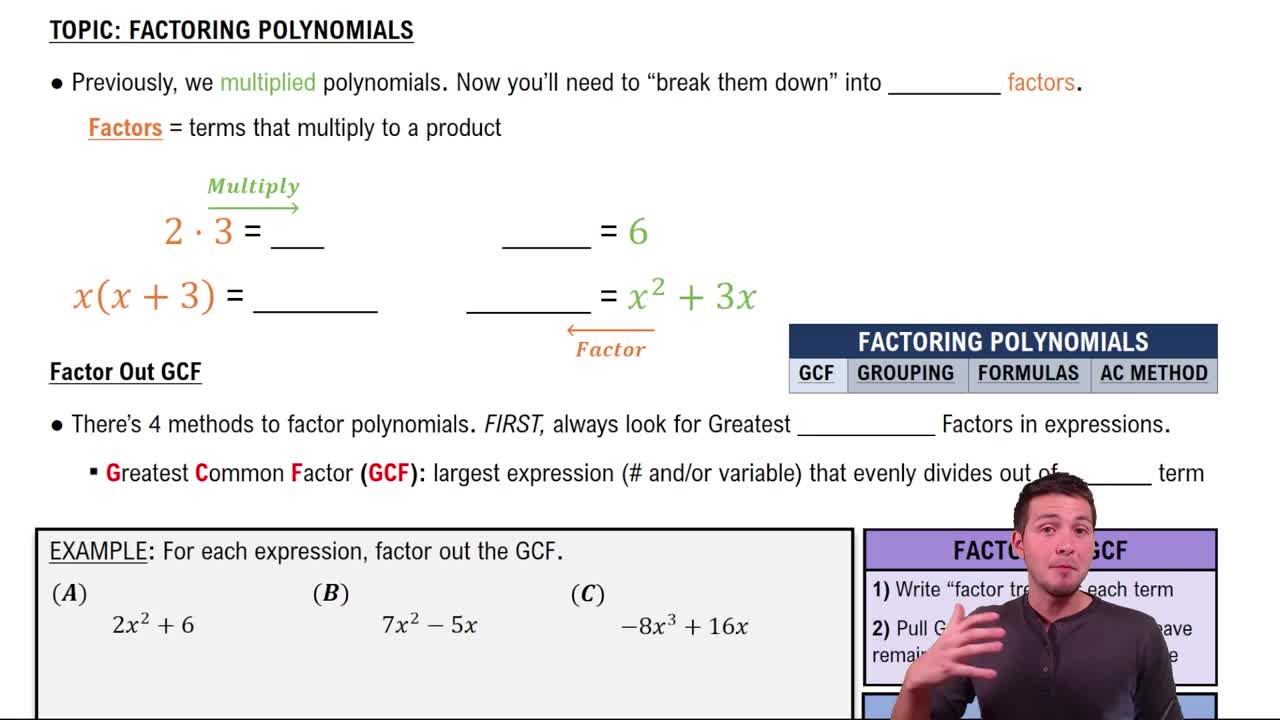
Factoring polynomials involves breaking down a polynomial into simpler components (factors) that, when multiplied together, yield the original polynomial. In this problem, recognizing that the denominator x^2 - 9 can be factored into (x + 3)(x - 3) is vital for simplifying the equation and solving it effectively.
추천 영상:
Introduction to Factoring Polynomials
관련 실천
교과서 질문
386
views
교과서 질문
Solve each equation in Exercises 83–108 by the method of your choice.
880
views
교과서 질문
In Exercises 59–94, solve each absolute value inequality.
724
views
교과서 질문
The equations in Exercises 79–90 combine the types of equations we have discussed in this section. Solve each equation. Then state whether the equation is an identity, a conditional equation, or an inconsistent equation. 4/(x2 + 3x - 10) - 1/(x2 + x - 6) = 3/(x2 - x - 12)
702
views
교과서 질문
In Exercises 85–90, find the x-intercepts of the graph of each equation. Then use the x-intercepts to match the equation with its graph. [The graphs are labeled (a) through (f).] y = 2(x + 2)^2 + 5(x + 2) - 3
670
views
교과서 질문
In Exercises 59–94, solve each absolute value inequality. 1 < |2 - 3x|
632
views