Write an equation in slope-intercept form of a linear function f whose graph satisfies the given conditions. The graph of ƒ passes through (−6, 4) and is perpendicular to the line that has an x intercept of 2 and a y-intercept of -4.
Ch. 2 - Functions and Graphs

3장, 문제 21
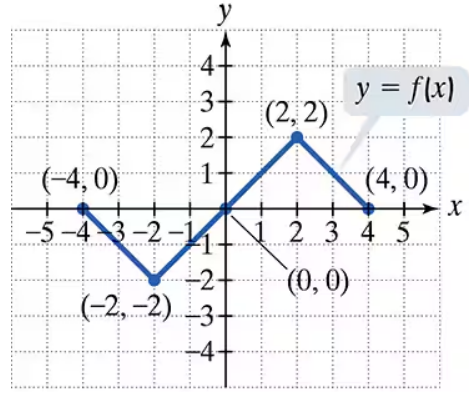
Use the graph of y = f(x) to graph each function g.

g(x) = f(x-1)+2
검증된 단계별 안내1
Identify the given function transformation: \(g(x) = f(x-1) + 2\). This means the graph of \(f(x)\) is shifted horizontally and vertically.
Understand the horizontal shift: The term \((x-1)\) inside the function indicates a shift to the right by 1 unit. So, every point \((x, y)\) on \(f(x)\) moves to \((x+1, y)\) on \(g(x)\).
Understand the vertical shift: The \(+2\) outside the function means the graph is shifted up by 2 units. So, every point \((x, y)\) on \(f(x)\) moves to \((x, y+2)\) on \(g(x)\).
Apply both transformations to each key point on the graph of \(f(x)\): For example, the point \((-2, 0)\) on \(f(x)\) will move to \((-2+1, 0+2) = (-1, 2)\) on \(g(x)\). Repeat this for the points \((0, -4)\) and \((2, 0)\).
Plot the new points on the coordinate plane and connect them with the same shape as the original graph to complete the graph of \(g(x)\).

비슷한 문제에 대한 검증된 영상 답변:
이 영상 해법은 위 문제에 도움이 된다고 튜터들이 추천한 것입니다.
영상 길이:
3m도움이 되었나요?
주요 개념
질문에 올바르게 답하기 위해 반드시 이해해야 하는 핵심 개념들은 다음과 같습니다.
Function Transformations
Function transformations involve shifting, stretching, compressing, or reflecting the graph of a function. In this problem, the function g(x) = f(x - 1) + 2 represents a horizontal shift to the right by 1 unit and a vertical shift upward by 2 units of the original function f(x). Understanding these shifts helps in accurately graphing the transformed function.
추천 영상:
Domain & Range of Transformed Functions
Horizontal Shifts
A horizontal shift occurs when the input variable x is replaced by (x - h), shifting the graph h units to the right if h is positive, or to the left if h is negative. For g(x) = f(x - 1), the graph of f(x) moves 1 unit to the right. This affects the x-coordinates of all points on the graph.
추천 영상:
Shifts of Functions
Vertical Shifts
A vertical shift happens when a constant k is added to the function, changing it to f(x) + k. This moves the graph up by k units if k is positive, or down if k is negative. In g(x) = f(x - 1) + 2, adding 2 shifts the entire graph of f(x - 1) upward by 2 units, affecting the y-coordinates.
추천 영상:
Shifts of Functions
관련 실천
교과서 질문
199
views
교과서 질문
Use the graph of y = f(x) to graph each function g. g(x) = f(x + 1) − 2
614
views
교과서 질문
Determine whether each equation defines y as a function of x. x+y³ = 8
194
views
교과서 질문
The functions in Exercises 11-28 are all one-to-one. For each function, a. Find an equation for f-1(x), the inverse function. b. Verify that your equation is correct by showing that f(ƒ-1 (x)) = = x and ƒ-1 (f(x)) = x. f(x) = 1/x
640
views
교과서 질문
Determine whether the graph of each equation is symmetric with respect to the y-axis, the x-axis, the origin, more than one of those, or none of these. x^2 + y^2 =17
182
views
교과서 질문
Find the domain of each function. f(x) = √(5x+35)
877
views
