Ch. 2 - Functions and Graphs
Blitzer - College Algebra 8th Edition
Blitzer8th EditionCollege AlgebraISBN: 9780136970514당신이 사용하는 게 아니라요?교과서 변경
3장, 문제 22

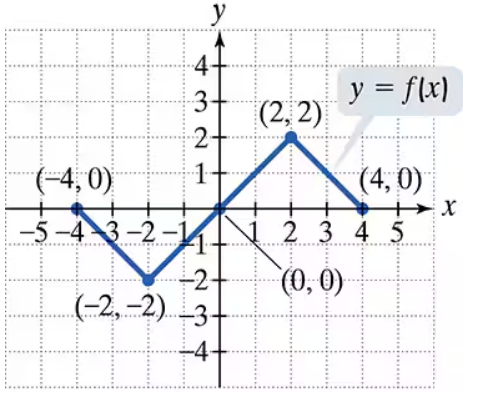
Use the graph of y = f(x) to graph each function g. g(x) = f(x + 1) − 2

검증된 단계별 안내
1
Understand the problem: The given function g(x) = f(x + 1) − 2 is a transformation of the function f(x). The goal is to apply the transformations step by step to the graph of f(x).
Step 1: Identify the horizontal shift. The term (x + 1) inside the function indicates a horizontal shift. Specifically, it shifts the graph of f(x) 1 unit to the left. This is because adding a positive value inside the parentheses moves the graph in the negative x-direction.
Step 2: Apply the horizontal shift. Take the graph of f(x) and move every point on the graph 1 unit to the left. This gives you an intermediate graph of f(x + 1).
Step 3: Identify the vertical shift. The term −2 outside the function indicates a vertical shift. Specifically, it shifts the graph of f(x + 1) 2 units downward. This is because subtracting a value outside the function moves the graph in the negative y-direction.
Step 4: Apply the vertical shift. Take the intermediate graph of f(x + 1) and move every point on the graph 2 units downward. The resulting graph is the graph of g(x) = f(x + 1) − 2.

비슷한 문제에 대한 검증된 영상 답변:

이 영상 해법은 위 문제에 도움이 된다고 튜터들이 추천한 것입니다.
영상 길이:
3m
도움이 되었나요?

주요 개념

질문에 올바르게 답하기 위해 반드시 이해해야 하는 핵심 개념들은 다음과 같습니다.

Function Transformation

Function transformation refers to the changes made to the graph of a function based on modifications to its equation. In this case, g(x) = f(x + 1) - 2 involves a horizontal shift to the left by 1 unit and a vertical shift downward by 2 units. Understanding these transformations is crucial for accurately graphing the new function based on the original function's graph.
추천 영상:
4:22
Domain & Range of Transformed Functions

Horizontal Shifts

Horizontal shifts occur when the input variable of a function is altered, affecting the graph's position along the x-axis. For g(x) = f(x + 1), the '+1' indicates a shift to the left. This concept is essential for determining how the graph of f(x) will be adjusted to create g(x).
추천 영상:
5:34
Shifts of Functions

Vertical Shifts

Vertical shifts involve moving the graph of a function up or down along the y-axis. In the function g(x) = f(x + 1) - 2, the '-2' indicates a downward shift of 2 units. Recognizing how vertical shifts affect the overall graph is important for accurately representing the new function derived from f(x).
추천 영상:
5:34
Shifts of Functions