In Exercises 39–50, graph the given functions, f and g, in the same rectangular coordinate system. Select integers for x, starting with -2 and ending with 2. Once you have obtained your graphs, describe how the graph of g is related to the graph of f. f(x) = x³, g(x) = x³ +2
Ch. 2 - Functions and Graphs

3장, 문제 47
Find ƒ+g and determine the domain for each function. f(x) = √(x +4), g(x) = √(x − 1)
검증된 단계별 안내1
Identify the given functions: \(f(x) = \sqrt{x + 4}\) and \(g(x) = \sqrt{x - 1}\).
Find the sum of the functions by adding them: \((f + g)(x) = f(x) + g(x) = \sqrt{x + 4} + \sqrt{x - 1}\).
Determine the domain of \(f(x)\) by setting the expression inside the square root to be greater than or equal to zero: \(x + 4 \geq 0\) which simplifies to \(x \geq -4\).
Determine the domain of \(g(x)\) similarly: \(x - 1 \geq 0\) which simplifies to \(x \geq 1\).
Find the domain of \((f + g)(x)\) by taking the intersection of the domains of \(f(x)\) and \(g(x)\), which is all \(x\) values satisfying both \(x \geq -4\) and \(x \geq 1\). This means the domain is \(x \geq 1\).

비슷한 문제에 대한 검증된 영상 답변:
이 영상 해법은 위 문제에 도움이 된다고 튜터들이 추천한 것입니다.
영상 길이:
3m도움이 되었나요?
주요 개념
질문에 올바르게 답하기 위해 반드시 이해해야 하는 핵심 개념들은 다음과 같습니다.
Function Addition (ƒ + g)
Adding two functions involves creating a new function where each output is the sum of the outputs of the original functions at the same input. For functions f and g, (ƒ + g)(x) = f(x) + g(x). This operation combines the values of both functions pointwise.
추천 영상:
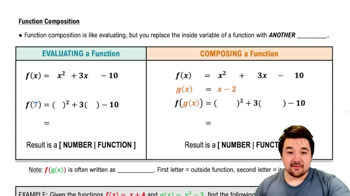
Function Composition
Domain of a Function
The domain of a function is the set of all input values (x) for which the function is defined. When combining functions, the domain of the resulting function is the intersection of the domains of the original functions, ensuring all expressions are valid.
추천 영상:
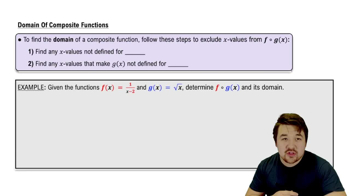
Domain Restrictions of Composed Functions
Square Root Function Domain Restrictions
A square root function √(expression) is defined only when the expression inside the root is non-negative. For f(x) = √(x + 4), x + 4 ≥ 0; for g(x) = √(x − 1), x − 1 ≥ 0. These inequalities determine the domain restrictions for each function.
추천 영상:
Domain Restrictions of Composed Functions
관련 실천
교과서 질문
102
views
교과서 질문
Give the center and radius of the circle described by the equation and graph each equation. Use the graph to identify the relation's domain and range. (x + 2)² + (y + 2)² = 4
813
views
교과서 질문
In Exercises 31–50, find f−g and determine the domain for each function. f(x) = √(x +4), g(x) = √(x − 1)
1228
views
교과서 질문
Use the graph of y = f(x) to graph each function g. g(x) = -f(x-1) + 1
826
views
교과서 질문
Find ƒ+g, f−g, fg, and f/g. Determine the domain for each function. f(x)= = 9x/(x - 4), g(x) = 7/(x+8)
557
views
교과서 질문
In Exercises 39-52, a. Find an equation for ƒ¯¹(x). b. Graph ƒ and ƒ¯¹(x) in the same rectangular coordinate system. c. Use interval notation to give the domain and the range off and ƒ¯¹. f(x) = (x+2)³
617
views
