Ch. 2 - Functions and Graphs
Blitzer - College Algebra 8th Edition
Blitzer8th EditionCollege AlgebraISBN: 9780136970514당신이 사용하는 게 아니라요?교과서 변경
3장, 문제 47abc

In Exercises 39-52, a. Find an equation for ƒ¯¹(x). b. Graph ƒ and ƒ¯¹(x) in the same rectangular coordinate system. c. Use interval notation to give the domain and the range off and ƒ¯¹. f(x) = (x+2)³

검증된 단계별 안내
1
Step 1: To find the inverse function ƒ¯¹(x), start by replacing f(x) with y. This gives y = (x + 2)³. Then, swap x and y to begin solving for the inverse. The equation becomes x = (y + 2)³.
Step 2: Solve for y in terms of x to find the inverse function. Take the cube root of both sides to isolate (y + 2). This gives ³√x = y + 2. Finally, subtract 2 from both sides to solve for y, resulting in ƒ¯¹(x) = ³√x - 2.
Step 3: To graph ƒ(x) = (x + 2)³ and ƒ¯¹(x) = ³√x - 2 on the same coordinate system, note that the graph of an inverse function is a reflection of the original function across the line y = x. Plot several points for both functions and ensure symmetry about the line y = x.
Step 4: Determine the domain and range of ƒ(x). Since the function (x + 2)³ is a cubic function, it is defined for all real numbers. Thus, the domain of ƒ(x) is (-∞, ∞). The range of a cubic function is also all real numbers, so the range of ƒ(x) is (-∞, ∞).
Step 5: Determine the domain and range of ƒ¯¹(x). The inverse function ƒ¯¹(x) = ³√x - 2 is a cube root function, which is also defined for all real numbers. Therefore, the domain of ƒ¯¹(x) is (-∞, ∞), and its range is (-∞, ∞).

비슷한 문제에 대한 검증된 영상 답변:

이 영상 해법은 위 문제에 도움이 된다고 튜터들이 추천한 것입니다.
영상 길이:
11m
도움이 되었나요?

주요 개념

질문에 올바르게 답하기 위해 반드시 이해해야 하는 핵심 개념들은 다음과 같습니다.

Inverse Functions

An inverse function reverses the effect of the original function. If f(x) transforms x into y, then the inverse function f¯¹(y) transforms y back into x. To find the inverse, we typically swap the roles of x and y in the equation and solve for y. Understanding this concept is crucial for part (a) of the question, where we need to derive the inverse of the given function.
추천 영상:
4:30
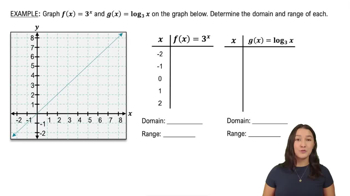
Graphing Logarithmic Functions

Graphing Functions

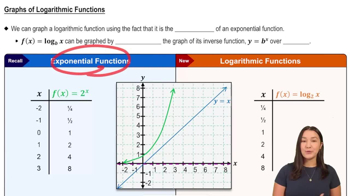
Graphing functions involves plotting points on a coordinate system to visualize the relationship between the input (x) and output (f(x)). For the original function f(x) and its inverse f¯¹(x), their graphs will reflect across the line y = x. This symmetry is important for part (b) of the question, as it helps in accurately representing both functions on the same graph.
추천 영상:
5:26
Graphs of Logarithmic Functions

Domain and Range

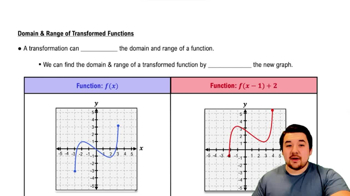
The domain of a function is the set of all possible input values (x-values), while the range is the set of all possible output values (f(x)). For the original function and its inverse, the domain of one is the range of the other and vice versa. Understanding how to express these sets in interval notation is essential for part (c) of the question, as it requires identifying and stating the domain and range for both functions.
추천 영상:
4:22
Domain & Range of Transformed Functions