Ch. 2 - Functions and Graphs
Blitzer - College Algebra 8th Edition
Blitzer8th EditionCollege AlgebraISBN: 9780136970514당신이 사용하는 게 아니라요?교과서 변경
3장, 문제 33

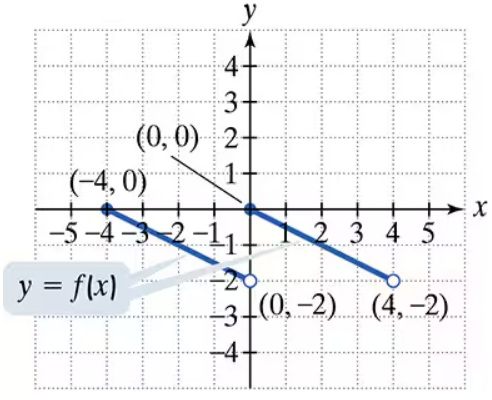
Use the graph of y = f(x) to graph each function g. g(x) = f(x)+2
Graph of y = f(x) showing two line segments with points at (-4,0), (0,0), (0,-2), and (4,-2) on a coordinate plane.

검증된 단계별 안내
1
Understand that the function g(x) = f(x) + 2 represents a vertical shift of the original function f(x).
Recall that adding a constant to a function, like +2, shifts the entire graph of the function upward by that constant amount.
Take each point (x, y) on the graph of y = f(x) and transform it to a new point (x, y + 2) for the graph of g(x).
Plot these new points on the coordinate plane, maintaining the same x-values but increasing each y-value by 2.
Connect the new points smoothly, preserving the shape of the original graph, to complete the graph of g(x) = f(x) + 2.

비슷한 문제에 대한 검증된 영상 답변:

이 영상 해법은 위 문제에 도움이 된다고 튜터들이 추천한 것입니다.
영상 길이:
2m
도움이 되었나요?

주요 개념

질문에 올바르게 답하기 위해 반드시 이해해야 하는 핵심 개념들은 다음과 같습니다.

Function Transformation

Function transformation involves changing the graph of a function in specific ways, such as shifting, stretching, or reflecting. In this case, adding a constant to the function, g(x) = f(x) + 2, shifts the graph vertically.
추천 영상:
4:22
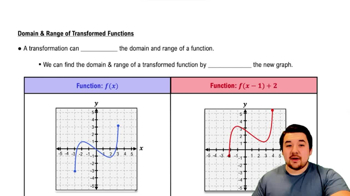
Domain & Range of Transformed Functions

Vertical Shift

A vertical shift moves the entire graph of a function up or down without changing its shape. Adding 2 to f(x) raises every point on the graph by 2 units, so the graph of g(x) = f(x) + 2 is the graph of f(x) shifted up 2 units.
추천 영상:
5:34
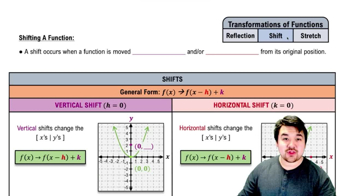
Shifts of Functions

Graphing Functions

Graphing functions involves plotting points that satisfy the function's equation and connecting them smoothly. Understanding how transformations affect the graph helps in sketching the new function accurately based on the original graph.
추천 영상:
5:26
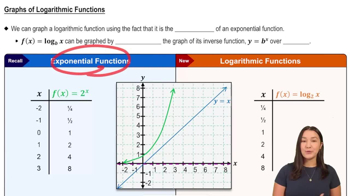
Graphs of Logarithmic Functions