Ch. 2 - Functions and Graphs
Blitzer - College Algebra 8th Edition
Blitzer8th EditionCollege AlgebraISBN: 9780136970514당신이 사용하는 게 아니라요?교과서 변경
3장, 문제 39abc

In Exercises 39-52, a. Find an equation for ƒ¯¹(x). b. Graph ƒ and ƒ¯¹(x) in the same rectangular coordinate system. c. Use interval notation to give the domain and the range of f and ƒ¯¹. f(x)=2x-1

검증된 단계별 안내
1
Step 1: To find the inverse function ƒ¯¹(x), start by replacing f(x) with y. The given function is f(x) = 2x - 1, so rewrite it as y = 2x - 1.
Step 2: Swap x and y in the equation to begin solving for the inverse. This gives x = 2y - 1.
Step 3: Solve for y in terms of x. Add 1 to both sides to isolate the term with y: x + 1 = 2y. Then divide both sides by 2 to solve for y: y = (x + 1)/2. The inverse function is ƒ¯¹(x) = (x + 1)/2.
Step 4: To graph ƒ and ƒ¯¹(x) on the same rectangular coordinate system, plot the original function f(x) = 2x - 1 (a straight line with slope 2 and y-intercept -1) and the inverse function ƒ¯¹(x) = (x + 1)/2 (a straight line with slope 1/2 and y-intercept 1/2). Note that the graphs of f and ƒ¯¹(x) are reflections of each other across the line y = x.
Step 5: Use interval notation to describe the domain and range. For f(x) = 2x - 1, the domain is all real numbers (-∞, ∞) and the range is also all real numbers (-∞, ∞). For ƒ¯¹(x) = (x + 1)/2, the domain is all real numbers (-∞, ∞) and the range is all real numbers (-∞, ∞).

비슷한 문제에 대한 검증된 영상 답변:

이 영상 해법은 위 문제에 도움이 된다고 튜터들이 추천한 것입니다.
영상 길이:
9m
도움이 되었나요?

주요 개념

질문에 올바르게 답하기 위해 반드시 이해해야 하는 핵심 개념들은 다음과 같습니다.

Inverse Functions

An inverse function, denoted as f¯¹(x), reverses the effect of the original function f(x). For a function to have an inverse, it must be one-to-one, meaning each output is produced by exactly one input. To find the inverse, you typically swap the x and y variables in the equation and solve for y.
추천 영상:
4:30
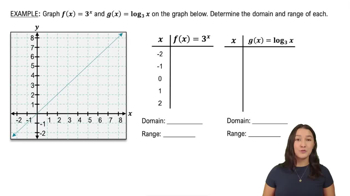
Graphing Logarithmic Functions

Graphing Functions

Graphing functions involves plotting points on a coordinate system to visualize the relationship between the input (x) and output (f(x)). When graphing both a function and its inverse, the two graphs will be reflections of each other across the line y = x. This visual representation helps in understanding how the function and its inverse interact.
추천 영상:
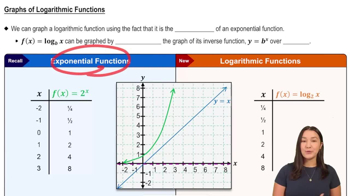
5:26
Graphs of Logarithmic Functions

Domain and Range

The domain of a function is the set of all possible input values (x-values), while the range is the set of all possible output values (f(x)). For inverse functions, the domain of f becomes the range of f¯¹, and vice versa. Using interval notation, we can succinctly express these sets, which is essential for understanding the behavior of both the function and its inverse.
추천 영상:
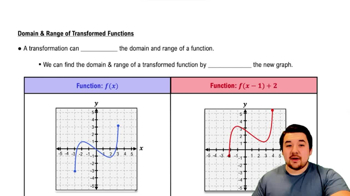
4:22
Domain & Range of Transformed Functions