Ch. 2 - Functions and Graphs
Blitzer - College Algebra 8th Edition
Blitzer8th EditionCollege AlgebraISBN: 9780136970514당신이 사용하는 게 아니라요?교과서 변경
3장, 문제 60

In Exercises 60–63, begin by graphing the standard quadratic function, f(x) = x^2. Then use transformations of this graph to graph the given function. g(x) = x^2 + 2

검증된 단계별 안내
1
Start by identifying the standard quadratic function, f(x) = x^2. This is a parabola that opens upwards with its vertex at the origin (0, 0). The graph is symmetric about the y-axis.
Next, observe the given function, g(x) = x^2 + 2. Notice that this is a transformation of the standard quadratic function. Specifically, the '+2' indicates a vertical shift.
To apply the vertical shift, move every point on the graph of f(x) = x^2 upward by 2 units. For example, the vertex of f(x) = x^2, which is at (0, 0), will now move to (0, 2).
Plot the new points after the vertical shift. For instance, if the original graph of f(x) = x^2 passes through (1, 1), the new graph will pass through (1, 3). Similarly, if it passes through (-1, 1), the new graph will pass through (-1, 3).
Finally, sketch the new graph of g(x) = x^2 + 2. It will have the same shape as the original parabola, but its vertex will be at (0, 2), and the entire graph will be shifted 2 units upward.

비슷한 문제에 대한 검증된 영상 답변:

이 영상 해법은 위 문제에 도움이 된다고 튜터들이 추천한 것입니다.
영상 길이:
1m
도움이 되었나요?

주요 개념

질문에 올바르게 답하기 위해 반드시 이해해야 하는 핵심 개념들은 다음과 같습니다.

Quadratic Functions

A quadratic function is a polynomial function of degree two, typically expressed in the form f(x) = ax^2 + bx + c. The graph of a quadratic function is a parabola, which opens upwards if 'a' is positive and downwards if 'a' is negative. Understanding the basic shape and properties of quadratic functions is essential for analyzing their transformations.
추천 영상:
06:36
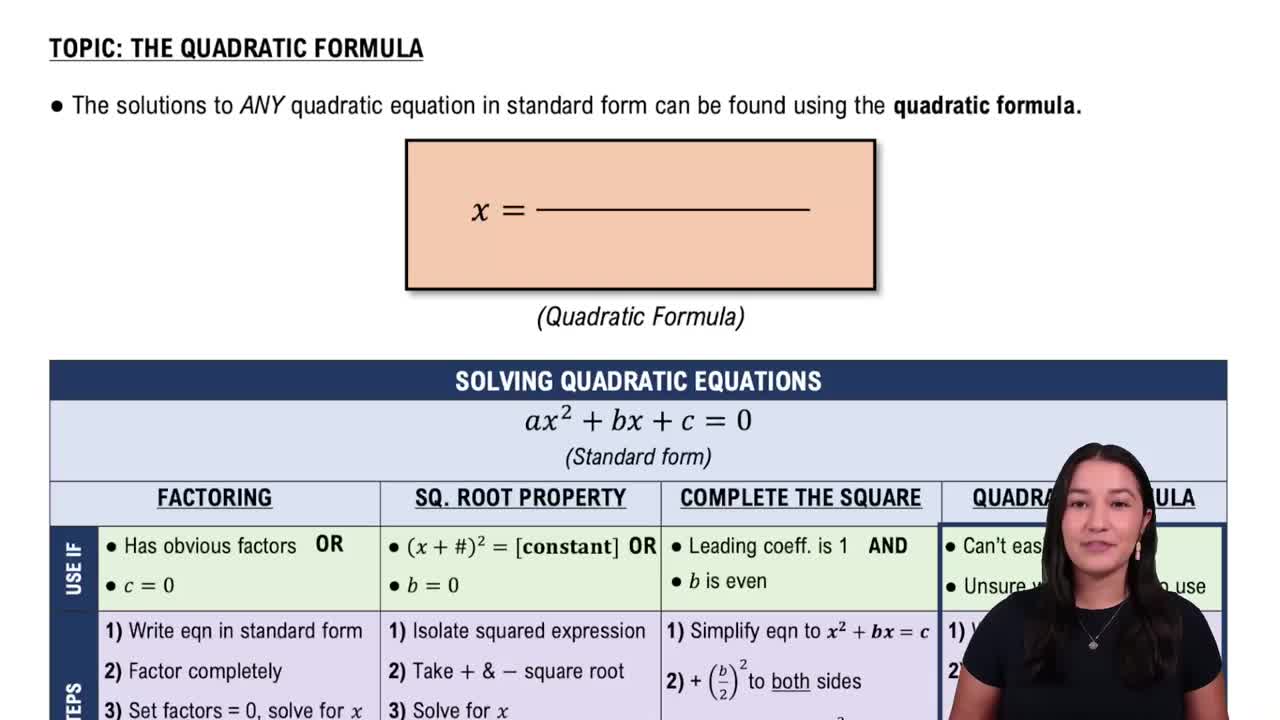
Solving Quadratic Equations Using The Quadratic Formula

Graph Transformations

Graph transformations involve shifting, reflecting, stretching, or compressing the graph of a function. For quadratic functions, vertical shifts occur when a constant is added or subtracted from the function, such as in g(x) = x^2 + 2, which shifts the graph of f(x) = x^2 upward by 2 units. Recognizing these transformations helps in accurately graphing modified functions.
추천 영상:
5:25
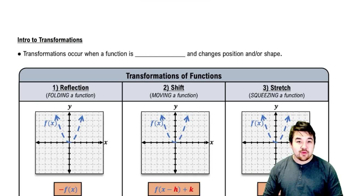
Intro to Transformations

Standard Form of a Quadratic Function

The standard form of a quadratic function is f(x) = ax^2 + bx + c, where 'a', 'b', and 'c' are constants. This form allows for easy identification of the vertex and the direction of the parabola. In the context of transformations, understanding how changes in 'c' affect the graph's position is crucial for accurately representing the function g(x) = x^2 + 2.
추천 영상:
04:34
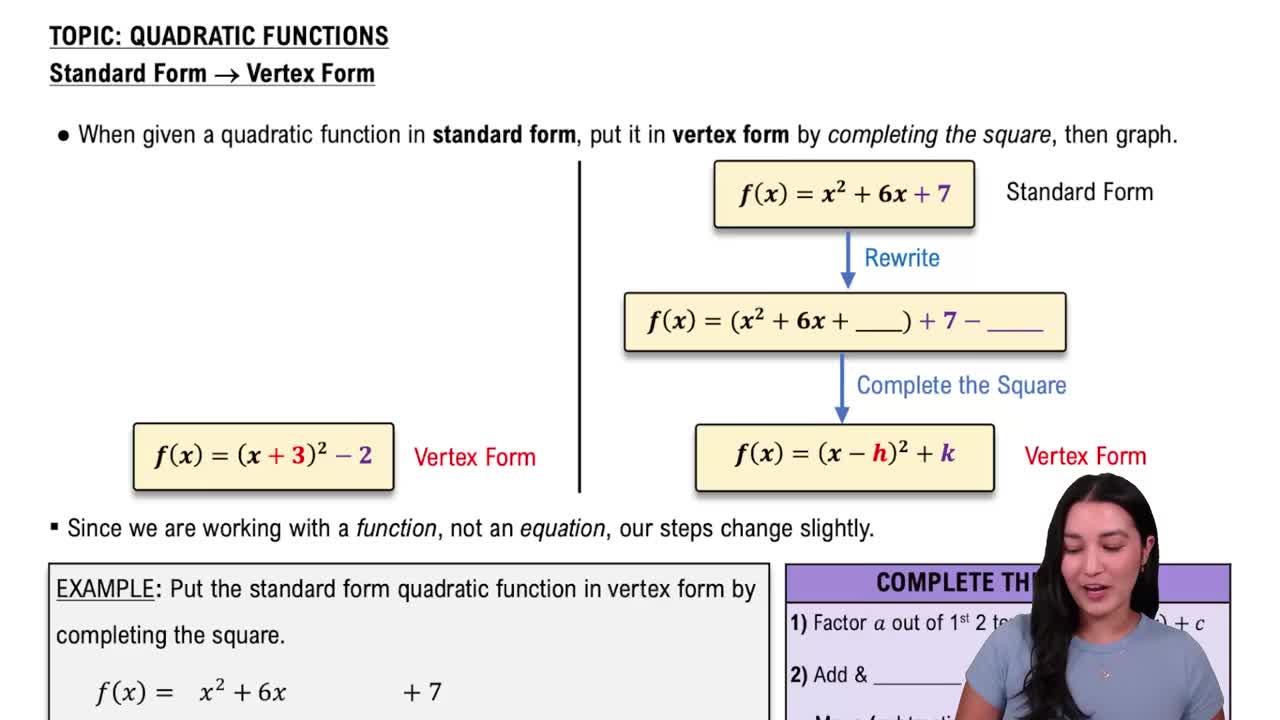
Converting Standard Form to Vertex Form