In Exercises 77–92, use the graph to determine a. the function's domain; b. the function's range; c. the x-intercepts, if any; d. the y-intercept, if any; and e. the missing function values, indicated by question marks, below each graph.
Ch. 2 - Functions and Graphs

3장, 문제 85
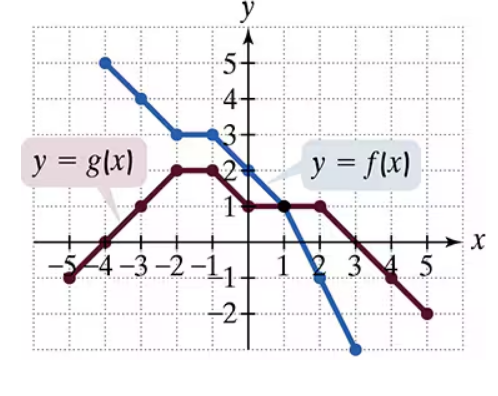
Use the graphs of f and g to solve Exercises 83–90.

Find (fg) (2).
검증된 단계별 안내1
Step 1: Understand the problem. You are tasked with finding (fg)(2), which means you need to evaluate the product of the functions f(x) and g(x) at x = 2.
Step 2: Locate x = 2 on the graph. Look at the horizontal axis and find the point where x = 2.
Step 3: Determine the value of f(2). Find the red graph (representing f(x)) and identify the y-coordinate of the point where x = 2.
Step 4: Determine the value of g(2). Find the blue graph (representing g(x)) and identify the y-coordinate of the point where x = 2.
Step 5: Multiply the values of f(2) and g(2). Once you have the values of f(2) and g(2), multiply them together to find (fg)(2).

비슷한 문제에 대한 검증된 영상 답변:
이 영상 해법은 위 문제에 도움이 된다고 튜터들이 추천한 것입니다.
영상 길이:
1m도움이 되었나요?
주요 개념
질문에 올바르게 답하기 위해 반드시 이해해야 하는 핵심 개념들은 다음과 같습니다.
Function Evaluation
Function evaluation involves substituting a specific input value into a function to determine its output. For example, if we have a function f(x), evaluating it at x = 2 means finding f(2). This is essential for solving problems that require specific outputs from given functions.
추천 영상:
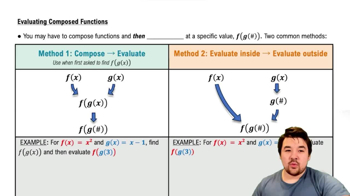
Evaluating Composed Functions
Product of Functions
The product of two functions, denoted as (fg)(x), is defined as the multiplication of their outputs at a given input x. Specifically, (fg)(x) = f(x) * g(x). To find (fg)(2), one must first evaluate f(2) and g(2), then multiply these results together.
추천 영상:
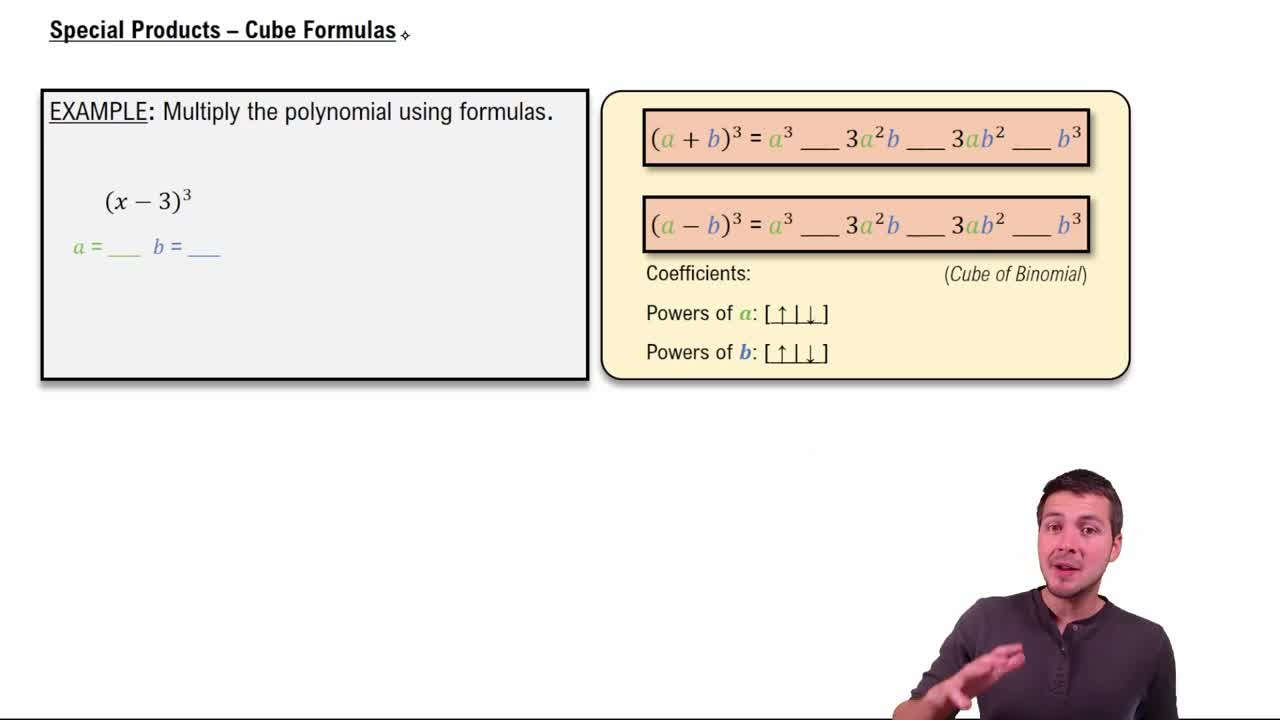
Special Products - Cube Formulas
Graph Interpretation
Interpreting graphs of functions involves analyzing the visual representation of the functions to extract information such as values at specific points. In this case, the graphs of f(x) and g(x) can be used to find f(2) and g(2) by locating the corresponding y-values at x = 2 on their respective graphs.
추천 영상:
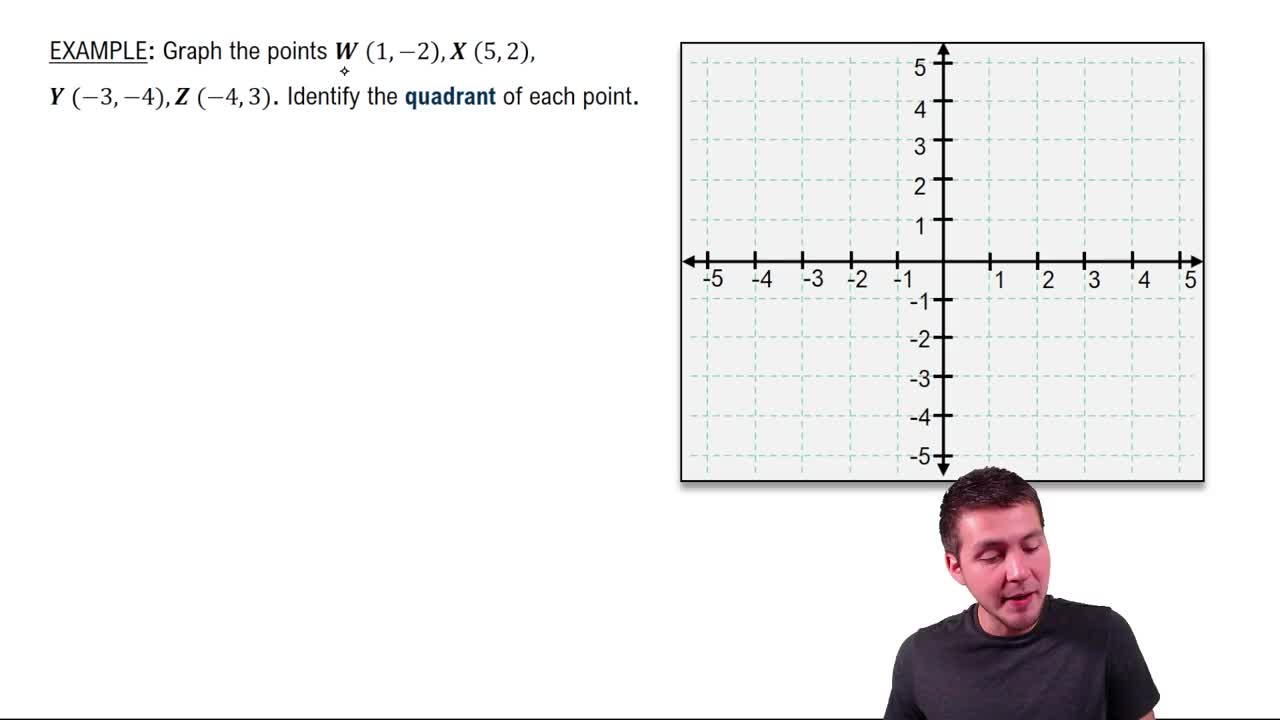
Graphs and Coordinates - Example
관련 실천
교과서 질문
899
views
교과서 질문
Begin by graphing the absolute value function, f(x) = |x|. Then use transformations of this graph to graph the given function. h(x) = |x + 3| - 2
791
views
교과서 질문
Use the graphs of f and g to solve Exercises 83–90.
Find(g/f)(3)
1294
views
교과서 질문
In Exercises 77–92, use the graph to determine a. the function's domain; b. the function's range; c. the x-intercepts, if any; d. the y-intercept, if any; and e. the missing function values, indicated by question marks, below each graph.
107
views
교과서 질문
Use the graphs of f and g to solve Exercises 83–90.
Find (g-f) (-2).
1195
views
교과서 질문
In Exercises 82–84, find f + g, f - g, fg, and f/g. Determine the domain for each function. f(x) = √(x + 7), g(x) = √(x - 2)
586
views
