Solve each rational inequality in Exercises 43–60 and graph the solution set on a real number line. Express each solution set in interval notation. x/(x + 2) ≥ 2
Ch. 3 - Polynomial and Rational Functions

4장, 문제 59
Exercises 53–60 show incomplete graphs of given polynomial functions. a) Find all the zeros of each function. b) Without using a graphing utility, draw a complete graph of the function. f(x)=3x5+2x4−15x3−10x2+12x+8

검증된 단계별 안내1
Start by finding the zeros of the polynomial function \(f(x) = 3x^{5} + 2x^{4} - 15x^{3} - 10x^{2} + 12x + 8\). To do this, first look for possible rational zeros using the Rational Root Theorem. The possible rational zeros are of the form \(\pm \frac{p}{q}\), where \(p\) divides the constant term 8 and \(q\) divides the leading coefficient 3.
Test the possible rational zeros by substituting them into the polynomial or by using synthetic division to check if they yield a remainder of zero. Each zero found will correspond to a factor of the polynomial.
Once a zero is found, use polynomial division (either long division or synthetic division) to divide the original polynomial by the corresponding factor \((x - r)\), where \(r\) is the zero. This will reduce the polynomial to a lower degree, making it easier to find the remaining zeros.
Repeat the process of finding zeros and dividing the polynomial until you factor the polynomial completely into linear and/or irreducible quadratic factors. The zeros of the polynomial are the roots of these factors.
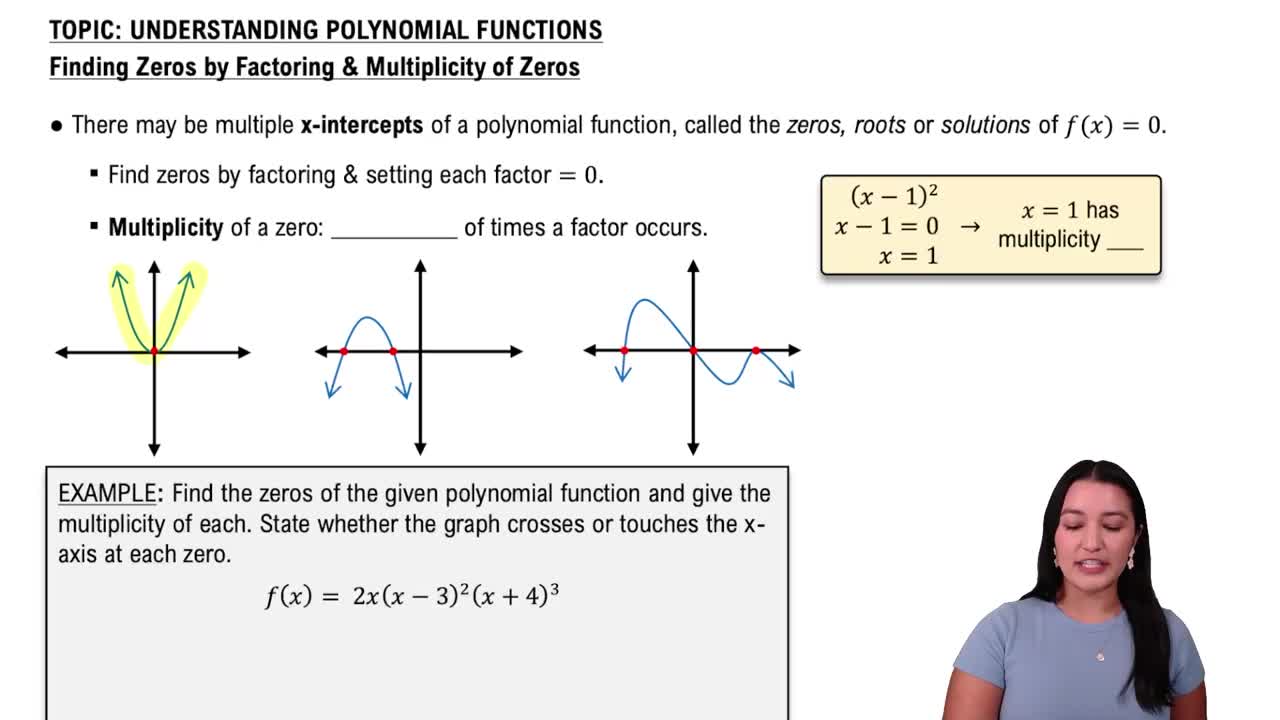
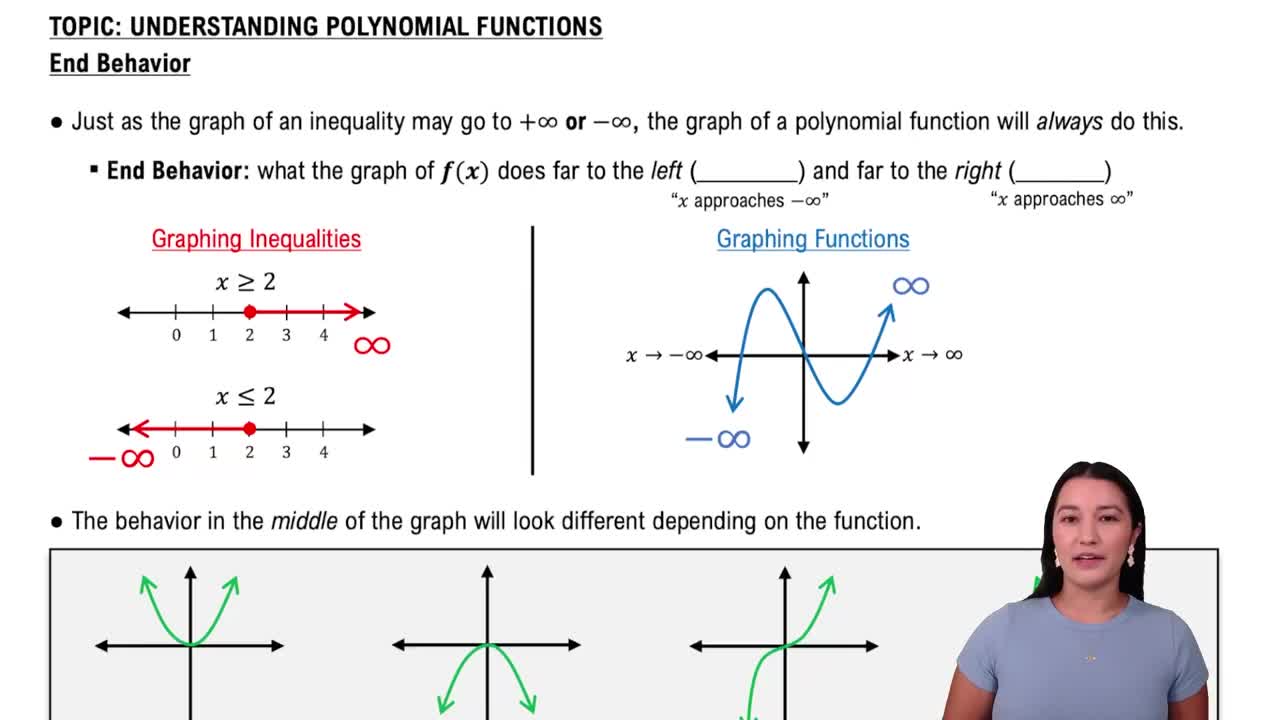
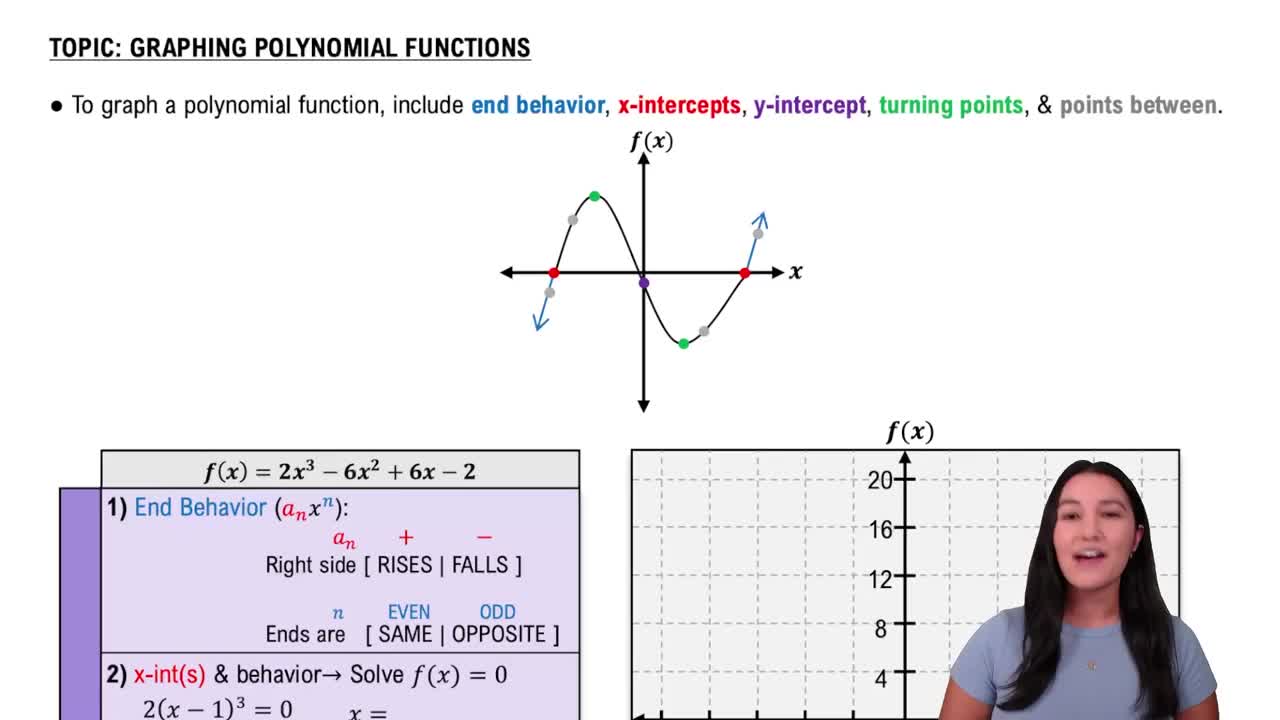
After finding all zeros, analyze the multiplicity of each zero to understand the behavior of the graph at those points (whether the graph crosses or touches the x-axis). Then, use this information along with the end behavior of the polynomial (determined by the leading term \$3x^{5}$) to sketch a complete graph of the function without using a graphing utility.

비슷한 문제에 대한 검증된 영상 답변:
이 영상 해법은 위 문제에 도움이 된다고 튜터들이 추천한 것입니다.
영상 길이:
9m도움이 되었나요?
주요 개념
질문에 올바르게 답하기 위해 반드시 이해해야 하는 핵심 개념들은 다음과 같습니다.
Finding Zeros of Polynomial Functions
Zeros of a polynomial are the values of x for which the function equals zero. To find them, one typically factors the polynomial or uses methods like synthetic division or the Rational Root Theorem. Identifying all zeros is essential for understanding the function's behavior and graph.
추천 영상:
Finding Zeros & Their Multiplicity
End Behavior of Polynomial Functions
The end behavior describes how the function behaves as x approaches positive or negative infinity. It depends on the leading term's degree and coefficient. For example, an odd-degree polynomial with a positive leading coefficient rises to the right and falls to the left, guiding the sketch of the graph.
추천 영상:
End Behavior of Polynomial Functions
Sketching Polynomial Graphs Without Technology
Drawing a polynomial graph by hand involves plotting zeros, determining multiplicities, analyzing end behavior, and finding key points like local maxima and minima. Understanding these features helps create an accurate, complete graph without relying on graphing utilities.
추천 영상:
Graphing Polynomial Functions
관련 실천
교과서 질문
579
views
교과서 질문
Solve:
597
views
교과서 질문
In Exercises 57–64, find the vertical asymptotes, if any, the horizontal asymptote, if one exists, and the slant asymptote, if there is one, of the graph of each rational function. Then graph the rational function. r(x) = (x^2 + 4x + 3)/(x + 2)^2
693
views
교과서 질문
Solve each rational inequality in Exercises 43–60 and graph the solution set on a real number line. Express each solution set in interval notation. (x - 2)/(x + 2) ≤ 2
460
views
교과서 질문
In Exercises 57–64, find the vertical asymptotes, if any, the horizontal asymptote, if one exists, and the slant asymptote, if there is one, of the graph of each rational function. Then graph the rational function. h(x) = (x^2 - 3x - 4)/(x^2 - x -6)
573
views
교과서 질문
Follow the seven steps to graph each rational function. f(x)=2x/(x2−4)
51
views