Solve each rational inequality in Exercises 43–60 and graph the solution set on a real number line. Express each solution set in interval notation. x/(x + 2) ≥ 2
Ch. 3 - Polynomial and Rational Functions

4장, 문제 59
In Exercises 57–64, find the vertical asymptotes, if any, the horizontal asymptote, if one exists, and the slant asymptote, if there is one, of the graph of each rational function. Then graph the rational function. h(x) = (x^2 - 3x - 4)/(x^2 - x -6)
검증된 단계별 안내1
Step 1: Factor the numerator and the denominator.
Step 2: Identify the vertical asymptotes by setting the denominator equal to zero and solving for x.
Step 3: Determine the horizontal asymptote by comparing the degrees of the numerator and the denominator.
Step 4: Check for a slant asymptote by performing polynomial long division if the degree of the numerator is exactly one more than the degree of the denominator.
Step 5: Use the information from the previous steps to sketch the graph of the rational function, noting the asymptotes and any intercepts.

비슷한 문제에 대한 검증된 영상 답변:
이 영상 해법은 위 문제에 도움이 된다고 튜터들이 추천한 것입니다.
영상 길이:
8m도움이 되었나요?
주요 개념
질문에 올바르게 답하기 위해 반드시 이해해야 하는 핵심 개념들은 다음과 같습니다.
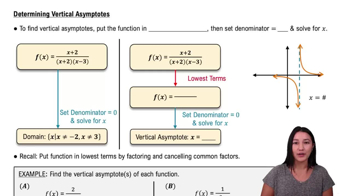
Vertical Asymptotes
Vertical asymptotes occur in rational functions where the denominator equals zero, leading to undefined values. To find them, set the denominator of the function to zero and solve for the variable. The values obtained indicate the x-coordinates where the graph approaches infinity or negative infinity, creating vertical lines that the graph cannot cross.
추천 영상:
Determining Vertical Asymptotes
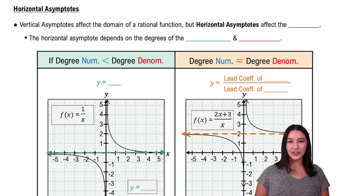
Horizontal and Slant Asymptotes
Horizontal asymptotes describe the behavior of a function as x approaches infinity or negative infinity. For rational functions, if the degree of the numerator is less than or equal to the degree of the denominator, a horizontal asymptote exists. Slant (or oblique) asymptotes occur when the degree of the numerator is exactly one more than that of the denominator, indicating that the graph will approach a linear function as x becomes very large or very small.
추천 영상:
Determining Horizontal Asymptotes
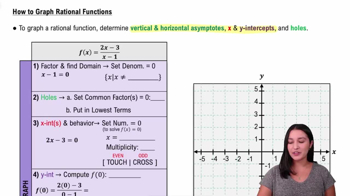
Graphing Rational Functions
Graphing rational functions involves plotting key features such as intercepts, asymptotes, and behavior at critical points. After identifying vertical and horizontal/slant asymptotes, one can determine the function's end behavior and sketch the graph accordingly. Additionally, finding x-intercepts and y-intercepts helps in accurately representing the function's overall shape and behavior.
추천 영상:
How to Graph Rational Functions
관련 실천
교과서 질문
579
views
교과서 질문
Solve:
597
views
교과서 질문
Exercises 53–60 show incomplete graphs of given polynomial functions. a) Find all the zeros of each function. b) Without using a graphing utility, draw a complete graph of the function. f(x)=3x5+2x4−15x3−10x2+12x+8
489
views
교과서 질문
Solve each rational inequality in Exercises 43–60 and graph the solution set on a real number line. Express each solution set in interval notation. (x - 2)/(x + 2) ≤ 2
460
views
교과서 질문
In Exercises 57–64, find the vertical asymptotes, if any, the horizontal asymptote, if one exists, and the slant asymptote, if there is one, of the graph of each rational function. Then graph the rational function. g(x) = (2x - 4)/(x + 3)
748
views
교과서 질문
Follow the seven steps to graph each rational function. f(x)=2x/(x2−4)
51
views