Ch. 3 - Polynomial and Rational Functions
Blitzer - College Algebra 8th Edition
Blitzer8th EditionCollege AlgebraISBN: 9780136970514당신이 사용하는 게 아니라요?교과서 변경
4장, 문제 31

Find an nth-degree polynomial function with real coefficients satisfying the given conditions. If you are using a graphing utility, use it to graph the function and verify the real zeros and the given function value. n=4; -2, 5, and 3+2i are zeros; f(1) = -96

검증된 단계별 안내
1
Identify the given zeros of the polynomial: -2, 5, and 3 + 2i. Since the polynomial has real coefficients, the complex conjugate 3 - 2i must also be a zero.
Write the factors corresponding to each zero: \((x + 2)\) for zero -2, \((x - 5)\) for zero 5, \((x - (3 + 2i))\) and \((x - (3 - 2i))\) for the complex zeros.
Multiply the complex conjugate factors to get a quadratic with real coefficients: \((x - (3 + 2i))(x - (3 - 2i)) = (x - 3)^2 + (2)^2 = (x - 3)^2 + 4\).
Form the polynomial function as \(f(x) = a(x + 2)(x - 5)((x - 3)^2 + 4)\), where \(a\) is a real number constant to be determined.
Use the given value \(f(1) = -96\) to substitute \(x = 1\) into the polynomial and solve for \(a\): \(-96 = a(1 + 2)(1 - 5)((1 - 3)^2 + 4)\). Then solve for \(a\).

비슷한 문제에 대한 검증된 영상 답변:

이 영상 해법은 위 문제에 도움이 된다고 튜터들이 추천한 것입니다.
영상 길이:
7m
도움이 되었나요?

주요 개념

질문에 올바르게 답하기 위해 반드시 이해해야 하는 핵심 개념들은 다음과 같습니다.

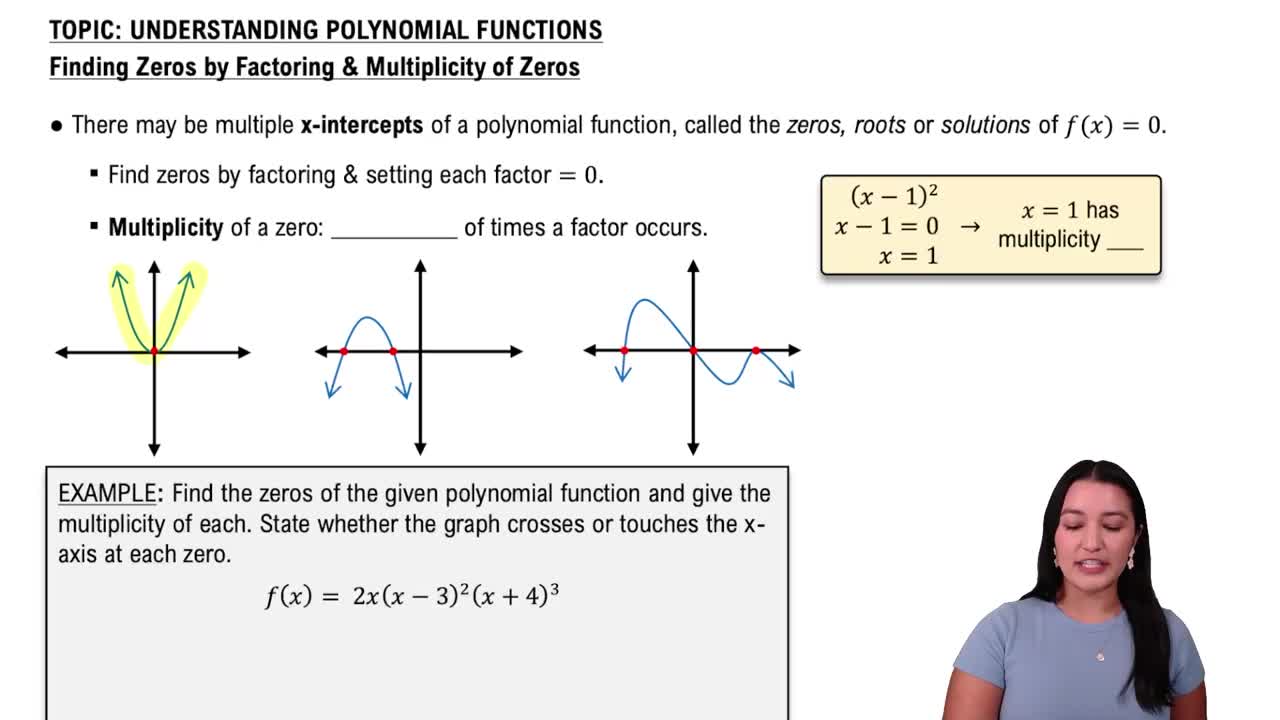
Polynomial Zeros and Their Multiplicity

Zeros of a polynomial are the values of x that make the polynomial equal to zero. For an nth-degree polynomial, there are exactly n zeros (counting multiplicities). Understanding how zeros relate to factors helps in constructing the polynomial function.
추천 영상:
03:42
Finding Zeros & Their Multiplicity

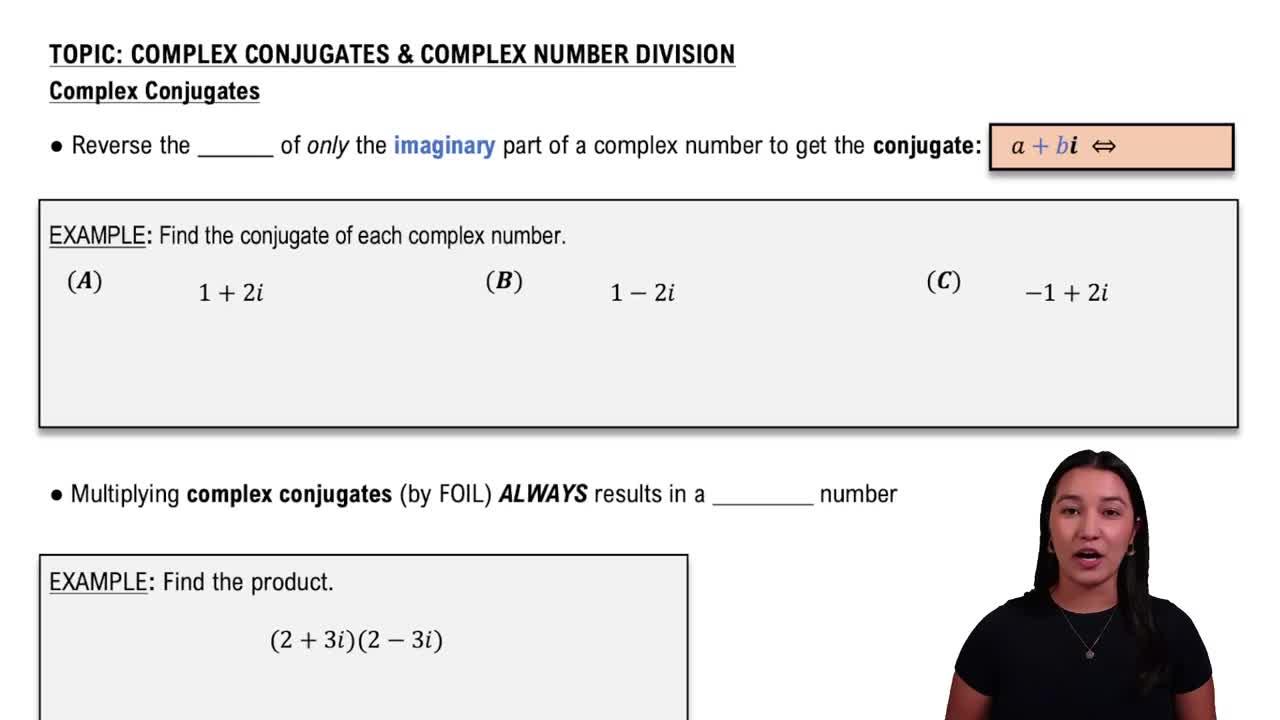
Complex Conjugate Root Theorem

If a polynomial has real coefficients and a complex number a + bi is a zero, then its conjugate a - bi must also be a zero. This ensures the polynomial remains with real coefficients and helps determine all zeros when complex roots are given.
추천 영상:
05:33
Complex Conjugates

Using a Given Function Value to Find the Leading Coefficient

After forming the polynomial from its zeros, the leading coefficient can be found by substituting a given x-value and its corresponding function value into the polynomial. Solving this equation adjusts the polynomial to satisfy the specific condition.
추천 영상:
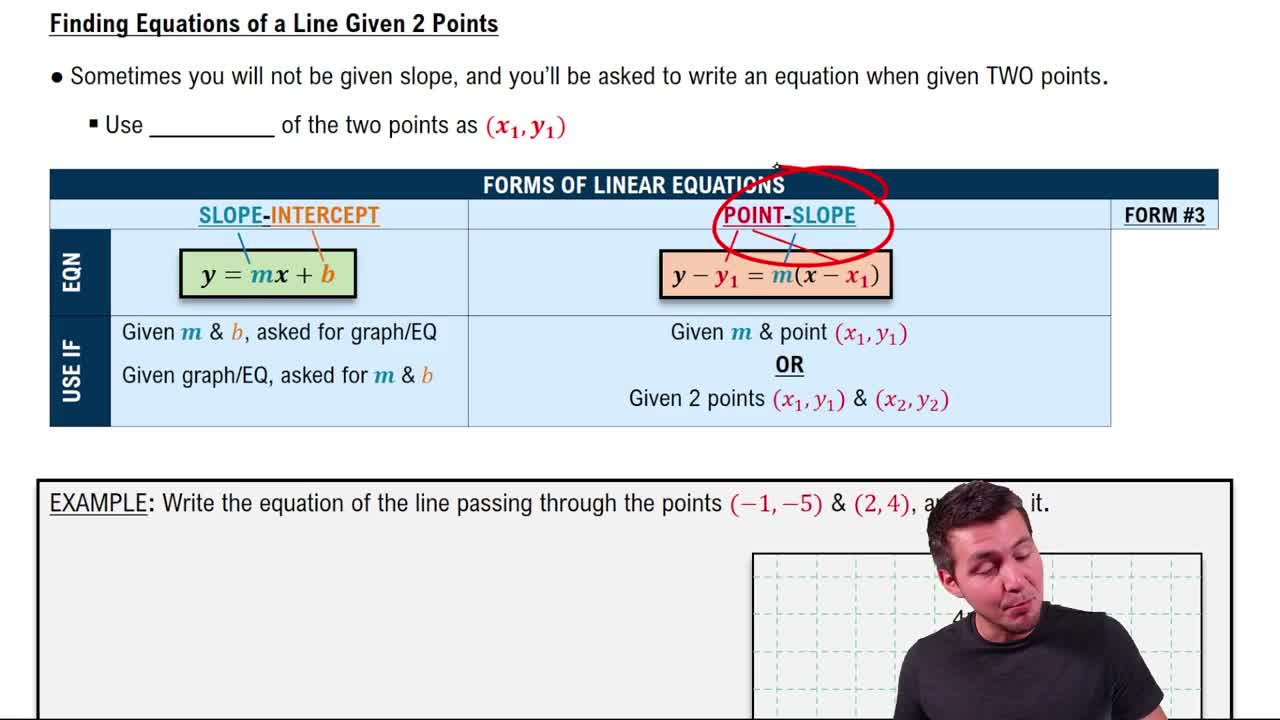
04:27
Finding Equations of Lines Given Two Points