Ch. 3 - Polynomial and Rational Functions
Blitzer - College Algebra 8th Edition
Blitzer8th EditionCollege AlgebraISBN: 9780136970514당신이 사용하는 게 아니라요?교과서 변경
4장, 문제 31

Find the zeros for each polynomial function and give the multiplicity for each zero. State whether the graph crosses the x-axis, or touches the x-axis and turns around, at each zero. f(x)=x3+7x24x28f(x)=x^3+7x^2−4x−28

검증된 단계별 안내
1
First, write down the polynomial function: \(f(x) = x^3 + 7x^2 - 4x - 28\).
Use the Rational Root Theorem to list possible rational zeros. These are factors of the constant term (\(-28\)) divided by factors of the leading coefficient (1), so possible zeros are \(\pm1, \pm2, \pm4, \pm7, \pm14, \pm28\).
Test these possible zeros by substituting them into \(f(x)\) or by using synthetic division to find which values make \(f(x) = 0\). Each value that results in zero is a root (zero) of the polynomial.
Once a zero is found, use polynomial division (synthetic or long division) to divide \(f(x)\) by the corresponding factor \((x - \text{zero})\) to reduce the polynomial to a quadratic or lower degree polynomial.
Repeat the process on the reduced polynomial to find all zeros. For each zero, determine its multiplicity by how many times the factor appears in the factorization. If the multiplicity is odd, the graph crosses the x-axis at that zero; if even, the graph touches the x-axis and turns around.

비슷한 문제에 대한 검증된 영상 답변:

이 영상 해법은 위 문제에 도움이 된다고 튜터들이 추천한 것입니다.
영상 길이:
4m
도움이 되었나요?

주요 개념

질문에 올바르게 답하기 위해 반드시 이해해야 하는 핵심 개념들은 다음과 같습니다.

Finding Zeros of a Polynomial

Zeros of a polynomial are the values of x for which the function equals zero. To find them, you can use factoring, synthetic division, or the Rational Root Theorem. Identifying zeros is essential because they represent the x-intercepts of the graph.
추천 영상:
03:42
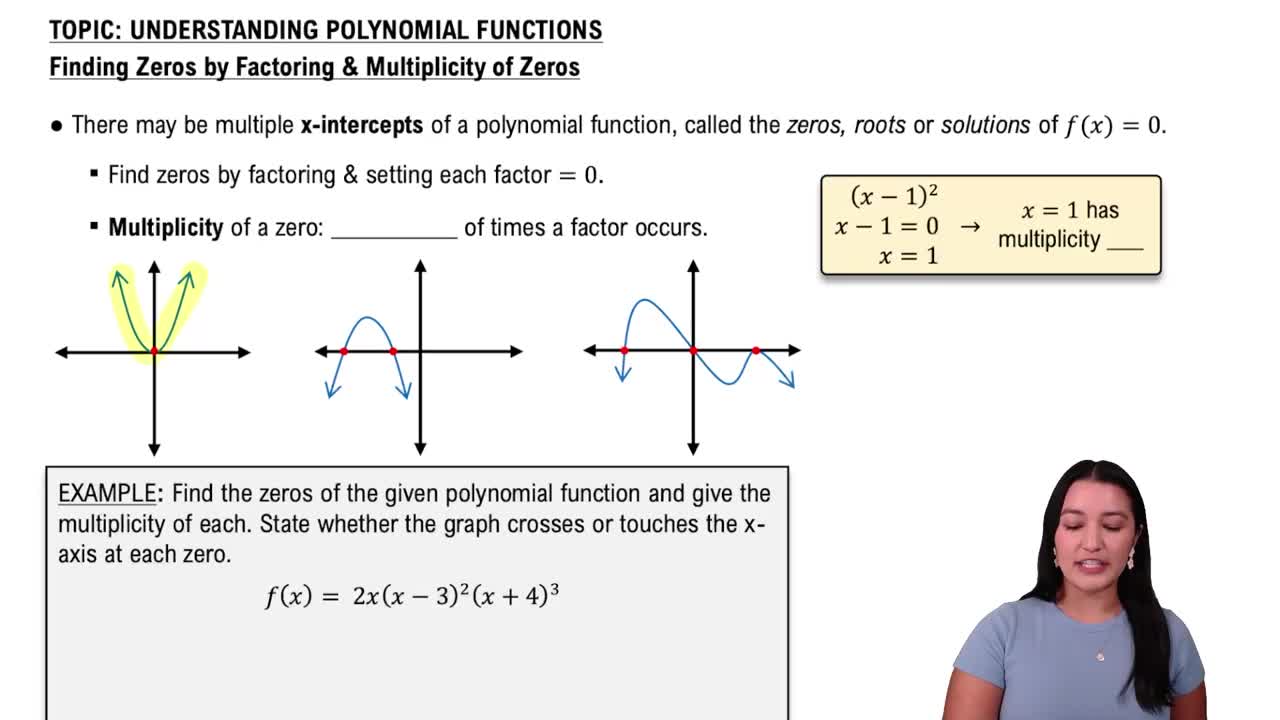
Finding Zeros & Their Multiplicity

Multiplicity of Zeros

Multiplicity refers to how many times a particular zero appears as a root of the polynomial. If a zero has an even multiplicity, the graph touches the x-axis and turns around at that point; if odd, the graph crosses the x-axis.
추천 영상:
03:42
Finding Zeros & Their Multiplicity

Behavior of the Graph at Zeros

The graph's behavior at each zero depends on the zero's multiplicity. For odd multiplicities, the graph crosses the x-axis, while for even multiplicities, it only touches and reverses direction. This helps in sketching the polynomial's graph accurately.
추천 영상:
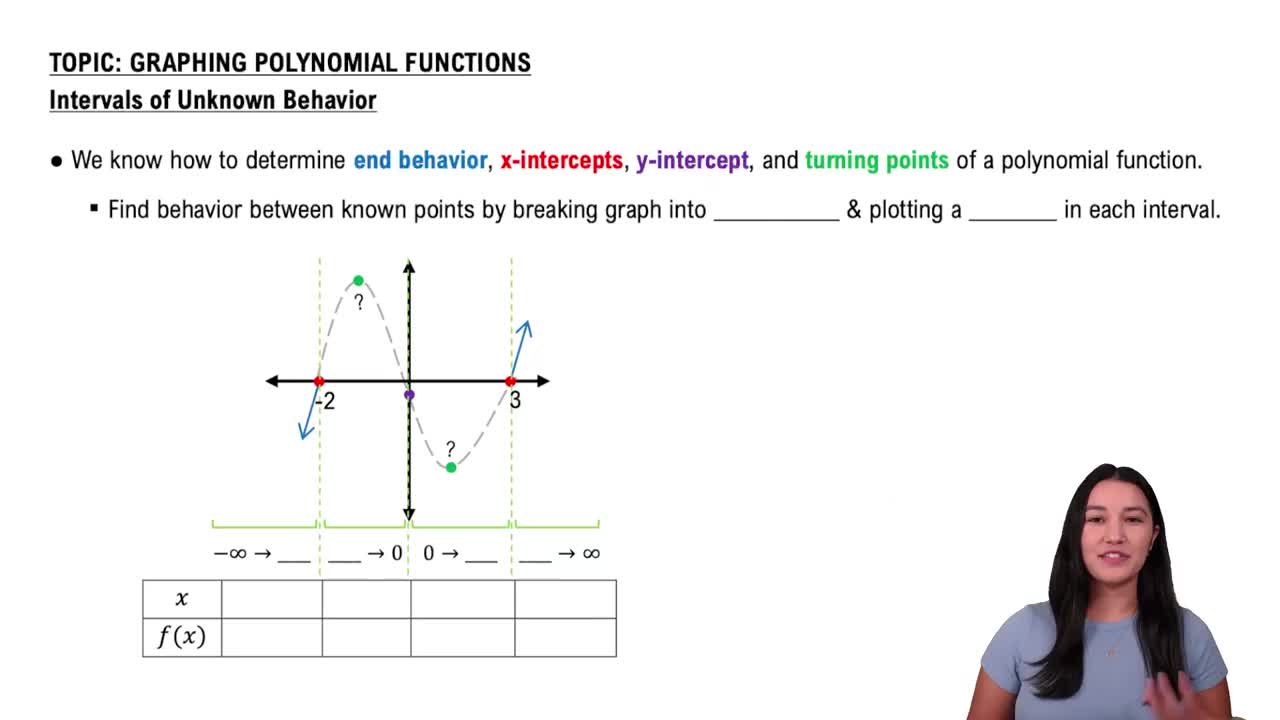
05:01
Identifying Intervals of Unknown Behavior