Write an equation in vertex form of the parabola that has the same shape as the graph of f(x) = 2x2 but with the given point as the vertex. (5, 3)
Ch. 3 - Polynomial and Rational Functions

4장, 문제 49
Find all zeros of the polynomial function or solve the given polynomial equation. Use the Rational Zero Theorem, Descartes's Rule of Signs, and possibly the graph of the polynomial function shown by a graphing utility as an aid in obtaining the first zero or the first root. 4x4−x3+5x2−2x−6=0
검증된 단계별 안내1
Identify the polynomial equation: \(4x^{4} - x^{3} + 5x^{2} - 2x - 6 = 0\).
Apply the Rational Zero Theorem to list all possible rational zeros. These are of the form \(\pm \frac{p}{q}\), where \(p\) divides the constant term \(-6\) and \(q\) divides the leading coefficient \(4\). So, possible values of \(p\) are \(\pm1, \pm2, \pm3, \pm6\) and possible values of \(q\) are \(\pm1, \pm2, \pm4\).
Use Descartes's Rule of Signs to estimate the number of positive and negative real zeros. Count the sign changes in \(f(x)\) for positive zeros and in \(f(-x)\) for negative zeros to narrow down the possibilities.
Test the possible rational zeros from step 2 by substituting them into the polynomial or using synthetic division to find a root that makes the polynomial equal to zero.
Once a root is found, perform polynomial division (either synthetic or long division) to divide the original polynomial by the corresponding factor \((x - r)\), reducing the polynomial's degree. Then repeat the process on the resulting polynomial to find all zeros.

비슷한 문제에 대한 검증된 영상 답변:
이 영상 해법은 위 문제에 도움이 된다고 튜터들이 추천한 것입니다.
영상 길이:
9m도움이 되었나요?
주요 개념
질문에 올바르게 답하기 위해 반드시 이해해야 하는 핵심 개념들은 다음과 같습니다.
Rational Zero Theorem
The Rational Zero Theorem helps identify possible rational roots of a polynomial by considering factors of the constant term and the leading coefficient. These candidates can be tested to find actual zeros, simplifying the process of solving polynomial equations.
추천 영상:
가이드 코스
Rationalizing Denominators
Descartes's Rule of Signs
Descartes's Rule of Signs provides a way to estimate the number of positive and negative real zeros of a polynomial by counting sign changes in the polynomial and its transformed version. This helps narrow down the possible roots before testing.
추천 영상:
가이드 코스
Cramer's Rule - 2 Equations with 2 Unknowns
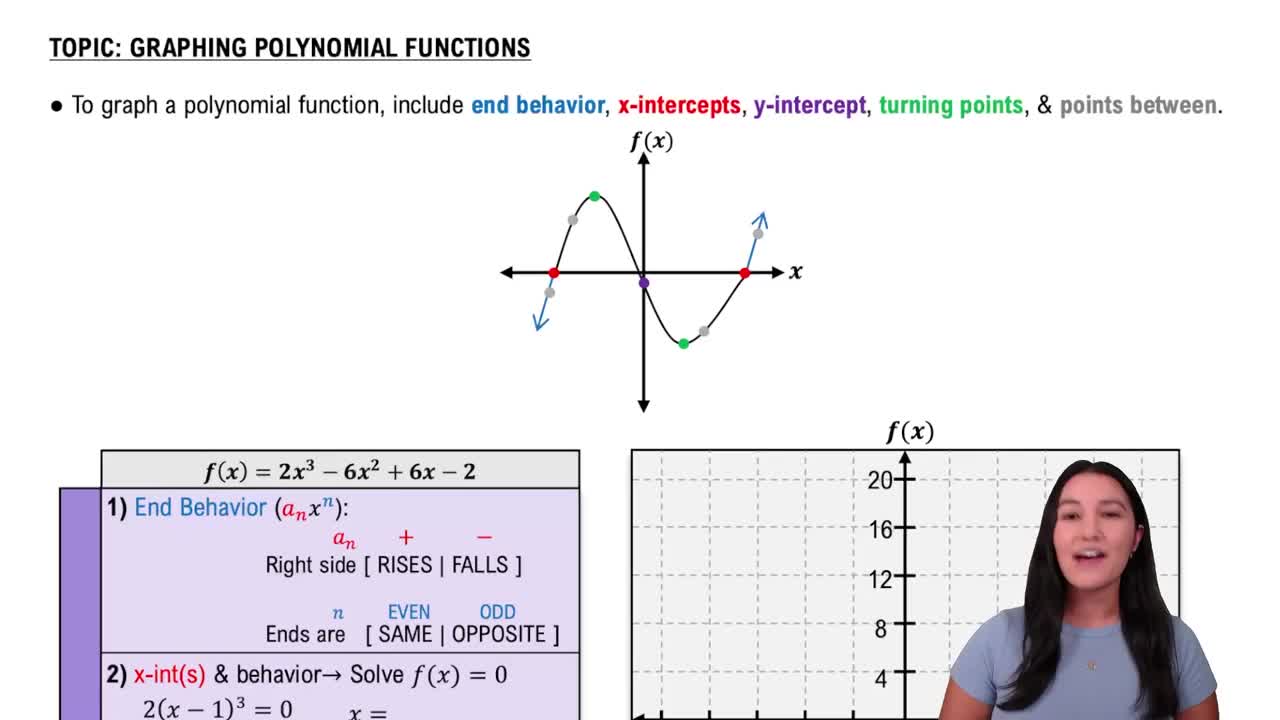
Graphing Polynomial Functions
Graphing a polynomial function using a graphing utility visually reveals approximate locations of zeros and the behavior of the function. This aids in selecting initial guesses for roots and understanding the multiplicity and nature of zeros.
추천 영상:
Graphing Polynomial Functions
관련 실천
교과서 질문
1049
views
교과서 질문
Give the domain and the range of each quadratic function whose graph is described. Maximum = -6 at x = 10
1089
views
교과서 질문
Use transformations of f(x)=1/x or f(x)=1/x2 to graph each rational function. g(x)=1/(x+1) − 2
789
views
교과서 질문
In Exercises 47–48, find an nth-degree polynomial function with real coefficients satisfying the given conditions. Verify the real zeros and the given function value. n = 3; 2 and 2 - 3i are zeros; f(1) = -10
1172
views
교과서 질문
Solve each rational inequality in Exercises 43–60 and graph the solution set on a real number line. Express each solution set in interval notation. (−x−3)/(x+2)≤0
489
views
교과서 질문
In Exercises 49–50, find all the zeros of each polynomial function and write the polynomial as a product of linear factors.
606
views