Find all zeros of the polynomial function or solve the given polynomial equation. Use the Rational Zero Theorem, Descartes's Rule of Signs, and possibly the graph of the polynomial function shown by a graphing utility as an aid in obtaining the first zero or the first root. 2x5+7x4−18x2−8x+8=0
Ch. 3 - Polynomial and Rational Functions

4장, 문제 51
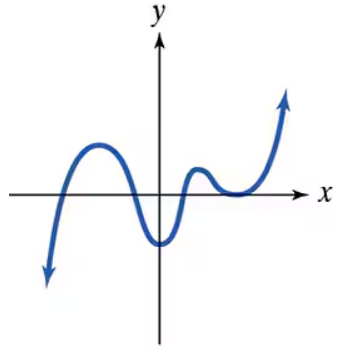
In Exercises 51–54, graphs of fifth-degree polynomial functions are shown. In each case, specify the number of real zeros and the number of imaginary zeros. Indicate whether there are any real zeros with multiplicity other than 1.

검증된 단계별 안내1
Step 1: Identify the degree of the polynomial. Since it is a fifth-degree polynomial, it has exactly 5 zeros in total (including real and imaginary zeros), according to the Fundamental Theorem of Algebra.
Step 2: Count the number of real zeros by observing where the graph crosses or touches the x-axis. In the graph, the polynomial crosses the x-axis at four points: approximately at x = -1, x = 1, x = 2, and one more point between 1 and 2 where the curve touches the x-axis but does not cross it.
Step 3: Determine the multiplicity of each real zero by analyzing the behavior of the graph at those points. If the graph crosses the x-axis, the zero has odd multiplicity (usually 1). If the graph only touches the x-axis and turns around, the zero has even multiplicity (greater than 1). Here, the zero between 1 and 2 appears to be a touch point, indicating multiplicity greater than 1.
Step 4: Calculate the number of imaginary zeros by subtracting the number of real zeros from the total number of zeros. Since the polynomial is degree 5 and there are 4 real zeros, the remaining zeros must be imaginary.
Step 5: Summarize the findings: state the number of real zeros, the number of imaginary zeros, and specify which real zeros have multiplicity greater than 1 based on the graph's behavior.

비슷한 문제에 대한 검증된 영상 답변:
이 영상 해법은 위 문제에 도움이 된다고 튜터들이 추천한 것입니다.
영상 길이:
3m주요 개념
질문에 올바르게 답하기 위해 반드시 이해해야 하는 핵심 개념들은 다음과 같습니다.
Real Zeros of a Polynomial
Real zeros of a polynomial are the x-values where the graph crosses or touches the x-axis. Each zero corresponds to a root of the polynomial equation. In the graph, these are the points where the curve intersects the x-axis.
추천 영상:
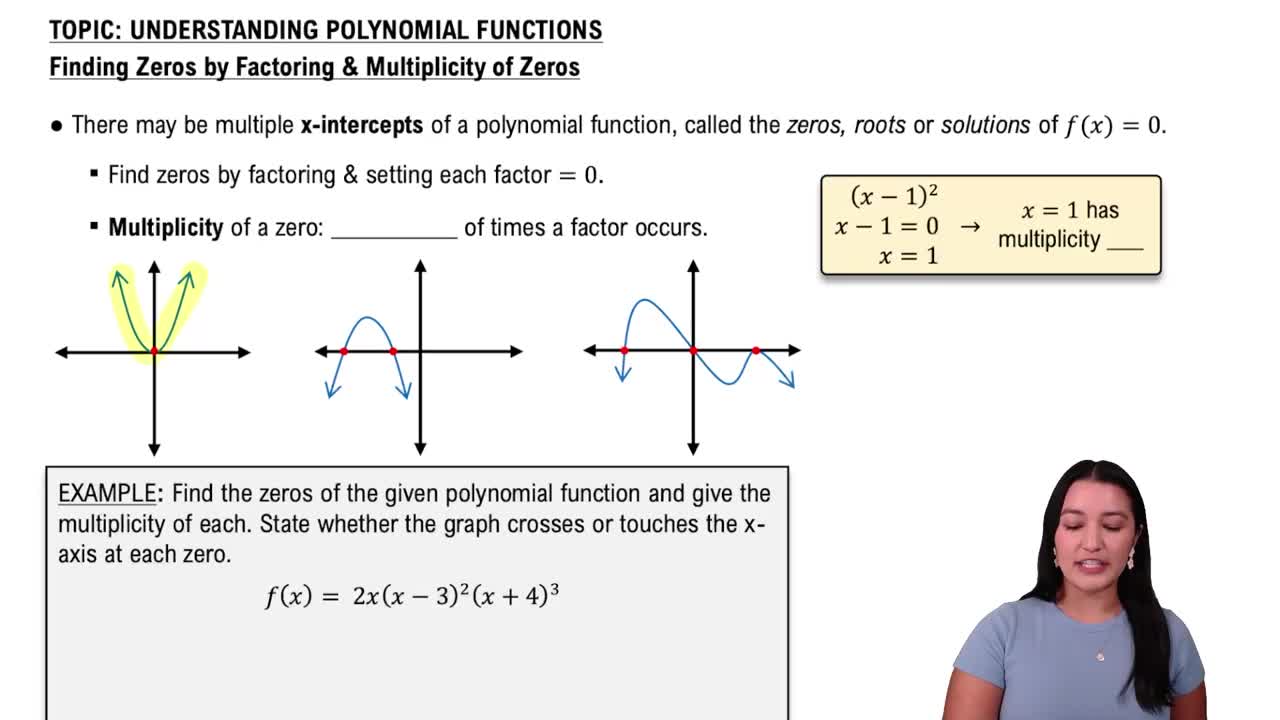
Finding Zeros & Their Multiplicity
Multiplicity of Zeros
Multiplicity refers to how many times a particular zero is repeated as a root of the polynomial. If the graph touches the x-axis and turns around, the zero has even multiplicity; if it crosses the axis, the zero has odd multiplicity. Multiplicity affects the shape of the graph near the zero.
추천 영상:
Finding Zeros & Their Multiplicity
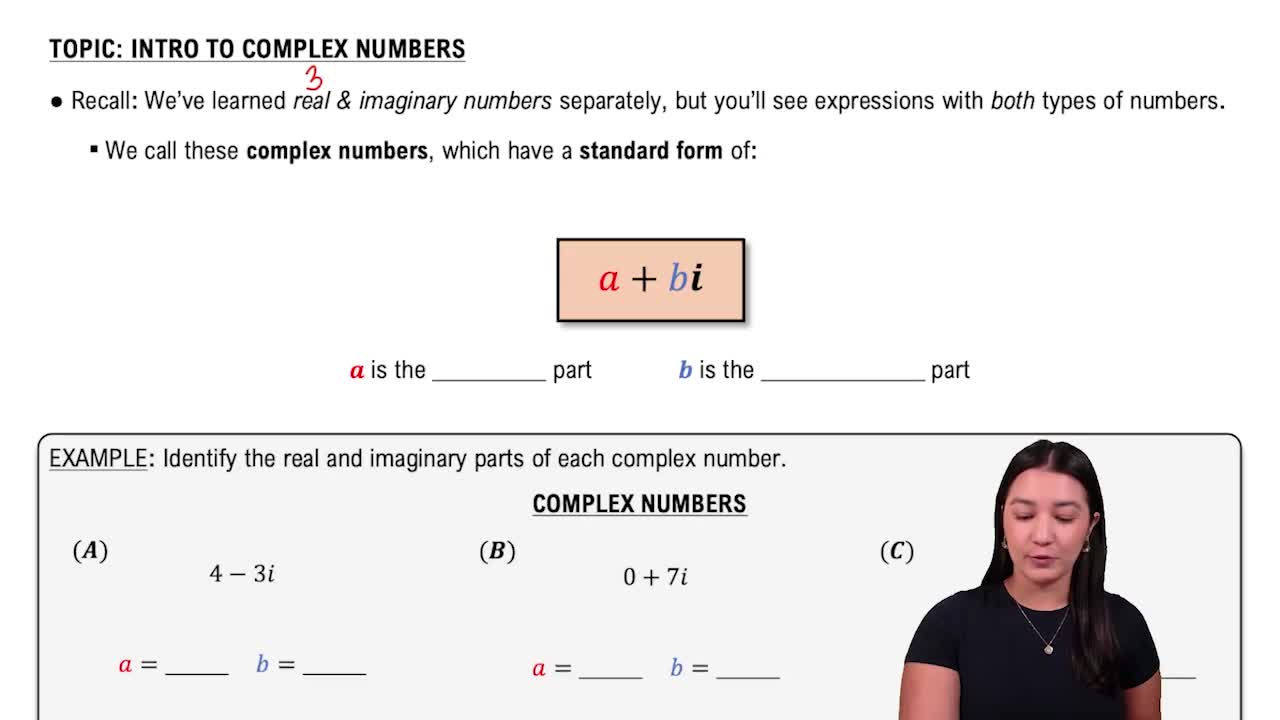
Imaginary (Complex) Zeros
Imaginary zeros are roots of the polynomial that are not real numbers and do not appear as x-intercepts on the graph. For a polynomial of degree n, the total number of zeros (real and imaginary) is n, counting multiplicities, according to the Fundamental Theorem of Algebra.
추천 영상:
Introduction to Complex Numbers
관련 실천
교과서 질문
603
views
교과서 질문
In Exercises 49–50, find all the zeros of each polynomial function and write the polynomial as a product of linear factors. g(x) = x^4 - 6x^3 + x^2 + 24x + 16
732
views
교과서 질문
Use transformations of f(x)=1/x or f(x)=1/x2 to graph each rational function. g(x)=1/(x+2)2
945
views
교과서 질문
Solve each rational inequality in Exercises 43–60 and graph the solution set on a real number line. Express each solution set in interval notation. (x+4)/x>0
531
views
교과서 질문
Write an equation in vertex form of the parabola that has the same shape as the graph of f(x) = 2x2 but with the given point as the vertex. (−10, −5)
1031
views
교과서 질문
Solve each rational inequality in Exercises 43–60 and graph the solution set on a real number line. Express each solution set in interval notation. x/(x−3)>0
557
views
