Exercises 53–60 show incomplete graphs of given polynomial functions. a) Find all the zeros of each function. b) Without using a graphing utility, draw a complete graph of the function. f(x)=−x3+x2+16x−16
Ch. 3 - Polynomial and Rational Functions

4장, 문제 51
Solve each rational inequality in Exercises 43–60 and graph the solution set on a real number line. Express each solution set in interval notation. x/(x−3)>0
검증된 단계별 안내1
Identify the critical points by setting the numerator and denominator equal to zero separately. For the numerator: \(x = 0\). For the denominator: \(x - 3 = 0\), so \(x = 3\). These points divide the number line into intervals to test.
Determine the intervals created by the critical points: \((-\infty, 0)\), \((0, 3)\), and \((3, \infty)\). These intervals will be tested to see where the inequality \(\frac{x}{x-3} > 0\) holds true.
Choose a test point from each interval and substitute it into the expression \(\frac{x}{x-3}\). Check the sign (positive or negative) of the result to determine if the inequality is satisfied in that interval.
Remember that the inequality is strict (\(>\) 0), so exclude points where the expression is zero or undefined. Specifically, exclude \(x = 0\) (where numerator is zero) and \(x = 3\) (where denominator is zero and expression is undefined).
Combine the intervals where the expression is positive to write the solution set in interval notation, and then graph these intervals on the real number line, marking excluded points appropriately.

비슷한 문제에 대한 검증된 영상 답변:
이 영상 해법은 위 문제에 도움이 된다고 튜터들이 추천한 것입니다.
영상 길이:
5m도움이 되었나요?
주요 개념
질문에 올바르게 답하기 위해 반드시 이해해야 하는 핵심 개념들은 다음과 같습니다.
Rational Inequalities
Rational inequalities involve expressions where one polynomial is divided by another, and the inequality compares this ratio to zero or another value. Solving them requires finding where the expression is positive, negative, or zero by analyzing the signs of numerator and denominator.
추천 영상:
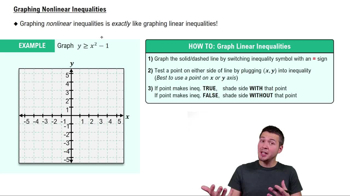
Nonlinear Inequalities
Critical Points and Sign Analysis
Critical points occur where the numerator or denominator equals zero, dividing the number line into intervals. By testing values in each interval, you determine the sign of the rational expression, which helps identify where the inequality holds true.
추천 영상:
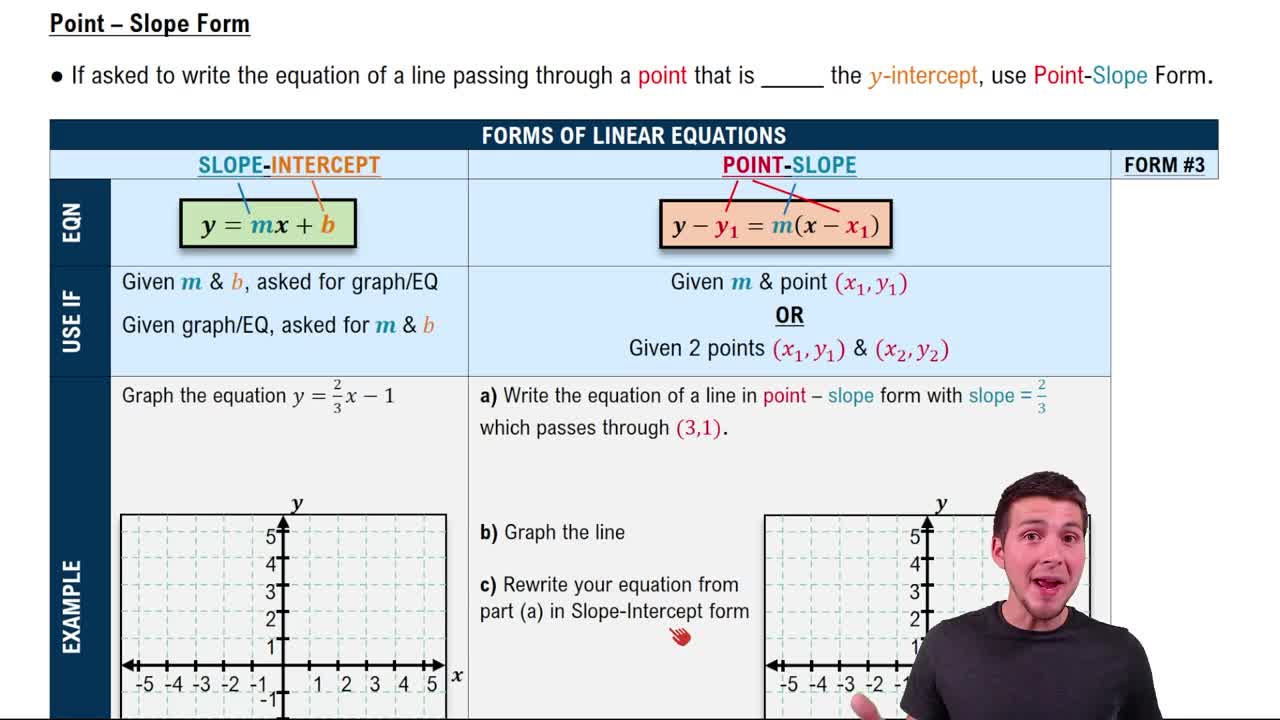
Point-Slope Form
Interval Notation and Graphing Solutions
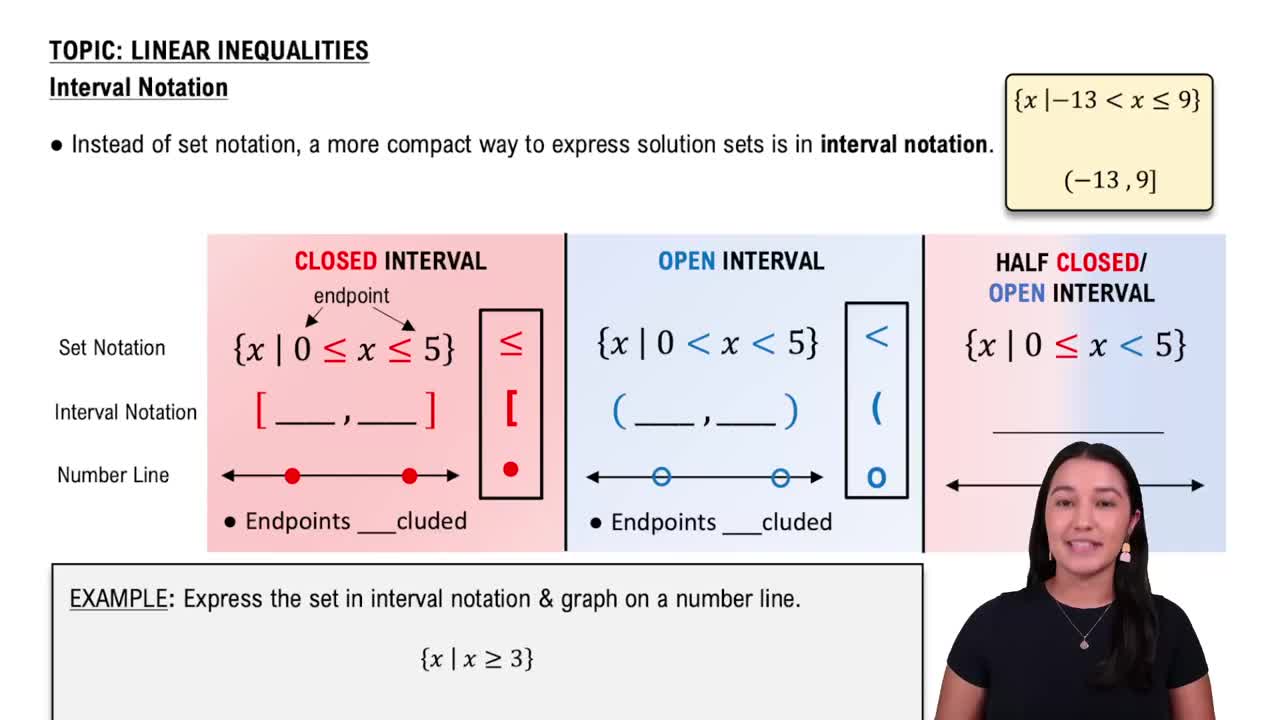
Interval notation concisely represents sets of real numbers that satisfy the inequality, using parentheses or brackets to indicate whether endpoints are included. Graphing on a number line visually shows these solution intervals and excluded points, aiding interpretation.
추천 영상:
Interval Notation
관련 실천
교과서 질문
530
views
교과서 질문
In Exercises 51–54, graphs of fifth-degree polynomial functions are shown. In each case, specify the number of real zeros and the number of imaginary zeros. Indicate whether there are any real zeros with multiplicity other than 1.
704
views
교과서 질문
Use transformations of f(x)=1/x or f(x)=1/x2 to graph each rational function. g(x)=1/(x+2)2
945
views
교과서 질문
Solve each rational inequality in Exercises 43–60 and graph the solution set on a real number line. Express each solution set in interval notation. (x+4)/x>0
531
views
교과서 질문
Use transformations of f(x)=1/x or f(x)=1/x2 to graph each rational function. h(x)=1/x2 − 4
861
views
교과서 질문
Write an equation in vertex form of the parabola that has the same shape as the graph of f(x) = 2x2 but with the given point as the vertex. (−10, −5)
1031
views