Exercises 82–84 will help you prepare for the material covered in the next section. Let f(x)=an(x4−3x2−4). If f(3)=−150, determine the value of a_n.
Ch. 3 - Polynomial and Rational Functions

4장, 문제 85
In Exercises 81–88, a. Find the slant asymptote of the graph of each rational function and b. Follow the seven-step strategy and use the slant asymptote to graph each rational function. f(x)=(x2+x−6)/(x−3)
검증된 단계별 안내1
Identify the given rational function: . We want to find the slant (oblique) asymptote, which occurs when the degree of the numerator is exactly one more than the degree of the denominator.
Perform polynomial long division of the numerator by the denominator . This will help us express as a quotient plus a remainder over the divisor, which reveals the slant asymptote.
Set up the division: divide the leading term of the numerator by the leading term of the denominator to get the first term of the quotient. Then multiply the entire divisor by this term and subtract from the numerator. Repeat this process until the degree of the remainder is less than the degree of the divisor.
The quotient obtained from the division (ignoring the remainder) represents the equation of the slant asymptote. Write this quotient as a linear function where and come from the division result.
For graphing, use the seven-step strategy: (1) find the domain, (2) find intercepts, (3) find vertical asymptotes (where denominator is zero), (4) find the slant asymptote from the division, (5) analyze end behavior using the slant asymptote, (6) plot points around the vertical asymptote and near the slant asymptote, and (7) sketch the graph showing the behavior near asymptotes and intercepts.

비슷한 문제에 대한 검증된 영상 답변:
이 영상 해법은 위 문제에 도움이 된다고 튜터들이 추천한 것입니다.
영상 길이:
20m주요 개념
질문에 올바르게 답하기 위해 반드시 이해해야 하는 핵심 개념들은 다음과 같습니다.
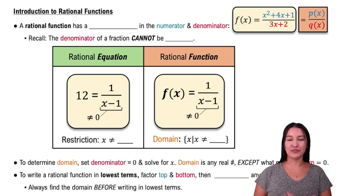
Rational Functions
A rational function is a ratio of two polynomials, expressed as f(x) = P(x)/Q(x), where Q(x) ≠ 0. Understanding the behavior of rational functions, including their domains and discontinuities, is essential for analyzing their graphs and asymptotes.
추천 영상:
Intro to Rational Functions
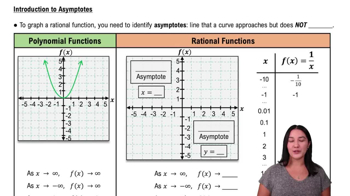
Slant (Oblique) Asymptotes
Slant asymptotes occur when the degree of the numerator is exactly one more than the degree of the denominator. They represent the line that the graph approaches as x approaches infinity or negative infinity, found by performing polynomial division.
추천 영상:
Introduction to Asymptotes
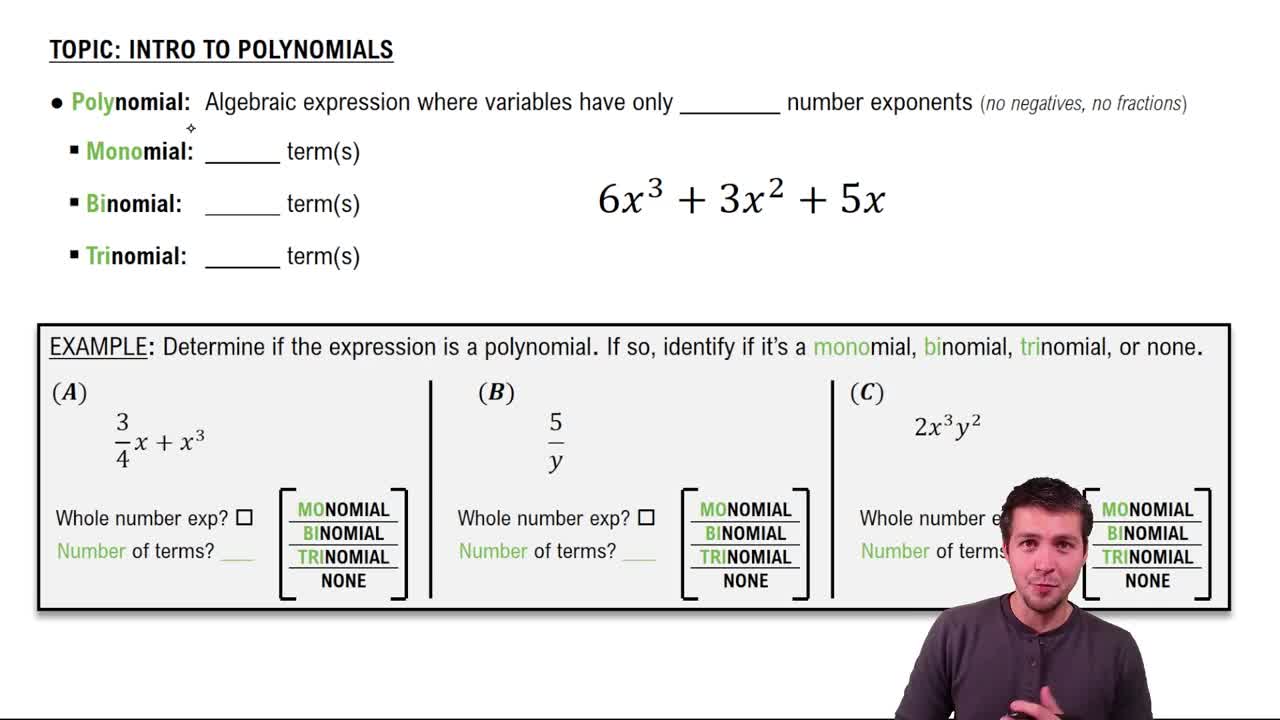
Polynomial Division
Polynomial division is a method used to divide one polynomial by another, similar to long division with numbers. It helps find the quotient and remainder, where the quotient gives the equation of the slant asymptote for rational functions with numerator degree one higher than denominator.
추천 영상:
Introduction to Polynomials
관련 실천
교과서 질문
370
views
교과서 질문
Solve each inequality in Exercises 86–91 using a graphing utility. 2x2 + 5x - 3 ≤ 0
577
views
교과서 질문
In Exercises 81–88, a. Find the slant asymptote of the graph of each rational function and b. Follow the seven-step strategy and use the slant asymptote to graph each rational function. f(x)=(x3+1)/(x2+2x)
601
views
교과서 질문
In Exercises 81–88, a. Find the slant asymptote of the graph of each rational function and b. Follow the seven-step strategy and use the slant asymptote to graph each rational function. f(x)=(x2+1)/x
604
views
교과서 질문
Exercises 82–84 will help you prepare for the material covered in the next section. Solve: x2+4x+6=0
359
views
교과서 질문
Solve each inequality in Exercises 86–91 using a graphing utility. x2 + 3x - 10 > 0
573
views