In Exercises 1–16, divide using long division. State the quotient, and the remainder, r(x). (6x3+13x2−11x−15)/(3x2−x−3)
Ch. 3 - Polynomial and Rational Functions

4장, 문제 13
In Exercises 9–16, a) List all possible rational zeros. b) Use synthetic division to test the possible rational zeros and find an actual zero. c) Use the quotient from part (b) to find the remaining zeros of the polynomial function.
검증된 단계별 안내1
Identify the polynomial function: \(f(x) = x^3 + 4x^2 - 3x - 6\).
List all possible rational zeros using the Rational Root Theorem. The possible rational zeros are of the form \(\pm \frac{p}{q}\), where \(p\) divides the constant term \(-6\) and \(q\) divides the leading coefficient \(1\). So, possible zeros are \(\pm 1, \pm 2, \pm 3, \pm 6\).
Use synthetic division to test each possible rational zero by dividing the polynomial by \((x - r)\) where \(r\) is a candidate zero. Perform synthetic division step-by-step until you find a zero that gives a remainder of zero.
Once you find an actual zero \(r\), write the quotient polynomial from the synthetic division. This quotient will be a quadratic polynomial.
Solve the quadratic quotient polynomial using factoring, completing the square, or the quadratic formula to find the remaining zeros of the original polynomial.

비슷한 문제에 대한 검증된 영상 답변:
이 영상 해법은 위 문제에 도움이 된다고 튜터들이 추천한 것입니다.
영상 길이:
5m도움이 되었나요?
주요 개념
질문에 올바르게 답하기 위해 반드시 이해해야 하는 핵심 개념들은 다음과 같습니다.
Rational Root Theorem
The Rational Root Theorem helps identify all possible rational zeros of a polynomial by considering factors of the constant term and the leading coefficient. These possible roots are expressed as ±(factors of constant term)/(factors of leading coefficient), providing a finite list to test.
추천 영상:
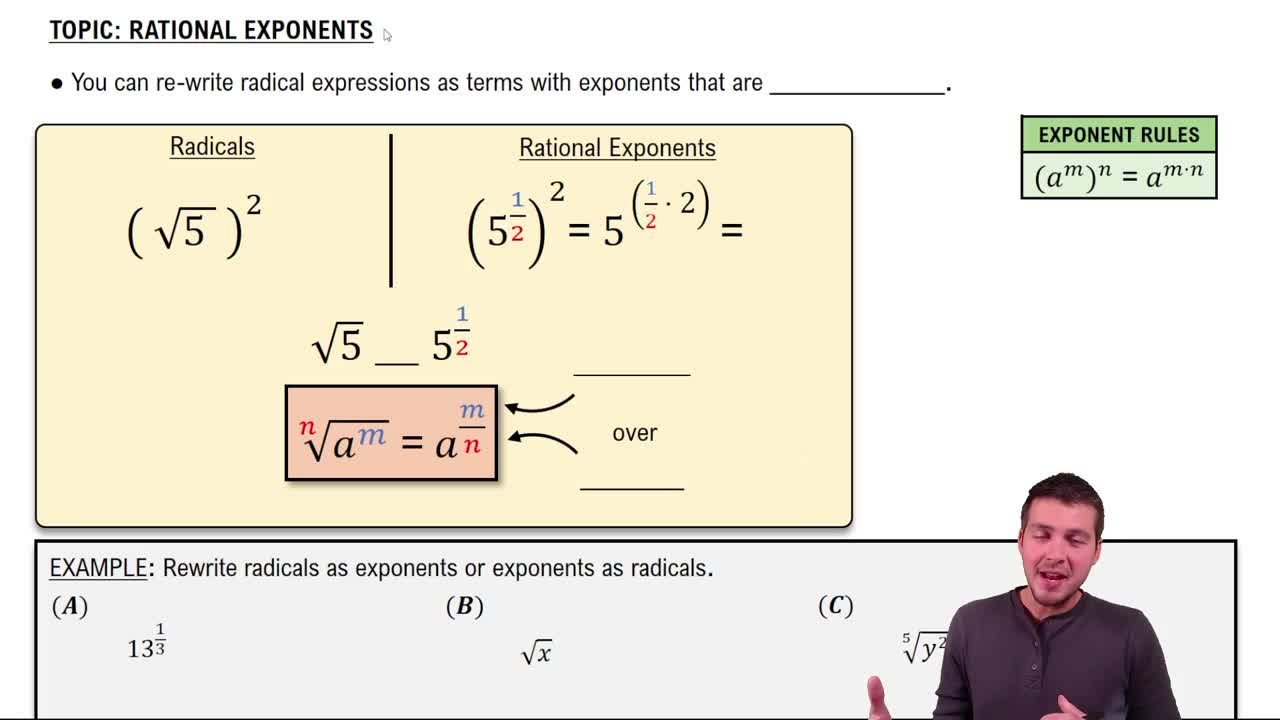
Rational Exponents
Synthetic Division
Synthetic division is a shortcut method for dividing a polynomial by a linear factor of the form (x - c). It simplifies the process of evaluating whether a candidate root is an actual zero by checking if the remainder is zero, and it produces the quotient polynomial for further factorization.
추천 영상:
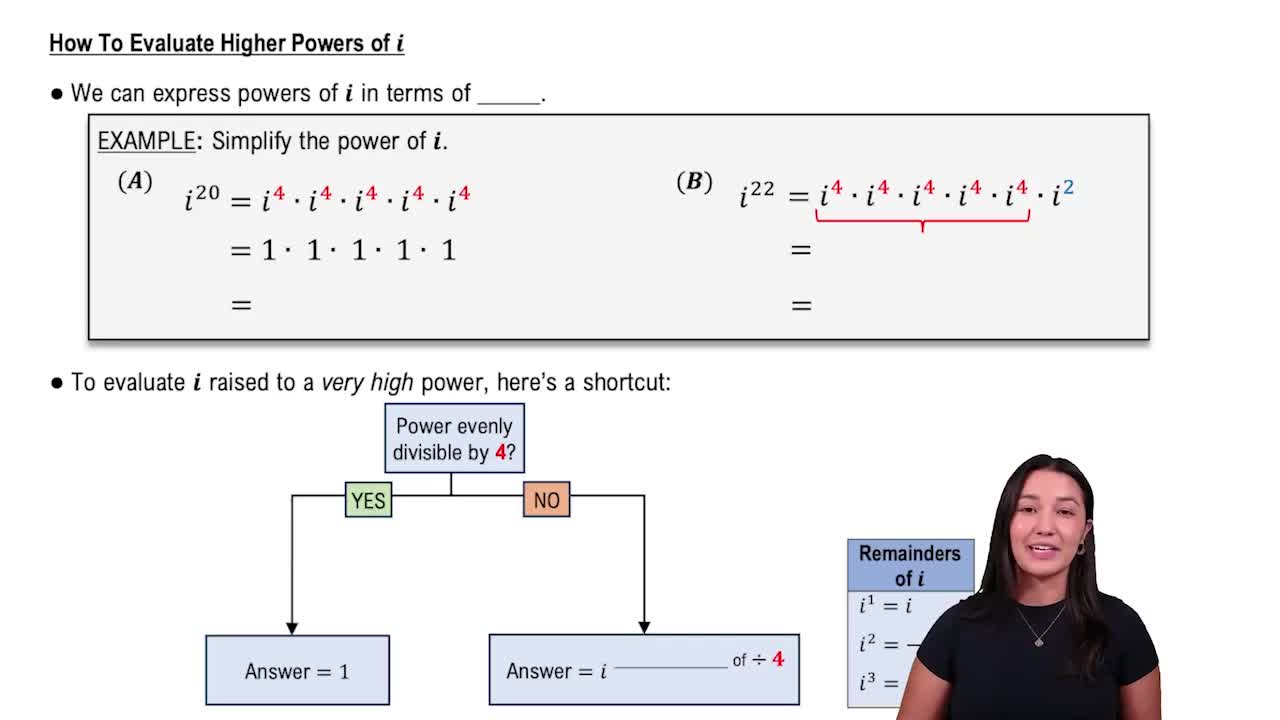
Higher Powers of i
Factoring and Finding Remaining Zeros
Once a zero is found using synthetic division, the quotient polynomial can be factored further or solved using other methods (like quadratic formula) to find the remaining zeros. This step breaks down the polynomial into simpler factors to identify all roots.
추천 영상:
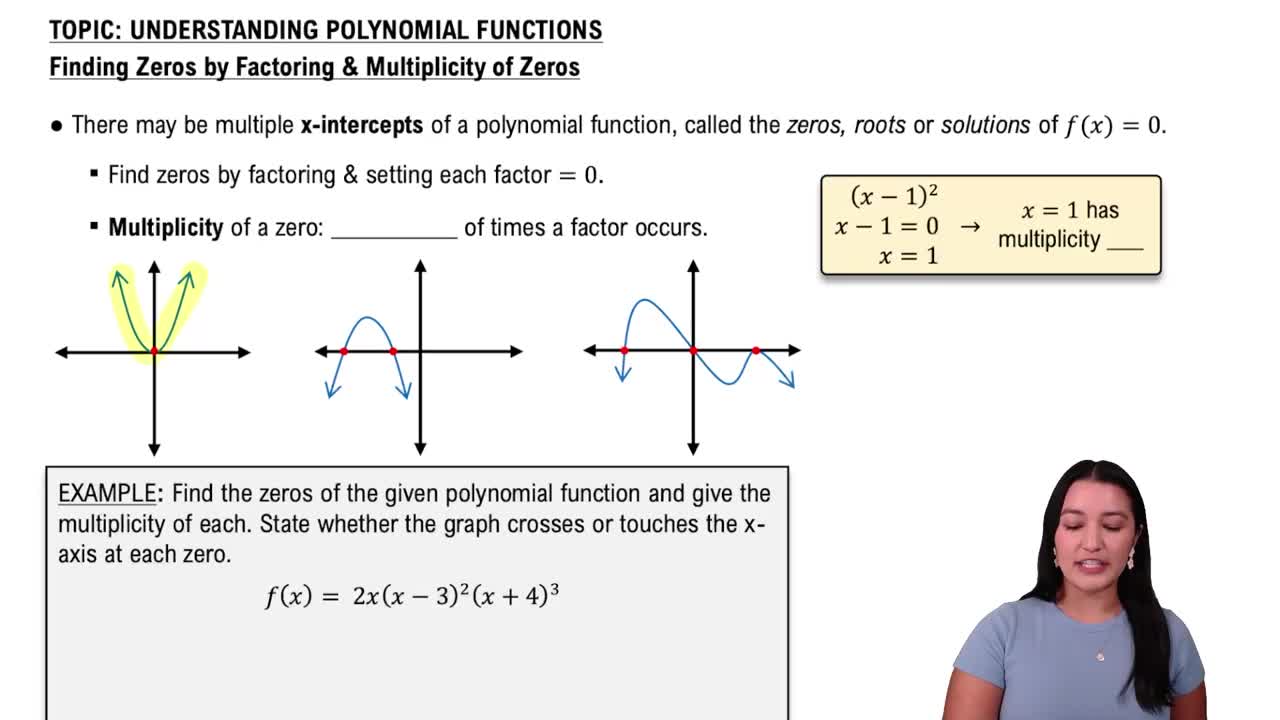
Finding Zeros & Their Multiplicity
관련 실천
교과서 질문
449
views
교과서 질문
Find the coordinates of the vertex for the parabola defined by the given quadratic function. f(x)=2x2−8x+3
1194
views
교과서 질문
Use the graph of the rational function in the figure shown to complete each statement in Exercises 9–14.
As _____
1390
views
1
rank
교과서 질문
Write an equation that expresses each relationship. Then solve the equation for y. x varies directly as the cube of z and inversely as y.
562
views
교과서 질문
Write an equation that expresses each relationship. Then solve the equation for y. x varies directly as the cube root of z and inversely as y.
533
views
교과서 질문
Solve each polynomial inequality in Exercises 1–42 and graph the solution set on a real number line. Express each solution set in interval notation. 2x2+x<15
505
views