Identify which graphs are not those of polynomial functions.
Ch. 3 - Polynomial and Rational Functions

4장, 문제 13
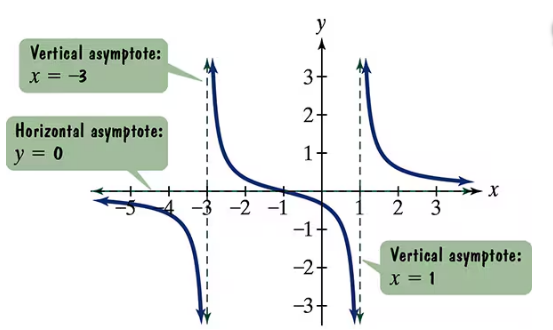
Use the graph of the rational function in the figure shown to complete each statement in Exercises 9–14.

As _____
검증된 단계별 안내1
Identify the horizontal asymptote from the graph. The horizontal asymptote is the line that the function approaches as \(x\) goes to positive or negative infinity. In this graph, the horizontal asymptote is given as \(y = 0\).
Recall that for rational functions, the behavior of \(f(x)\) as \(x \to -\infty\) (or \(x \to \infty\)) is determined by the horizontal asymptote, if one exists.
Since the horizontal asymptote is \(y = 0\), this means that as \(x\) becomes very large in the negative direction, the function values \(f(x)\) approach 0.
Therefore, you can complete the statement: As \(x \to -\infty\), \(f(x) \to 0\).
This means the function values get closer and closer to zero but do not necessarily equal zero for very large negative \(x\).

비슷한 문제에 대한 검증된 영상 답변:
이 영상 해법은 위 문제에 도움이 된다고 튜터들이 추천한 것입니다.
영상 길이:
1m도움이 되었나요?
주요 개념
질문에 올바르게 답하기 위해 반드시 이해해야 하는 핵심 개념들은 다음과 같습니다.
Vertical Asymptotes
Vertical asymptotes occur where the function approaches infinity or negative infinity as the input approaches a specific value. They represent values of x where the function is undefined, often due to division by zero in rational functions. In the graph, vertical asymptotes are shown at x = 6 and x = 14.
추천 영상:
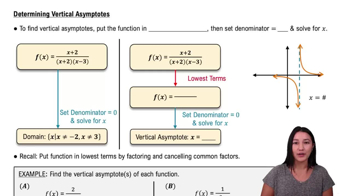
Determining Vertical Asymptotes
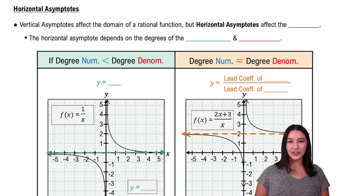
Horizontal Asymptotes
A horizontal asymptote describes the behavior of a function as x approaches positive or negative infinity. It indicates the value that the function approaches but does not necessarily reach. In this graph, the horizontal asymptote is y = 0, meaning as x goes to ±∞, f(x) approaches 0.
추천 영상:
Determining Horizontal Asymptotes
End Behavior of Rational Functions
The end behavior of a rational function describes how the function behaves as x approaches infinity or negative infinity. It is often determined by the degrees of the numerator and denominator polynomials. Here, since the horizontal asymptote is y = 0, as x → -∞, f(x) → 0.
추천 영상:
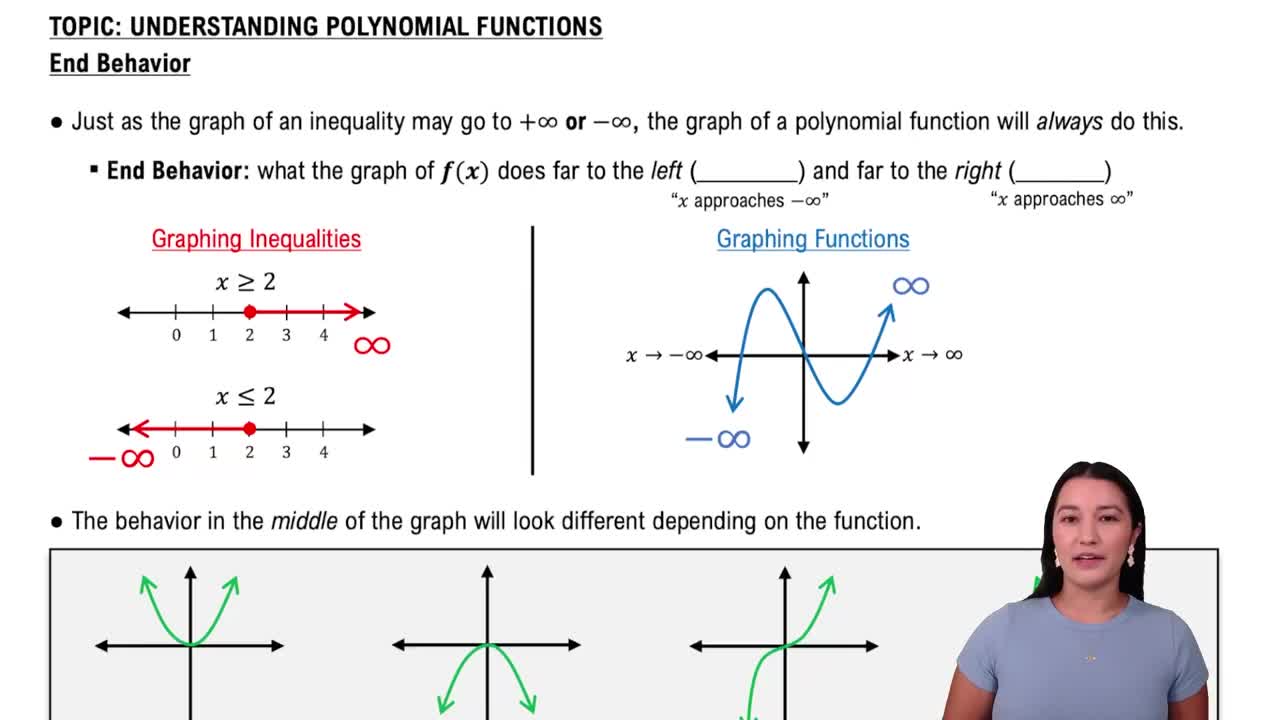
End Behavior of Polynomial Functions
관련 실천
교과서 질문
1191
views
교과서 질문
Find the coordinates of the vertex for the parabola defined by the given quadratic function. f(x)=2x2−8x+3
1194
views
교과서 질문
Divide using long division. State the quotient, and the remainder, r(x). (x4−81)/(x−3)
549
views
교과서 질문
Write an equation that expresses each relationship. Then solve the equation for y. x varies directly as the cube of z and inversely as y.
562
views
교과서 질문
In Exercises 9–16, a) List all possible rational zeros. b) Use synthetic division to test the possible rational zeros and find an actual zero. c) Use the quotient from part (b) to find the remaining zeros of the polynomial function.
442
views
교과서 질문
Solve each polynomial inequality in Exercises 1–42 and graph the solution set on a real number line. Express each solution set in interval notation. 2x2+x<15
505
views