Use synthetic division to show that 5 is a solution of x^4−4x^3−9x^2+16x+20=0. Then solve the polynomial equation.
Ch. 3 - Polynomial and Rational Functions

4장, 문제 79
Solve the variation problems in Exercises 77–82. The pitch of a musical tone varies inversely as its wavelength. A tone has a pitch of 660 vibrations per second and a wavelength of 1.6 feet. What is the pitch of a tone that has a wavelength of 2.4 feet?
검증된 단계별 안내1
Understand the problem: The pitch of a musical tone varies inversely as its wavelength. This means that as the wavelength increases, the pitch decreases, and vice versa. Mathematically, this relationship can be expressed as \( p = \frac{k}{w} \), where \( p \) is the pitch, \( w \) is the wavelength, and \( k \) is a constant of proportionality.
Use the given information to find the constant \( k \): Substitute the given pitch \( p = 660 \) vibrations per second and wavelength \( w = 1.6 \) feet into the formula \( p = \frac{k}{w} \). Solve for \( k \) by multiplying both sides of the equation by \( w \), resulting in \( k = p \cdot w \).
Substitute the values \( p = 660 \) and \( w = 1.6 \) into the equation \( k = p \cdot w \) to calculate the constant \( k \). This will give you the value of \( k \), which remains constant for this relationship.
Use the constant \( k \) to find the pitch of the tone with a wavelength of 2.4 feet. Substitute \( k \) and \( w = 2.4 \) into the formula \( p = \frac{k}{w} \). Solve for \( p \) by dividing \( k \) by \( w \).
Simplify the expression \( p = \frac{k}{w} \) to find the pitch of the tone with a wavelength of 2.4 feet. This will give you the final answer for the pitch.

비슷한 문제에 대한 검증된 영상 답변:
이 영상 해법은 위 문제에 도움이 된다고 튜터들이 추천한 것입니다.
영상 길이:
3m도움이 되었나요?
주요 개념
질문에 올바르게 답하기 위해 반드시 이해해야 하는 핵심 개념들은 다음과 같습니다.
Inverse Variation
Inverse variation describes a relationship where one variable increases as the other decreases. In mathematical terms, if two variables x and y vary inversely, their product is constant (xy = k). This concept is crucial for solving problems where one quantity affects another in an opposite manner, such as the relationship between pitch and wavelength in this question.
추천 영상:
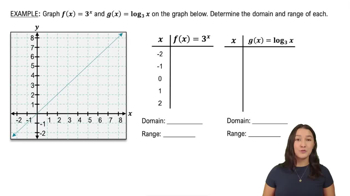
Graphing Logarithmic Functions
Wavelength and Frequency
Wavelength and frequency are fundamental concepts in wave physics, particularly in sound. Wavelength is the distance between successive crests of a wave, while frequency refers to the number of vibrations or cycles per second, measured in hertz (Hz). Understanding how these two quantities relate is essential for solving problems involving sound waves, as they are inversely related in this context.
추천 영상:
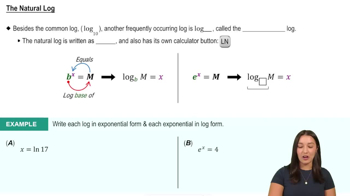
The Natural Log
Setting Up Proportions
Setting up proportions is a method used to solve problems involving ratios and relationships between quantities. In this case, knowing the initial pitch and wavelength allows us to create a proportion to find the unknown pitch for a different wavelength. This technique is vital for applying the concept of inverse variation to find the solution effectively.
추천 영상:
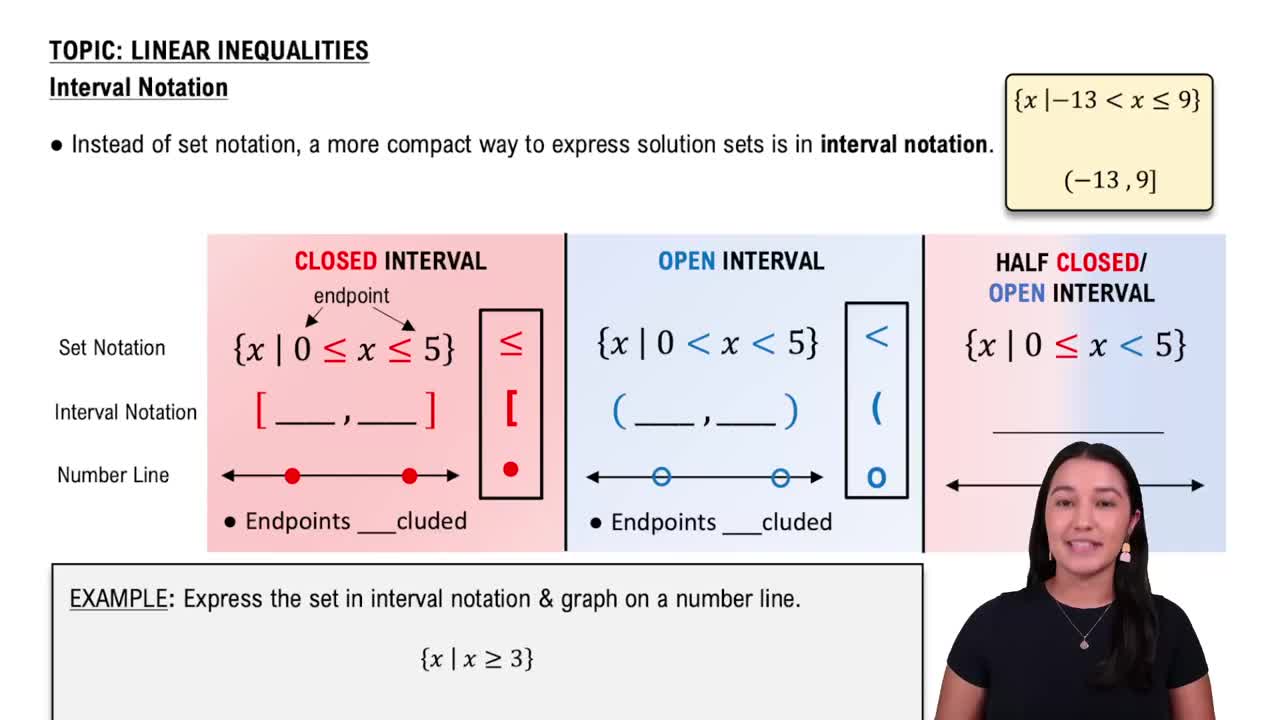
Interval Notation
관련 실천
교과서 질문
676
views
교과서 질문
Solve the variation problems in Exercises 77–82. The distance that a body falls from rest is directly proportional to the square of the time of the fall. If skydivers fall 144 feet in 3 seconds, how far will they fall in 10 seconds?
593
views
교과서 질문
In Exercises 57–80, follow the seven steps to graph each rational function. f(x)=(3x2+x−4)/(2x2−5x)
1046
views
교과서 질문
In Exercises 57–80, follow the seven steps to graph each rational function. f(x)=(x2+x−12)/(x2−4)
621
views
교과서 질문
In Exercises 81–88, a. Find the slant asymptote of the graph of each rational function and b. Follow the seven-step strategy and use the slant asymptote to graph each rational function. f(x)=(x2−1)/x
648
views
교과서 질문
Find the inverse of f(x)=(x−10)/(x+10).
559
views